Monday, July 6, 2009

The Smarter Jimmy Carter Charter

[Published April 2008]

Ex-President Jimmy Carter has hogged the media spotlight this week over his intended - and subsequent - meetings with Hamas head honcho Khaled Meshaal and other Hamas leaders - thereby incurring the wrath of Israel, the United States, the European Union and the Palestinian Authority.

Meeting with terrorists whose charter demands the elimination of Israel and the Jewish people is a total waste of time and undermines genuine efforts to end the long running conflict between Jews and Arabs.

It appears Mr Carter has yet to discover this truth as the visit to the grave of his “dear friend” the late Yasser Arafat this past week has demonstrated.

Arafat refused to accept the offer made by Israel in 2000 to create a second sovereign Arab state in former Palestine (in addition to the already existing state of Jordan). Arafat was unable to abandon his own charter calling for Israel’s destruction and found the choice of peace with Israel too difficult to make when it was presented to him on a plate.

President Bush’s Road Map attempted to revive the idea of such a State in 2002 and was supported diplomatically by Russia, the United Nations and the European Union. Yet it has failed to make even the slightest dent on the diplomatic horizon to this very day and is doomed to failure.

These lost opportunities will not come back again as the current situation in the West Bank and Gaza continues to rapidly descend into ever increasing violence.

What therefore motivated Mr Carter to arrange his meeting with Mr Meshaal at this point of time and what he hoped to achieve by doing so remains a real mystery.

One thing is certain - Mr Carter’s meeting will prove to be a definite non-starter in progressing the diplomatic comings and goings that pass for well intended - but totally misguided - attempts to end the Israeli-Arab conflict.

Yet Mr Carter himself had hit on a definite starter to solve the Israel-Arab conflict more than 25 years ago. If pursued by him now, it could prove of immeasurable assistance in ending the 125 years old struggle between Jews and Arabs over the territory once called Palestine.

In Time Magazine dated 11 October 1982, Mr Carter spoke about” the inherent weakness of Jordan” and stated:
“As a nation, it is a contrivance, arbitrarily devised by a few strokes of the pen.”

Mr Carter would have been mindful of the statement made at that time by Hassan Bin Talal - the Crown Prince of Jordan - in the American magazine “Foreign Affairs” when His Royal Highness stated:
“Small as Jordan is, our country is politically, socially, economically, militarily and historically inseparable from the Palestinian issue.”

Mr Carter would have also been well aware of the following remarks reported as having been made by “the almost certain Republican presidential nominee Ronald Reagan” in the Jerusalem Post on 11 May 1980 :
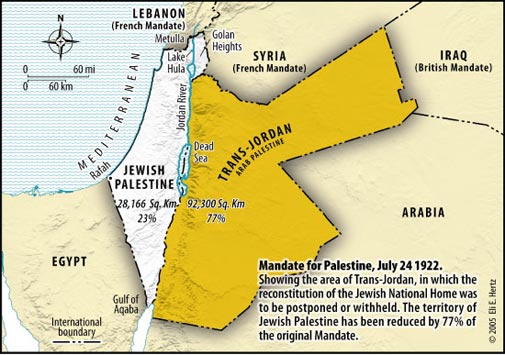
“He (Mr Reagan) pointed out that the land of the former Palestine Mandate originally included both sides of the Jordan River before Transjordan was established in 1922 in 80% of historic Palestine. The remaining 20%, he said, is today in Israel’s control.”.

Mr Carter was correct in his assessment of Jordan - as was Mr Reagan and Crown Prince Hassan.

Jordan is indeed a contrivance - the artificial creation of Britain, which in 1922 laid the groundwork that was to result in Jordan becoming a sovereign independent Arab state in 80% of Palestine in 1946. No Jews would be permitted to settle there - and are still so excluded - although it had been originally designated in 1920 as part of the area within which the Jewish National Home was to be reconstituted.

Jordan’s crucial role is bringing to a successful resolution the claims by Jews and Arabs to sovereignty over the West Bank and Gaza - a mere 6% of the area of the former Palestine Mandate - is as relevant today as it was in 1982 when Mr Carter made his defining statement.

Jordan indeed was in the diplomatic spotlight until 1988 when Yasser Arafat then declared the independence of a non-existent entity called “Palestine” and Jordan ceded all claims to the West Bank in favour of Arafat’s Palestine Liberation Organization sworn - like Hamas - to the total destruction of Israel.

Israel also believed it could negotiate with Arafat and his terrorist organisation and signed the Oslo Accords in 1993 - a decision that failed to bring the peace that was so triumphantly postulated at the time.

Mr Carter hopped on the Arafat bandwagon and thereafter totally ignored the role Jordan had to play in any negotiated settlement. He has done the cause of peace no service in adopting this illusory approach.

Peacemaking attempts with those sworn to Israel’s elimination have thus proved an abysmal failure.

Mr Carter now needs to go back to his original thinking and use his prestige and influence in encouraging Jordan to join in talks with Israel on the division of the West Bank between them. This has been and remains the only possible way forward to end the fighting between Arabs and Jews.

Jordan already has a signed peace treaty with Israel - a treaty that has withstood many pressures that could have led to its termination since it was executed in 1994. It is a tribute to Israel and Jordan’s successive governments that they have maintained - and in many areas strengthened - their areas of co-operation and understanding whilst all other proposed arrangements with the Palestinian Authority have collapsed into a diplomatic shambles around them.

Talking realistically to Jordan’s leaders and encouraging and supporting Jordan’s pivotal role in ending the conflict can certainly bear dividends of real benefit for both Jews and Arabs.

Jimmy Carter raised expectations that he would pursue this charter in 1982. His abandonment of it since 1988 has proved to be a poor error of judgement.

Running with the bulls has many dangers - one of which is they can suddenly turn around and bite you where it really hurts. Terrorist leaders like Khaled Meshaal are no different as Mr Carter will find out.

Now is the time for Mr Carter to get smart, realise his error, revisit his 1982 thinking and pursue it to its inevitable conclusion.

Palestine After Bush - Vision or Mirage?

[Published April 2008]

14 April 2008 marks the fourth anniversary of the date when the signposts pointing the direction towards realizing President Bush’s vision for a Palestinian State were emblazoned on the diplomatic horizon.

Few however have grasped the significance of - or conveniently wish to forget - what occurred that day when President Bush and Israel’s then Prime Minister Ariel Sharon met in Washington.

A historic exchange of letters took place between them with Israel announcing it would unilaterally initiate a process of gradual disengagement starting with the intention “to relocate military installations and all Israeli villages and towns in the Gaza Strip” as well as “other military installations and a small number of villages in Samaria”.

In addition Israel planned to accelerate the construction of the Security Fence which it stated would be a security rather than a political barrier, temporary rather than permanent and therefore would not prejudice any final status issues including final borders.

This Disengagement Plan was to be undertaken with the hope of reducing friction between Israelis and Palestinians, to improve the economy of the Palestinian Authority and to enhance the welfare of its people. It was designed to improve security for Israel and stabilize its political and economic situation. It was clearly expressed to be an initiative not being undertaken under President Bush’s Road Map but was an independent Israeli plan whilst not being inconsistent with the Road Map.

President Bush in his letter to Mr Sharon acknowledged the Disengagement Plan to be “a bold and historic initiative that can make an important contribution to peace” and a “courageous decision “.

The President’s letter stated the United States appreciated the risks such an undertaking represented and gave Mr Sharon the following written assurances:

1. The United States would do its utmost to prevent any attempt by anyone to impose any plan other than the Road Map.

2. The United States reiterated its steadfast commitment to Israel’s security, including defensible borders and to preserve and strengthen Israel’s capability to deter and defend itself - by itself - against any threat or possible combination of threats .

3. Israel would retain its right to defend itself against terrorism, including to take actions against terrorist organisations.

4. The United States was committed to Israel’s well being as a Jewish State,

5. The United States understood that after Israel withdrew from Gaza and/or parts of the West Bank, existing arrangements regarding control of airspace, territorial waters and land passages would continue pending agreement on other arrangements.

6. An agreed, just, fair and realistic framework for the solution of the Palestinian refugee issue would need to be found through the establishment of a Palestinian State, and the settling of the Palestinian refugees there, rather than in Israel.

7. In the light of new realities on the ground, including already existing major Israeli population centers, it would be unrealistic to expect that the outcome of the final status negotiations would be a full and complete return to the armistice lines of 1949.

The Disengagement Plan proved an absolute disaster with none of its defined goals or objectives being attained. Indeed the seizure by Hamas of absolute power in the Gaza Strip in June 2007 and the complete failure of the Palestinian Authority to now have any influence over political decisions being made there represents a diplomatic denouement of massive proportions.

The Road Map remains but a twinkle in the eye of President Bush with not one single step put into operation despite six years of intense diplomacy. Any chances of it being fully implemented by the end of this year when the President leaves office is a hopeless exercise in wishful thinking.

The only people who keep talking up this possibility are President Bush, Secretary of State Condoleezza Rice and Special Envoy Tony Blair.

The Presidential aspirants - John McCain, Barak Obama and Hillary Clinton - remain remarkably tight-lipped as to the policies they intend to pursue if President Bush’s “June 24, 2002 vision” remains unrealised when one of them is elected the next President of the United States.

Each candidate needs to answer the following questions before polling day:

1. Will you remain committed to President Bush’s vision and to its implementation as described in the Road Map?

2. Will you confirm that you intend to honour the assurances given by President Bush in his letter to Israel’s Prime Minister Ariel Sharon on 14 April 2004?

There is no room for equivocation by the candidates. A simple “yes” or “no” to each question is required.

Israel cannot be expected to accept - nor should it have to confront - any attempt by the next President to walk away from - or seek to alter - the assurances made by President Bush.

If the next President fails to honour the 14 April 2004 assurances, he (or she) will be held entirely responsible for seeing the window of opportunity for creating an independent State of Palestine for the first time ever in history slammed unceremoniously in his (or her) face.

“Palestine” after Bush will then no longer be a vision but only a mere mirage that will finally disappear when the international community opens its eyes, erases the thought completely from its mind and finally focuses on the division of the West Bank and Gaza between Israel, Jordan and Egypt.

Tuesday, June 30, 2009

Palestine After Bush - Vision or Mirage?

[Published April 2008]

14 April 2008 marks the fourth anniversary of the date when the signposts pointing the direction towards realizing President Bush’s vision for a Palestinian State were emblazoned on the diplomatic horizon.

Few however have grasped the significance of - or conveniently wish to forget - what occurred that day when President Bush and Israel’s then Prime Minister Ariel Sharon met in Washington.

A historic exchange of letters took place between them with Israel announcing it would unilaterally initiate a process of gradual disengagement starting with the intention “to relocate military installations and all Israeli villages and towns in the Gaza Strip” as well as “other military installations and a small number of villages in Samaria”.

In addition Israel planned to accelerate the construction of the Security Fence which it stated would be a security rather than a political barrier, temporary rather than permanent and therefore would not prejudice any final status issues including final borders.

This Disengagement Plan was to be undertaken with the hope of reducing friction between Israelis and Palestinians, to improve the economy of the Palestinian Authority and to enhance the welfare of its people. It was designed to improve security for Israel and stabilize its political and economic situation. It was clearly expressed to be an initiative not being undertaken under President Bush’s Road Map but was an independent Israeli plan whilst not being inconsistent with the Road Map.

President Bush in his letter to Mr Sharon acknowledged the Disengagement Plan to be
“a bold and historic initiative that can make an important contribution to peace” and a “courageous decision “.

The President’s letter stated the United States appreciated the risks such an undertaking represented and gave Mr Sharon the following written assurances:

1. The United States would do its utmost to prevent any attempt by anyone to impose any plan other than the Road Map.

2. The United States reiterated its steadfast commitment to Israel’s security, including defensible borders and to preserve and strengthen Israel’s capability to deter and defend itself - by itself - against any threat or possible combination of threats .

3. Israel would retain its right to defend itself against terrorism, including to take actions against terrorist organisations.

4. The United States was committed to Israel’s well being as a Jewish State,

5. The United States understood that after Israel withdrew from Gaza and/or parts of the West Bank, existing arrangements regarding control of airspace, territorial waters and land passages would continue pending agreement on other arrangements.

6. An agreed, just, fair and realistic framework for the solution of the Palestinian refugee issue would need to be found through the establishment of a Palestinian State, and the settling of the Palestinian refugees there, rather than in Israel.

7. In the light of new realities on the ground, including already existing major Israeli population centers, it would be unrealistic to expect that the outcome of the final status negotiations would be a full and complete return to the armistice lines of 1949.

The Disengagement Plan proved an absolute disaster with none of its defined goals or objectives being attained. Indeed the seizure by Hamas of absolute power in the Gaza Strip in June 2007 and the complete failure of the Palestinian Authority to now have any influence over political decisions being made there represents a diplomatic denouement of massive proportions.

The Road Map remains but a twinkle in the eye of President Bush with not one single step put into operation despite six years of intense diplomacy. Any chances of it being fully implemented by the end of this year when the President leaves office is a hopeless exercise in wishful thinking.

The only people who keep talking up this possibility are President Bush, Secretary of State Condoleezza Rice and Special Envoy Tony Blair.

The Presidential aspirants - John McCain, Barak Obama and Hillary Clinton - remain remarkably tight-lipped as to the policies they intend to pursue if President Bush’s “June 24, 2002 vision” remains unrealised when one of them is elected the next President of the United States.

Each candidate needs to answer the following questions before polling day:

1. Will you remain committed to President Bush’s vision and to its implementation as described in the Road Map?

2. Will you confirm that you intend to honour the assurances given by President Bush in his letter to Israel’s Prime Minister Ariel Sharon on 14 April 2004?

There is no room for equivocation by the candidates. A simple “yes” or “no” to each question is required.

Israel cannot be expected to accept - nor should it have to confront - any attempt by the next President to walk away from - or seek to alter - the assurances made by President Bush.

If the next President fails to honour the 14 April 2004 assurances, he (or she) will be held entirely responsible for seeing the window of opportunity for creating an independent State of Palestine for the first time ever in history slammed unceremoniously in his (or her) face.

“Palestine” after Bush will then no longer be a vision but only a mere mirage that will finally disappear when the international community opens its eyes, erases the thought completely from its mind and finally focuses on the division of the West Bank and Gaza between Israel, Jordan and Egypt.

Condoleezza's Contortions Can't Create Palestine

[Published April 2008]


US Secretary of State Condoleezza Rice has expressed her amazement at the scope of the concessions Israel has agreed to make to the Palestinian Authority in a 35 page booklet given to her by Israel’s Defence Minister - Ehud Barak - during her latest visit to Israel this week.

Her back flip in praising Israel for once certainly did not go unnoticed.

Twisting and turning in another direction she also took the opportunity to stress the importance of a final agreement in helping end the debate over “what belongs in Israel and what belongs in Palestine.”

She still fails to comprehend however that no amount of concessions Israel makes will be acceptable to the Palestinian Authority which requires that every square meter of the West Bank and Gaza belong in “Palestine”.

This is not going to occur as Israel’s Prime Minister Ehud Olmert made crystal clear to Ms Rice when he told her this week that he would continue to allow construction in West Bank settlement blocs and east Jerusalem.

To underline the importance of his message , Mr Olmert told his political party Kadima the same thing as his following remarks were reported by the Jerusalem Post:

“It is not true that we are building in violation of our obligations,” Olmert said at a meeting of the Kadima faction in the Knesset. “We are not building new settlements, everyone must understand this,” said Olmert, who underscored that Betar Illit “is not a new settlement.” Olmert emphasized that building had not been frozen in Jerusalem neighborhoods that are located across the Green Line, and that building in Jerusalem would continue. Any reports to the contrary were false, he said.

“We don’t hide our views on Jerusalem and major settlement blocs, we are being honest about everything throughout the negotiations,” said Olmert.

To term Betar Illit a “settlement” is an understatement. It is Israel’s fastest growing city boasting a population of 35000 religious Jews - estimated to increase to 100000 by the year 2010.

Any thought that the population of this city - located just 5 kilometres from Jerusalem - and many others like it such as Maale Adumim, Efrat, Ramot and Ariel will be included in “Palestine” is pure fantasy and make believe. Any idea that their populations can be forcibly transferred is as racist as suggesting that Israeli Arabs be transferred to “Palestine”.

President Bush has recognised this reality and has already made it clear in written commitments to Israel that these Israeli cities and other Israeli settled areas in the West Bank will belong to Israel in any final agreement.

Condoleezza Rice appears to be studiously ignoring her President’s stated position as she once more took the opportunity on this latest visit to utter her well rehearsed and oft repeated mantra:

“Settlement activity should stop - expansion should stop,”

Such statements may earn her brownie points with the Palestinian Authority but they are an obstacle and a hindrance to any final status agreement ever being reached. They only serve to create false expectations in the Palestinian Authority to continue demanding that every square meter of the West Bank be ceded by Israel.

If Ms Rice’s goal is the creation of a 23rd Arab State between Israel and Jordan by December 2008, then the first hurdle she must jump is to get the Palestinian Authority to acknowledge that “Palestine” will not include a sizeable portion of the West Bank - that Jews - who had lived there for thousands of years before being finally driven out in 1948 but who had returned once again in 1967 - will remain a permanent population in some part of the West Bank that will belong to Israel.

The second hurdle she has to straddle is getting the Palestinian Authority to recognise that it has no legal right to exclusively claim the whole or any part of the West Bank as its sovereign territory. There is another claimant - Israel - that has a far better claim under the League of Nations Mandate and the United Nations Charter.

The West Bank is the Wild West of the Middle East - “no man’s land” in the truest sense of that phrase -until sovereignty has been finally allocated between those who seek to make a claim to it.

If there is to be any final status agreement she needs to spend her time telling the Palestinian Authority that the West Bank will have to be divided between it and Israel. She needs to assert that if this position is not accepted by the Palestinian Authority, then Jordan may well be called upon to step in to effect that partition with Israel as the only means of ending a deadlock that would inevitably see President Bush’s Road Map crashing into oblivion when he leaves the office of President of the United States.

Easing restrictions on the daily lives of the Arab residents of the West Bank will not bring the Palestinian Authority to moderate its demand for the whole of the West Bank. Only the President of the United States or his Secretary of State can ram home the utterly hopeless nature of continuing with that claim. Until they do the Road Map is destined to end up in the shredder - like so many other plans that preceded it over the last 70 years.

No amount of ducking and weaving by Ms Rice can put off her confronting these hurdles any longer. There are many more to be negotiated by Ms Rice before she even gets close to the finishing line.

However if she can’t make it over these first two she should not even be trying to run the race.

Paris,Palestine And Pledges

[Published March 2008]


Tony Blair has found that it doesn’t take too much to wipe the smile off one’s face when trying to resolve the competing Arab and Jewish claims to the territory once called Palestine - known today as Israel, Jordan, the West Bank and Gaza.

The razzle dazzle of the International Donors’ Conference for the Palestinian State held in Paris in December last year under Mr Blair’s Co-Chairmanship saw US$7.4 billion pledged over three years by the international community to meet a hastily put together plan prepared by Palestinian Authority Prime Minister Salam Fayyad.

By the time the Chair and two co-chairs of the Paris Conference convened again in Paris in January to review current progress, another $300 million had been added to the pledges.

However Arab Donor countries - whom one would expect to be among the most concerned to see the creation of the Palestinian State - had only contributed 20% of the pledged funds. They were clearly indicating with their cheque books that they were not too confident that the Palestinian State proposed by President George Bush was likely to eventuate - after 5 years of intense diplomatic pressure had failed to bring it to even the first stage of implementation.

On the other hand Europe had pledged 53% of the funds - indicating the huge stake they were prepared to invest in seeing the creation of yet another Arab State - the 23rd - to be located between Israel and Jordan by the end of this year. Their optimism in December is hard to fathom.

The months following since then have seen a sober realism that this money cannot solve the problem whilst the political issues remain unresolved. Indeed these donors appear destined to see their money follow the billions of dollars that have disappeared over the last 15 years with no appreciable improvement in the living conditions of the people for whom this largesse is now specifically intended.

The warning bells were sounded at the United Nations Seminar on Assistance to the Palestinian People held in Amman on 18-19 February when the following remarks were recorded:
“The Donor Coordination Adviser, Office of the Special Envoy of the Quartet (Tony Blair) in Jerusalem, Tor Wennesland, said he had hoped that he could have been able to flag some major success stories at the Seminar. His office was moving seriously forward on some major sectors and hoped those efforts would become specific and concrete and visible soon, but Mr. Blair was trying to achieve economic revitalization in a situation where the capacity of the Palestinian Authority was seriously constrained. In short, ‘the work we have been doing has been a major walk up a very steep hill”

Mr Wennesland warned:
“There would not be any sustainable growth in the Palestinian areas before there was a negotiated political solution to the final status issues. That meant that what was being done now would be of a temporary nature. There were limits as to what could be achieved on the economic and development side, given the current constraints. That was the challenge and the reality.”

He confessed:
“A major part of the ‘Blair vision’ had been to revitalize the private sector in the Palestinian Territory, but ‘we are not there yet’ [www.reliefweb.int].

Those donors who started honouring their pledges in the first days of January must now be concerned at their decision to part with their money so quickly. They should be worried about their money ending up in the bottomless pit of corruption that has enveloped the Palestinian Authority and appears likely to occur once again following this latest bonanza to emerge from Paris.

Tony Blair however is undeterred and is now seeking still further funds to add to the Paris pledges despite the warnings sounded by his Donor Co-Ordination Adviser just three weeks ago.

He has now urged private sector investors to attend a conference in Bethlehem in May saying “Palestine is open for business”
“The world is invited to the party we are throwing” added Prime Minister Fayyad. “From the depths of all this misery, we Palestinians are determined to authorise and to build that state despite all obstacles.”

Mr Blair sees the Bethlehem conference as the private sector partner to the Paris Donors Conference. However private investors will no doubt heed the lead taken by the Arab countries and listen very carefully to what Mr Wennesland had to say before being induced into investing their money with the Palestinian Authority.

Mr Blair will be launching the Tony Blair Faith Foundation later this year. The foundation will promote understanding between the major faiths and increase understanding of the role of faith in the modern world.

Mr Blair has certainly taken a quantum leap of faith in dealing with the Palestinian Authority and one can only wish him the “best of British”

The odds however are that he will end up with egg on his face - like so many people of goodwill who preceded him and found that when push came to shove the Palestinian Authority was unprepared to abandon its demand for return of all of the West Bank and Gaza and for millions of Arabs to be given the right to live in Israel.

Until these issues are resolved donor countries and private investors would be well advised to retain their funds firmly under their control. Perhaps this kind of monetary boycott might induce some change in the intransigent attitude of the Palestinian Authority and create the breakthrough that has so far eluded everyone who has tried.

With only nine months to go any such prospect of success looks bleak indeed

Ending The Ping Pong Game In Gaza

[Published March 2008]

United Nations Secretary-General Ban Ki-moon seems unable to comprehend that Israel is at war with Hamas - declared a hostile entity by Israel and a proscribed terrorist organisation by America and the European Union.

He regards the conflict as a game of aerial ping pong - or - as it is couched in diplomatic language - “an unending cycle of violence” - where Israel and Hamas trade shot for shot against each other backwards and forwards over the border in a deadly serious contest that steadily escalates in intensity and then ends for a short time until the next game begins.

The Secretary-General believes Israel is not playing by the rules, that its shots are hit with “disproportionate and excessive use of force” in its struggle to defeat its sworn enemy. From Hamas’ point of view this is also a game with no result other than the comprehensive and total elimination of its opponent from ever playing any further game of any kind in the Middle East.

Cowardly Hamas terrorists hide behind the burkas and chadors of Gaza’s female population (sometimes even donning them as disguise) and secrete their rockets in the rooms where their own children sleep - resulting in innocent women and children being killed and injured as Hamas terrorists use this civilian cover as a human shield to resist Israel’s attempts to uproot and remove the terrorists from their midst.

The television and media images are not pretty. Hamas callously exploits these civilian deaths and suffering to promote international outrage and condemnation of Israel.

The Secretary-General is rightly disturbed at the large number of Gazan women and children who - as spectators - become innocent victims of this deadly game being played by these two arch rivals.

Mr Ban’s only solution is to proclaim his concern “at the possibility of violence escalating.” He has offered “our strong support for all efforts to bring about an end to the violence and a period of calm.” He calls “on all parties to step back from the brink of even deeper and more deadly clashes.”

In other words all Mr Ban can offer is a polite request that it is time to end the current game, have a drinks break and start the next game when the time bell rings.

This spineless display of leadership is pathetic.

There is something far more positive that Mr Ban should be doing to galvanise the United Nations to end this abysmal state of suffering and despair by Gaza’s non-combatant civilian population.

Mr Ban has to his credit condemned the Gazan rocket attacks as “acts of terrorism” and has called for an end to these attacks. He has said that they “serve no purpose, endanger Israeli civilians and bring misery to the Palestinian people.”

Mr Ban knows the rocket attacks and counter attacks by Israel will not stop. He therefore has an obligation to immediately implement a solution to end the misery of Gaza’s innocent civilians.

This can be achieved by taking the following steps:

1. The Secretary General should call on each member of the United Nations to offer temporary shelter to Gazans wishing to leave Gaza and to indicate the number of people they are prepared to take. The 22 Arab States and 35 other Moslem member countries in the United Nations should be among those who first step forward to help their Arab Moslem brothers and sisters escape the horrors of Gaza.

2. Egypt should be asked to open its border with Gaza at a special “exit only” crossing point to permit Gazans wishing to leave Gaza to pass into Egypt to escape the conflict raging in Gaza.

3. UNWRA should set up a temporary transit facility in Egypt to receive the departing Gazans and process and facilitate their emigration to the countries offering them temporary residence.

4. Any funds required to implement these arrangements should be levied on all UN members in proportion to the contributions they currently make to fund the operations of the UN.

5. If Hamas should seek in any way to prevent civilians leaving Gaza, the UN should send an armed force there to open up a safe passage to the Egyptian border to enable those civilians to leave.

The temporary emigration of innocent Gazan civilians will relieve their suffering, give Israel the opportunity to end Hamas’ terrorist rule in Gaza and pave the way for the departing Gazans to return to their homes when this has been accomplished.

It will not be easy for Gazans to settle as temporary residents in another country but it will certainly afford them the chance of life - rather than the continuing possibility of death or injury,

This is a meaningful response to ending the humanitarian crisis faced by Gaza’s innocent civilian population and Mr Ban should be shouting it from the rooftops of the UN Headquarters in New York..

If few Gazans avail themselves of this lifeline, one can only assume they endorse and fully support the actions of Hamas and wish to remain in Gaza to express their loyalty and belief in Hamas and its goal to eliminate the State of Israel. They cannot then claim the status of “innocent civilians”

Mr Ban must stop wringing his hands and making pious and empty declarations. He is the umpire in this deadly game of aerial ping pong and he should start calling the shots - not sit by idly with nothing more than a murmured and muted response which neither side is going to listen to.

The UN has the opportunity with Gaza to show that it knows how to combat and defeat terrorists.

If it adopted this approach it could prove to be game, set and match for good against evil and set an example for other regions such as South Lebanon - where terrorists are similarly allowed to operate at will in such a barbaric and cowardly manner amid a civilian population unable to remove them.

The game isn’t over till the last point has been played. The UN needs to win it or we will all be losers.

Power Plays In Palestine

[Published February 2008]


Jordan’s decision to begin supplying electricity to Jericho last Monday - coupled with Egypt’s intention to do exactly the same in Gaza - sends a clear message that perhaps the lights are at last being turned on for the first time in 40 years - possibly heralding the beginning of the end to the gloom and darkness that has marked the long running Arab-Jewish conflict over the territory once called Palestine.

Jordan and Egypt have indicated they are acting out of humanitarian concern for the Arab residents of the West Bank and Gaza rather than seeking to again rule in the West Bank and Gaza as they respectively did between 1948-1967.

However Jordanian political analyst Saleh Zaytoun has taken a different view and said this new supply does carry “political overtones” describing it as “reminiscent of the custodianship these countries once provided” in Gaza and the West Bank before they were removed by Israel in the Six Day War of 1967.

Jordanian officials and even King Abdullah himself are trying to play down the political consequences of Jordan’s decision. However it is clear that any such action could only have been initiated with the consent of Israel - and the same would no doubt apply to Egypt’s decision to follow suit in 18 months time when the electricity grid to Gaza will have been completed.

Fifteen years after Oslo and the creation of the Palestinian Authority designed to negotiate with Israel an end to the Arab- Jewish conflict, the Authority has been reduced to a powerless and ineffectual rump as its much stronger rival - Hamas - has taken control of Gaza and openly boasts that it can overthrow the Palestinian Authority’s rule in the Arab occupied areas of the West Bank whenever it chooses to do so.

Five years of vainly trying to implement President Bush’s Road Map to create a new Arab State between Israel, Egypt and Jordan has also proved a disastrous failure. The involvement of the most powerful negotiating team ever assembled in the history of world diplomacy - America, the United Nations, Russia and the European Union - has not succeeded in even remotely translating the President’s vision into a reality.

With President Bush set to stand down at the end of the year virtually everyone has now written off the Road Map’s end objective as “mission impossible” to achieve by then.

None of the US Presidential candidates - John McCain, Barack Obama or Hillary Clinton - has made any commitment to seeing President Bush’s vision through to completion after he is on longer President. Any light at the end of the tunnel is rapidly disappearing despite the frantic efforts of negotiating teams from Israel and the Palestinian Authority to portray otherwise.

The one positive and enduring aspect of Arab-Israel contacts has been the peace treaties signed between Israel and Egypt in 1978 and Israel and Jordan in 1994. Both peace treaties have withstood many pressures that could have so easily ended in their abrupt termination and have been maintained in the face of many attempts to seek their unwinding. It is a tribute to the political leaders in each country that they have resisted the temptation of giving in to such attempts.

A peace treaty between Israel and the Palestinian Authority is impossible to achieve. The Authority’s demands for the return of every square metre of the West Bank and Gaza and the demand that millions of Arabs be allowed to settle in Israel are non-negotiable and cannot and will not be met by Israel. In adopting this stance Israel is supported by a written commitment given by President Bush.

Jordan and Egypt are not blind to the bleak future that awaits the Arab residents of Gaza and the West Bank once the Road Map is finally pronounced dead and buried as appears inevitable when the next US President assumes office in January 2009.

At this very moment the lights are being turned off in Gaza as Israel girds its loins for a vigorous response to the incessant barrage of mortars and rockets being fired daily from Gaza indiscriminately into civilian population centres in Israel.

Establishing another Arab State in the miniscule area of land between Jordan, Israel and Egypt has always been a non-starter only kept alive by intransigent Arab League demands and the dream of a well intended but thoroughly misinformed President Bush who has become - as so many Presidents before him have found to their chagrin - a victim of bad advice furnished by a State Department staffed by a large team of former diplomats who served in 22 Arab States and 45 other Moslem States.

Division of the West Bank and Gaza between Jordan, Egypt and Israel - by redrawing the existing boundaries between them - remains the one and only possible solution to ending the humanitarian disaster that is bound to occur unless the present stalemate is ended.

Jordan and Egypt need to at least resume the roles they occupied in the Arab occupied areas of the West Bank and in Gaza between 1948-1967 and assume control over the lives and destiny of the Arab residents.

Neither the Palestinian Authority nor Hamas have proved themselves remotely capable of ending the conflict. Nor has the Authority or Hamas given up on their desire to see Israel wiped off the map - a fate they seem both destined to suffer themselves as a result of the opportunities wasted in years of fruitless negotiations and power plays between themselves.

“Electricity” may indeed become the buzzword that electrifies the region into action.

Let us hope that indeed we will soon no longer have 20 watt light globes trying to operate in 100 watt sockets.