Mandate for Palestine - July 24, 1922

Mandate for Palestine - July 24, 1922
Jordan is 77% of former Palestine - Israel, the West Bank (Judea and Samaria) and Gaza comprise 23%.
Showing posts with label Beilin. Show all posts

Tuesday, February 22, 2022

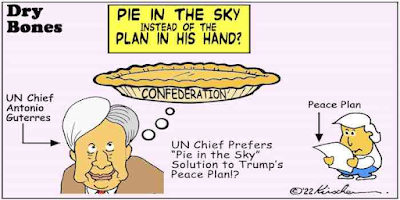
Guterres changes course on UN Israel-PLO two-state solution


United Nations (UN) Secretary-General Antonio Guterres has had an epiphany—just four days after declaring on February 8th that there was no plan B to replace the UN-endorsed Israel-PLO two-state solution: Creating a second Arab State – in addition to Jordan—in the territory comprised in the 1922 League of Nations Mandate for Palestine.

On February 12th Guterres spoke positively of a new grassroots Plan B - “The Holy Land Confederation” - creating an Israeli-Palestinian confederation - after meeting with its authors in New York.

Creation of The Holy Land Confederation involves:
  • the Palestine Liberation Organisation leadership (PLO) and the Israeli government negotiating a confederal peace agreement within one year on the future borders of the two States and on a future confederation - including its potential evolution and further stages of liberalization over another four years
  • If no confederal agreement is reached within one year then negotiations for a Peace Agreement will center on the two state solution only.
The authors of the confederation have conceded:

“No formal confederations exist today, and the few states that call themselves a “confederation” are in fact federations” (p.91)

Yet this pie in the sky, vague and nebulous confederation proposal has been deemed significant enough for Guterres to give it his endorsement.

Guterres’ spokesman Stephane Dujarric said after the February 12th meeting:

“The secretary-general received [former Israeli justice minister] Yossi Beilin and [former Palestinian negotiator] Hiba Husseini, who presented him with their report on the ‘Holy Land Confederation’ process ... He thanked them for their useful contribution to try and achieve a lasting solution to the conflict,”

The meeting with Guterres lasted just 40 minutes and included four of Guterres’ advisers. Guterres reportedly said the plan could perhaps help revive the peace process - expressing regret at the absence of negotiations.

Beilin reportedly said he asked Guterres if the confederation plan could be included in Guterres’ talking points with leaders in the region and if Guterres could help the group use the UN platform for debates and discourse on the confederation:

“He [Guterres] promised that in his talks with his interlocutors, as he said, he will raise this option of a confederation,” Beilin said, adding that separately, “for the first time after many years, [Guterres said] he can have a dialogue with the Israeli government.”

There is another – and far better - alternative plan waiting in the wings to revive the peace process and get negotiations started: The Trump-Israel-PLO-Jordan Initiative
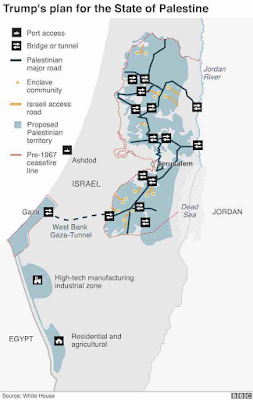


  1. Israel and the PLO negotiate for the creation of a two-state solution on the basis of President Trump’s 2020 Peace Plan – and in default of their agreeing to do so or failing to reach agreement
  2. Israel and Jordan negotiate to redraw their current agreed international boundary designated under Clause 3(2) of the 1994 Jordan-Israel peace Treaty – based on Trump’s Plan
  3. 100% of Gaza and about 70% of Judea and Samaria (West Bank) containing 95% of its Arab population will in either scenario be internationally-recognised as being under Arab sovereignty and control.
  4. No Arab or Jew will have to leave his current home.
Israel has endorsed Trump’s Plan as a “historic opportunity” and “significant milestone” whilst the Arab League has rejected it.

The uncertainties and five year time frame involved in negotiations to establish The Holy Land Confederation stand in strong contrast to the immediate results that negotiations based on The Trump-Israel-PLO-Jordan Initiative could yield within months.

Guterres will be doing world peace a disservice if he ignores endorsing The Israel-PLO-Jordan Trump Initiative after endorsing The Holy Land Confederation proposal.

Guterres’ welcome change of course opens up a new horizon for finally resolving the 100 years old Arab-Jewish conflict.


Author’s note: The cartoon—commissioned exclusively for this article—is by Yaakov Kirschen aka “Dry Bones”- one of Israel’s foremost political and social commentators—whose cartoons have graced the columns of Israeli and international media publications for decades.

Tuesday, August 17, 2010

Palestine - Mountains And Molehills

[Published November 2009]

Judging by the fuss and flurry over the past week you would think that the world was in meltdown unless a resolution was found to finalising claims of sovereignty by Jews and Arabs to a piece of land 280 square kilometres in area (equal to just 5% of the size of Delaware) - forming part of the 5640 square kilometre territory called the “West Bank“.

Everyone involved needs to take a deep breath, calm down and review where this dispute is now at and put it in its proper perspective in the light of the events of the last seven days.

Continuing Palestinian Authority intransigence to concede even one square kilometre of this territory to Israel led to a breakdown in negotiations between Israel and the Palestinian Authority 12 months ago. Since then there have been large changes in the political landscape including the invasion of Gaza by Israel, the election of a new Government in Israel, the publication of the Goldstone Report and the continuing unresolved division of governance in the West Bank and Gaza between Fatah and Hamas.

The West Bank holds deep emotional and religious ties for the Jews - since it is the biblical heartland of the Jewish people - and is part of the territory within which the Jewish National Home was to be reconstituted under the League of Nations Mandate for Palestine and Article 80 of the United Nations Charter.

430000 Jews also happen to live in these 280 square kilometres pursuant to legal rights conferred on them by the Mandate for Palestine and the UN Charter. Israel also considers retention of this area to be absolutely essential for its security because of its strategic location.

United Nations Security Council Resolution 242 predicated that an area of the West Bank would be retained under Israel’s sovereignty as part of its secure and recognized borders in any negotiations.

In a fit of pique the Palestinian Authority has now refused to resume negotiations with Israel - ostensibly because Israel refuses to stop building houses and public buildings in the cities and population centres in the West Bank already designated and established for Jewish development - the so-called “settlements“.

For the Arabs, their interest in continuing to reject Israel’s claim to this 280 square kilometres is directed at driving out its Jewish residents and reducing the security of Israel in pursuit of a policy aimed at eventually destroying Israel by creating yet another Arab state - the 22nd - in the world.

The President of the Palestinian Authority - Mahmoud Abbas - threatened this week not to stand for President at the next elections supposedly to be held in January. Such elections are unlikely since his political opponent - Hamas - has the power to stymie the elections and has indicated it will do so.

Abbas is presently holding on to power illegitimately since his term expired last January. The vacancy caused should have been filled by the Speaker of the Palestinian Legislative Council - Aziz Dweik - but Mr Abbas refuses to yield.

Notwithstanding his political impotence - Mr Abbas hoped his threatened resignation would bring forth cries to rethink his resignation because a Hamas nominee might become President.

Some in Israel rose to the bait.

Israel’s ceremonial President Shimon Peres and the failed politician Yossi Beilin headed the Israeli chorus calling on Abbas to recant.

Peres recalled that along with Rabin, he and Abbas were among signatories to the 1993 Oslo peace accord and he appealed to Abbas by name not to quit.
“We both signed the Oslo agreement, I turn to you as a colleague, don’t let go.”
Beilin told the Lebanon Daily Star:
“The resignation threat presents a real danger because there is no other Palestinian leader on the horizon who can enjoy the same international prestige and try to lead his public to an agreement with Israel. If Abbas tells US President Barack Obama he is considering resigning, the American leader should not consider this an empty threat. It would constitute a blow to his administration’s regional policies, following long months of wasted time and empty maneuvers.”

Apparently President Obama was unmoved by such pleas as his Secretary of State reportedly accepted Mr Abbas’s resignation. Abbas had clearly lost the poker game on this score.

Abbas will now no doubt try to hold on to the reins of power in the absence of any elections. However he is a spent force incapable of delivering anything he signs or agrees to.

Statements and contradicting statements were also made by various Arab spokesmen during the week threatening to dismantle the Palestinian Authority. This was yet another attempt to pressure Israel to stop all building activity in the “settlements“ as the price for the resumption of negotiations.

As a tactic it could not possibly work. Israel had already made concessions in this area that Secretary of State Clinton had acknowledged to be “unprecedented” .

In a November 4 interview with Jackie Northam of National Public Radio Clinton said:
“What is so clear is that once borders are decided, the settlement issue goes away. The Israelis build whatever they want in their territory, the Palestinians build whatever they want in theirs,”
America had again spoken to clear the air in an attempt to make Abbas see sense and resolve the issue of borders without delay. Her advice seems certain to be ignored. He is in no position to concede any land without bringing the wrath of Hamas on him.

Just in case Abbas was not listening to Clinton - President Obama had the following to say in a taped video played at the Rabin Memorial Commemoration on 8 November:
"Palestinian dreams of statehood will be deferred unless Israelis are assured of their own safety and security”
The abject surrender of control in Gaza to Hamas has destroyed the credibility and effectiveness of the Palestinian Authority to govern any area of the West Bank in a way that could possibly meet Israel’s security requirements.

There is only one Arab State that can possibly do that - Jordan - the last Arab state to occupy the West Bank from 1948-1967 - and with whom Israel has a signed peace treaty that has stood the test of time and many pressures faced by both countries since the treaty was signed in 1994.

A trial balloon was also floated this week suggesting Palestinian Authority Prime Minister Fayyad was seeking a new Security Council resolution to replace Resolution 242 in a bid to win the international community’s support for the borders of a Palestinian state. The move was said to be designed to bring stronger pressure on Israel to withdraw from the West Bank.

This idea is doomed to failure in the Security Council.

All the Arab huff and puff of the past week should be viewed as failed and desperate attempts by the Palestinian Authority to make mountains out of molehills so as to avoid making decisions on borders and to try and shore up support for its rapid decline in political influence.

The Authority and Abbas have jumped head first into the abyss leaving Israel with no reliable or credible negotiating partner. They should both be replaced by Jordan as Israel‘s Arab partner for negotiations on the future sovereignty of the West Bank.

Until this change occurs President Obama should turn his attention and efforts to resolving the really serious problems that presently confront him - Iran, Iraq, Afghanistan, Pakistan, climate change, his own domestic economy, universal health care and terrorism within the military.

Leave the Arabs and Jews alone to first sort out this minimalist territorial issue over a sliver of land.

The agreement on borders still remains the first mountain to be climbed by Arab negotiators. There are others to follow but if this - the easiest to climb - cannot be achieved then it is pointless trying to scale the much higher peaks - refugees, water,Jerusalem, demilitarization - that still remain to be conquered.