Mandate for Palestine - July 24, 1922

Mandate for Palestine - July 24, 1922
Jordan is 77% of former Palestine - Israel, the West Bank (Judea and Samaria) and Gaza comprise 23%.
Showing posts with label International Criminal Court. Show all posts

Sunday, June 6, 2021

Israel's dysfunctional Government cannot survive


An amalgam of eight leaders trading insults and denigrating each other — whilst their parties have adopted policies that are totally irreconcilable on critical issues — is not the foundation for any stable Government — especially in Israel — whose enemies will become increasingly emboldened following the announcement of a cobbled-together Israeli Government comprising very different bedfellows.

A vote of confidence first needed from 61 members of the Knesset before this dysfunctional Government even begins operating is certainly not a foregone conclusion.

Either an Islamic-Arab party — Ra’am (4 seats) — or an extreme left wing party — Meretz (6 seats) which includes two Israeli Arabs — possess the ability to drag Israelis to a fifth election in 3 years.

This Government could implode in making decisions involving such issues as:
  • Hauling Israel before the International Criminal Court (ICC)
  • Authorising future building in Judea and Samaria (West Bank)
  • Extending Israeli sovereignty into Judea and Samaria
  • Preventing the renewal of violent protests by Israel’s Arab population that saw synagogues burnt and attacks on Jews and their property during last month’s Israel- Gaza conflict
Fractured relations and policy differences abound: 
  • Meretz leader — Nitzan Horowitz — has adopted the position that the ICC has grounds for investigating Israel for suspected war crimes. 
Gideon Sa’ar — leader of the New Hope party — said that he would not include Meretz in any coalition he led for holding that viewpoint. 
“Horowitz can’t join the government with positions like that,”
Yamina MK Ayelet Shaked — echoed Sa’ar’s sentiments:
“Anyone who talks like that will not be with us in a coalition,”
Yet Sa’ar and Shaked — and supposedly 10 other members of New Hope and Yamina parties — are ready to sit with Horowitz in coalition as the ICC probe continues and Israel’s Government has to formulate its responses.
 
  • Prime Minister-elect Bennett repeatedly called Ra’am leader Mansour Abbas a “terror supporter” before the elections — but now opines
“Mansour Abbas isn’t a terror supporter. I met an honest man and a brave leader who is reaching out and seeking to help Israeli citizens.”
An amazing epiphany indeed for an Arab leader whose party’s 4 seats could bring down this Government at any time.

  • During the election campaign — Bennett signed a pledge on TV (pictured below) — making the following commitments:
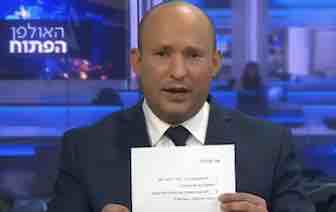
“I won’t allow Yair Lapid to be prime minister, including in a rotation (agreement.)” and “I will not establish a government based on the support of Mansour Abbas from the Islamic Movement.”
Bennett’s credibility has been shot to pieces.
  • Bennett has long held the following views:
“The central problem is the failure of the Israeli leadership to simply state that the land of Israel belongs to the people of Israel. We have to say this to ourselves on Channel 2 and on CNN that Israel belongs to the Jews”
“We have to tell ourselves and the whole world that his land has belonged to us for 3,000 years. The most certain path to defeat is for Israel to forget its sense of justice. This is true historically and legally. There has never been a Palestinian state here.” 
 Can Bennett utter one word about these historic and modern-day legal claims without the leaders of Meretz and Ra’am threatening to pack their bags and bring down the Government?
  • Bennett has argued since 2012 in his detailed “Israel Stability Initiative” that Israel needs to extend its sovereignty into Area C of Judea and Samaria and that Gaza should be separated from Judea and Samaria. Advancing Bennett’s plan could see the Government’s downfall.
Israelis deserve a Government united in policy and possessing the firm resolve to combat their sworn enemies. This rancour-ridden Government — infected by deep political differences — is not the answer.


Author’s note: The cartoon—commissioned exclusively for this article—is by Yaakov Kirschen aka “Dry Bones”—one of Israel’s foremost political and social commentators—whose cartoons have graced the columns of Israeli and international media publications for decades.

Monday, April 26, 2021

Israel reels from rockets, riots and arm-wrestles


Rockets from Gaza indiscriminately targeting Israel’s civilian population and Arab riots targeting Israel’s Jewish population in the streets of Jerusalem seem to have not moved Israel’s politicians to stop engaging in arm-wrestles in pursuit of their own personal political power.

It is hard to know who is to blame for this current sorry state of affairs: the electors who have brought about — what appears on the face of it — four indecisive elections in two years — or the seemingly-intelligent politicians they have elected who have been unable to reach a compromise on setting up a Government with 61 of the Knesset’s 120 currently-elected representatives.

A vendetta continues to be pursued to remove Israel’s longest serving Prime Minister Bibi Netanyahu — despite the overwhelming vote of confidence he and his party received from Israeli voters on March 23, 2021 — 1,066,892 votes.

The following leaders and their respective parties are seeking to replace Netanyahu as Prime Minister or deny him the right to head a right of centre Government:
  • Naftali Bennett — 273836 votes
  • Avigdor Liberman — 248370 votes
  • Gideon Sa’ar — 209161 votes
All three and their respective parties have similar policies and political ideologies as Netanyahu and his allies. Collectively — as Likud, Shas, Yemina, United Torah Judaism, Yisrael Beitenu, Religious Zionism and New Hope - they comprise 72 of the 120 Knesset members.

These three leaders need to fall in behind Netanyahu to end the political uncertainty steadily eroding Israel’s ability to deal with the challenges it is facing — not only from rockets and rioting — but from the continuing confrontation with Iran, Hezbollah, the International Criminal Court, a hostile United Nations and the Biden Administration.

That this appalling political stand-off could have also been avoided in the three previous elections is an indictment on the common obstructionist denominator in all four elections: Avigdor Liberman

Liberman and his Yisrael Beiteinu party have managed to garner the following votes on each occasion:
  • April 9, 2019: 173004 votes
  • September 17, 2019: 310154 votes
  • March 2, 2020: 263365 votes
  • March 23, 2021: 248370 votes
Given that valid votes cast have increased over the period of these four elections from 4,309,270 votes in April 2019 to 4,410,052 votes in March 2021 — the electors have clearly indicated their loss of support for — and confidence in — Liberman and his cronies. Yet he continues to dictate and dominate the political stage in a manner that can only be considered to be inimical to Israel’s domestic and international interests — overwhelmingly rejected by Israelis voting with their feet.

Bennett has hardly fared much better. His party — Yamina — in the April 9, 2019 elections secured 138598 votes — followed successively by 260655 votes, 240689 votes and 273836 votes. He can hardly claim to be Israel’s next Prime Minister with this kind of electoral support.

Netanyahu trounced Sa’ar in the race for Likud leadership last December — winning some 72.5% of the party vote in a landslide win. Sa’ar formed his own breakaway party — New Hope — with disastrous results in the recent election.

That Netanyahu should continue to be frustrated in leading Israel’s next Government by these three political spoilers beggars belief.

Netanyahu certainly has his problems — spending an increasing amount of his time in defending three indictments brought against him by Israel’s Attorney General. However the presumption of innocence should be afforded him — as it is with any other person in Israel facing charges.

It surely is time for these three amigos — Liberman, Bennett and Sa’ar — to put the voters ahead of their own personal ambitions, swallow their pride and end their political grandstanding.

Israel — and Israelis — deserve better.

Author’s note: The cartoon — commissioned exclusively for this article — is by Yaakov Kirschen aka “Dry Bones”- one of Israel’s foremost political and social commentators — whose cartoons have graced the columns of Israeli and international media publications for decades.

Tuesday, April 6, 2021

Israel's voting system needs urgent reform


A million or more Israelis did not vote in each of the four indecisive elections held in the last two years – costing Israel an estimated $4.24 billion - whilst causing political upheaval and electoral instability as a result.

The Central Elections Committee (CEC) sets out how Israel’s electoral system works:
“Israel has an electoral system based on nation-wide proportional representation. In other words, the number of seats that each list receives in the Knesset - the House of Representatives - is proportional to the number of votes it received…

... the only limitation placed on a list which participated in the elections that can keep it from being elected is that it must pass the qualifying threshold, which is currently 3.25%.”
The CEC explains the historical background for this unique voting system:

“The State of Israel inherited the rigid system of proportional representation from the political system of the yishuv (the organized Jewish community) in mandatory times. This system was based on the zeal with which the various political parties - in which ideology and personalities played a major role - fought to preserve their independence. The justification given for the large number of parties resulting from the system was, that in a period in which major, far-reaching and rapid changes were still taking place in the population make-up as a result of immigration, it was important to enable maximal representation for various groups and opinions.”

What was appropriate during the Mandate for Palestine (1920 – 1948) is clearly not working now.

The following Table highlights why Israel’s electoral system needs urgent reform:

Date of Election           04/09/2019     09/17/2019    03/02/2020    03/23/2021

Eligible Voters               6,339,729       6,394,030      6,453,255      6,578,084      

Valid Votes cast              4,309,270       4,436,806      4,553, 161       4,436,365

Qualifying 
threshold before 
any list can gain 
at least one seat 
(3.25% x Valid 
Votes Cast)                        140005          144197         147978          144182

Votes per seat 
(Valid Votes 
Cast/120 seats)                 32860             35917           37943           36969

    1. The threshold of 3.25% has enabled 13 lists securing more than 144182 votes each to be allocated the 120 seats in this current election. 
    2. If the threshold had been 5% - 221818 votes - 9 lists only would have passed the threshold and been allocated the 22 seats awarded to those 4 extra lists.
    3. Non-voter turnout this election will be less than the difference of 2,141,719 shown between Eligible Voters and Valid Votes Cast - since Eligible Voters living abroad or temporarily overseas on business or vacation cannot vote.
    4. Non-voters this election who also voted in March 2020 are considerably greater than the 116796 decrease in Valid Votes Cast in this election given:
      • Eligible Voters increased by 124819
      • The Arab Lists vote collapsed from 581507 votes in March 2020 to 379647 this election – a difference of 201860 votes
The large number of Israelis who failed to vote in the last four elections should sound alarm bells for Israel.

The threats to Israel’s very existence posed by Iran, the Palestine Liberation Organisation, Hamas and Hezbollah – and overtly-hostile international organisations such as the United Nations, the United Nations Human Rights Council, UNESCO and the International Criminal Court – makes it essential that Israel has a politically-stable and unified Government not beholden to kingmakers from small parties who end up exercising inordinate power in deciding the format and composition of the next Government – including the allocation of ministerial portfolios.

Electoral reform could include:
  • Allowing absentee voting outside Israel
  • Raising the qualifying threshold from 3.25%
  • Making voting compulsory
  • Adopting school programs emphasising the importance of voting in Knesset elections
Israel’s election train needs to be righted before it completely runs off the rails.

Author’s note: The cartoon — commissioned exclusively for this article — is by Yaakov Kirschen aka “Dry Bones”- one of Israel’s foremost political and social commentators — whose cartoons have graced the columns of Israeli and international media publications for decades. His cartoons can be viewed at Drybonesblog


Thursday, February 11, 2021

The 'State of Palestine' remains a United Nations mirage


The International Criminal Court (ICC) Pre-Trial Chamber 1 decision that the ICC has jurisdiction to investigate alleged war crimes committed in Gaza, the West Bank and East Jerusalem has infuriated Israel — but should bring no joy to Hamas, the Palestine Liberation Organisation (PLO) or the United Nations which continues to support the PLO’s claim for the creation of a second Arab State in former Palestine — in addition to Jordan.

The ICC Prosecutor believes:
"there is a reasonable basis to believe that members of Hamas and Palestinian armed groups […] committed the war crimes of: intentionally directing attacks against civilians and civilian objects (articles 8(2)(b)(i)-(ii), or 8(2)(e)(i)); using protected persons as shields (article 8(2)(b)(xxiii)); wilfully depriving protected persons of the rights of fair and regular trial (articles 8(2)(a)(vi) or 8(2)(c)(iv)) and wilful killing (articles 8(2)(a)(i), or 8(2)(c)(i)); and torture or inhuman treatment (article 8(2)(a)(ii), or 8(2)(c)(i)) and/or outrages upon personal dignity (articles 8(2)(b)(xxi), or 8(2)(c)(ii))’ (para 94)
The Prosecutor further concluded in para 94 that these potential cases would be currently admissible for prosecution once jurisdiction was established.

The Court noted:
“The identification of potential cases by the Prosecutor and her evolving investigation, which is likely to be protracted and resource-intensive, entails that the question of jurisdiction under consideration has concrete ramifications for the further conduct of the proceedings. The initiation of an investigation by the Prosecutor also means that States Parties are under the obligation to cooperate with the Court pursuant to part 9 of the Statute. It is, therefore, all the more necessary to place the present proceedings on a sound jurisdictional footing as early as possible.”(para 86)
The PLO and Hamas will be kept very busy answering the ICC Prosecutor’s enquiries regarding those Palestinian war crimes identified in para 94.

The Court further emphasised that:
“the present decision is strictly limited to the question of jurisdiction set forth in the Prosecutor’s Request and does not entail any determination on the border disputes between Palestine and Israel. The present decision shall thus not be construed as determining, prejudicing, impacting on, or otherwise affecting any other legal matter arising from the events in the Situation in Palestine either under the Statute or any other field of international law.”(para 60)
Any expectation Israel will return to the negotiating table after the PLO’s flirtation with the ICC is hard to visualise.

The 163 page partly dissenting opinion of Judge Péter Kovács’ dwarfs the Court’s actual 60 page decision. It is complicated and breathtaking in its scope and incredible research.

In it Judge Kovács’ made the following observations: 
“To sum up, no conclusion can be drawn that the ‘Non-Member Observer State’ status in the United Nations should be construed in abstracto to mean that its holder is a sovereign State.” (para 219) 
“Palestine is a State Party 9 (under the ICC Statute—ed) despite its current and perhaps peculiar international legal situation. As a State in statu nascendi, Palestine may also perform its rights and obligations. However, this does not mean that its ‘statehood’ has been achieved, that the issue of its territory as ‘territory of the State’ has been settled, or that its ‘borders’ can be conceived as State boundaries.” (para 267)
“Although Mr. Mahmoud Abbas is the Head of State of a State Party, Palestine has not yet achieved a full-fledged and sovereign State status” (Para 303)
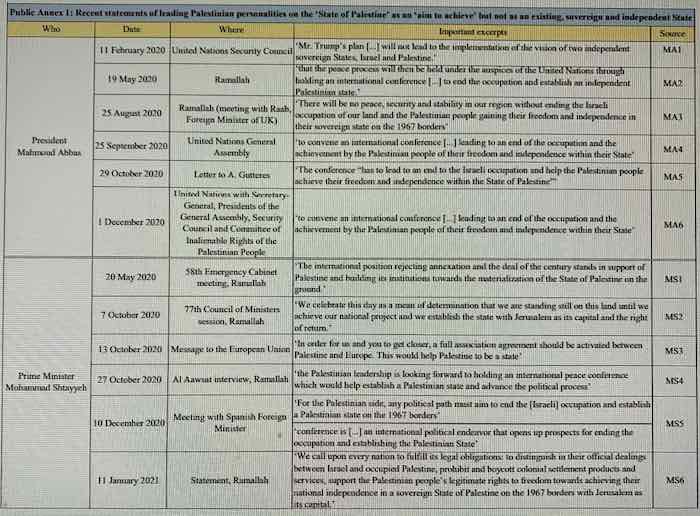
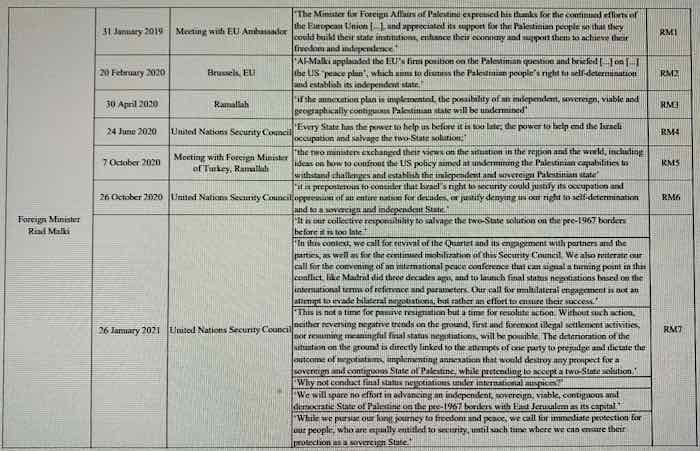
His Honour also listed the recent statements (below) of leading Palestinian personalities on the ‘State of Palestine’ as an ‘aim to achieve’ and not as an existing, sovereign and independent State.

The State of Palestine remains a United Nations mirage based on fiction—not fact.


Author’s note: The cartoon — commissioned exclusively for this article — is by Yaakov Kirschen aka “Dry Bones”- one of Israel’s foremost political and social commentators — whose cartoons have graced the columns of Israeli and international media publications for decades. His cartoons can be viewed at Drybonesblog

Tuesday, March 1, 2016

Obama Honouring Presidential Commitments Trumps Protocol


[Published 2 February 2015]


The furore engendered by House Speaker John Boehner inviting Israeli Prime Minister Benjamin Netanyahu to address Congress on March 3 — supposedly in breach of Presidential protocol - marks the first step in Congress flexing its muscles to persuade President Obama to re-think his concerted attempts to undermine the written commitments made by President Bush to Israel’s then Prime Minister Ariel Sharon in his letter dated 14 April 2004 - as overwhelmingly endorsed by the House of Representatives 407-9 on 23 June 2004 and the Senate 95-3 the next day (“American Written Commitments”)

Those 2004 American Written Commitments to Israel have become even more critical in 2015 — as a completely changed political environment sees America:
1. leading negotiations with Iran on curbing Iran’s nuclear program
2. heading a coalition of 62 States seeking to degrade and destroy Islamic State
3. forming part of the London 11 countries backing the unsuccessful bid to oust Assad from power in Syria
4. witnessing the shredding of the 2003 Bush Roadmap calling for the creation of a second Arab State in former Palestine — in addition to Jordan - as PLO Chairman Mahmoud Abbas chooses instead to travel the road leading to the United Nations and the International Criminal Court.
These American Written Commitments were made to support Sharon’s decision to unilaterally disengage from Gaza — which Israel duly honoured in 2005 — when the Israeli Army and 8000 Israeli civilians left Gaza — many after living there for almost forty years.

Israel’s disengagement brought Hamas to power in Gaza’s one and only election - which has since seen three wars, thousands of deaths and casualties, property destruction running into billions of dollars and 11000 rockets being indiscriminately fired into Israeli civilian population centres.

Those American Written Commitments assured Israel that the United States:
1. Would do its utmost to prevent any attempt by anyone to impose any other plan other than the Roadmap envisioned by President Bush on 24 June 2002.
2. Reiterated America’s steadfast commitment to Israel’s security, including secure, defensible borders,
3. Was strongly committed to Israel’s security and well-being as a Jewish state.
4. Understood that an agreed, just, fair and realistic framework for a solution to the Palestinian refugee issue as part of any final status agreement would need to be found through the establishment of a Palestinian state, and the settling of Palestinian refugees there, rather than in Israel.
5. Accepted as part of a final peace settlement that Israel must have secure and recognized borders, which should emerge from negotiations between the parties in accordance with UNSC Resolutions 242 and 338.
6. Acknowledged that in light of new realities on the ground, including already existing major Israeli populations centers, it would be unrealistic to expect that the outcome of final status negotiations would be a full and complete return to the armistice lines of 1949, that all previous efforts to negotiate a two-state solution had reached the same conclusion
President Obama and his administration have sought to circumvent these American Written Commitments — thereby encouraging continuing Arab rejectionism of Israeli peace overtures whilst souring the American—Israeli longstanding relationship.

Obama’s Secretary of State Hillary Clinton reportedly took the first steps to repudiate these American Written Commitments on 6 June 2009:
“Since coming to office in January, President Barack Obama has repeatedly called on Israel to halt all settlement activity in Palestinian areas, a demand rejected by the government of Israeli Prime Minister Benjamin Netanyahu.

The Israelis say they received commitments from the previous US administration of President George W. Bush permitting some growth in existing settlements.

They say the US position was laid out in a 2004 letter from Bush to then Israeli premier Ariel Sharon.

Clinton rejected that claim, saying any such US stance was informal and “did not become part of the official position of the United States government.”
Clinton made Obama’s intentions clear — when she stated on 25 November 2009
“We believe that through good-faith negotiations the parties can mutually agree on an outcome which ends the conflict and reconciles the Palestinian goal of an independent and viable state based on the 1967 lines, with agreed swaps, and the Israeli goal of a Jewish state with secure and recognized borders that reflect subsequent developments and meet Israeli security requirements.”

This blatant disregard for the American Written Commitments - which had never mentioned land swaps -signalled trouble for Israel - if Obama ever confirmed Clinton’s statements.

Eighteen months later Israel’s worst fears were realised when President Obama declared on 19 May 2011:
“The borders of Israel and Palestine should be based on the 1967 lines with mutually agreed swaps, so that secure and recognized borders are established for both states.”

Israel’s curt response came the same day:

Mr. Netanyahu said in a pointed statement just before boarding a plane to Washington that while he appreciated Mr. Obama’s commitment to peace, he:
“expects to hear a reaffirmation from President Obama of American commitments made to Israel in 2004 which were overwhelmingly supported by both Houses of Congress.”

These American Written Commitments cannot be unilaterally revoked or varied — if America is to retain any international credibility for honouring agreements it makes with other States.

Israel — and Israel alone — must determine where its secure, recognized and defensible borders are to be located under these American Written Commitments.

Obama will hopefully get this unequivocal message when Congress welcomes Netanyahu to address it — protocol or no protocol.

Saturday, November 21, 2015

Palestine - Kerry Oblivious To Demise Of Palestinian Authority


[Published 23 February 2014]


US Secretary of State John Kerry and the US State Department continue to cling to the illusion that the Palestinian Authority still exists—despite PLO insistence that it does not following this Decree on 3 January 2013:
Decree No. 1 for the year 2013
On the use of the name of the State of Palestine and its emblem on letterheads, seals and related official documents
President of the State of Palestine
Chairman of the Executive Committee of the Palestine Liberation Organization
Based on the Statute of the Palestine Liberation Organization
And after reviewing the Fundamental Law of 2003, as amended
Based on the Resolution of the General Assembly of the United Nations No. GA 11317, deciding to upgrade the status of Palestine to the status of observer state in the United Nations Organization.
Based on the recommendations of the Palestinian Committee in charge of the steps to be taken in this regard, and based on the powers vested in us, and in conformity with the public interest,
We decided the following:

Article (1)

Official documents, seals, signs and letterheads of the Palestinian National Authority official and national institutions shall be amended by replacing the name ‘Palestinian National Authority’ whenever it appears by the name ‘State of Palestine’ and by adopting the emblem of the State of Palestine. The relevant authorities shall be in charge of monitoring the implementation of this Decree, taking into account the requirements of use.

Article (2)

Official documents, seals, signs and letterheads in the embassies of the State of Palestine and its missions abroad shall be amended by keeping the name ‘State of Palestine’ and emblem only and the name of ‘mission’ afterwards. The Ministry of Foreign Affairs shall be in charge of implementing these amendments. Dealing with States who do not recognize the State of Palestine shall also be taken into consideration.

Article (3)

No amendment shall be made to the name and emblem in official documents, seals, letterheads and signs of the institutions of the Palestine Liberation Organization.

Article (4)

All competent authorities, each in their respective area, shall implement the provisions of this Decree starting from its date. This Decree shall be notified to those it may concern and shall be published in the Official Gazette.

Mahmoud Abbas
President of the State of Palestine
Chairman of the Executive Committee of the Palestine Liberation Organization
—Translated from Maan News.

Kerry and the State Department’s inability to appreciate this major change in PLO policy became very apparent following Kerry’s visit to Paris last week to meet “President of the State of Palestine” and “Chairman of the Executive Committee of the PLO” - Mahmoud Abbas.

The State Department web site described Kerry’s visit in these terms:
“In Paris, Secretary Kerry will meet with Palestinian Authority President Abbas to discuss the ongoing negotiations between the Palestinians and Israelis.”

State Department spokeswoman Jen Psaki said in Abu Dhabi - where Kerry was meeting United Arab Emirate officials:
“Secretary Kerry will meet with Palestinian Authority President Abbas in Paris, France on Wednesday to discuss the ongoing negotiations between the Palestinians and Israelis,”

Lebanon’s Daily Star—obviously embarrassed to report such Kerry and State Department nonsense - went so far as to deliberately hide Psaki’s reference to the Palestinian Authority:
“State Department spokeswoman Jen Psaki confirmed the meeting, saying they would “discuss the ongoing negotiations between the Palestinians and Israelis”

Wily long time PLO negotiator - Saeb Erekat - was however prepared to let Kerry wander along his path of blissful ignorance with these amazing remarks reported in Xinhua:
“A Palestinian official warned on Monday that the failure of the current Palestinian-Israeli peace talks will lead to the collapse of the Palestinian National Authority (PNA).

“The failure of negotiations means that things will go back to zero point,” chief Palestinian negotiator Saeb Erikat told the official Voice of Palestine radio.

“This may lead Israel to reoccupy the Palestinian territories and thus the PNA will collapse,” he said, adding that the PNA will approach the international organizations including the International Criminal Court (ICC) to sue the state of Israel if the talks do not succeed.

It is the first time a Palestinian official warns of a possible collapse of the PNA if the US-backed negotiations fail.”

Marie Harf—Deputy State Department Spokesman—in her daily press briefing on 19 February—still thought Kerry was meeting with the Palestinian Authority Chairman—the party to negotiations with Israel under the Oslo Accords and the Bush Roadmap:
“Today, Secretary Kerry is in Paris, where he has had meetings with French Foreign Minister Fabius and Jordanian Foreign Minister Judeh. Later tonight, he’s scheduled to meet with Palestinian Authority President Abbas.”

Kerry’s Public Schedule maintained the fiction for 20 February:
“2:00 p.m. LOCAL Secretary Kerry meets with Palestinian Authority President Mahmoud Abbas, in Paris, France.”

Photographs on the State Department website - recording photo-ops with “Palestinian Authority President Mahmoud Abbas”—clearly indicate that Kerry is unaware that:
1. The Palestinian Authority no longer exists

2. The State of Palestine exists on the soil of Palestine

3. The Palestinian Arabs are no longer stateless or homeless

4. Negotiations under Oslo and the Roadmap have become meaningless

Kerry and the State Department will have a lot of explaining to do if his framework agreement fails to take these crucial PLO changes into account.

“Kerry cops caning” would make an excellent headline.

Friday, June 19, 2015

Quartet And UNESCO In Head-on Collision


[Published 19 April 2012]


UNESCO’S recognition that Palestine is a State has now been totally refuted by the Quartet - America, the Russian Federation, the European Union (EU) and the United Nations (UN).

The Quartet - in its latest statement - has now endorsed the view of the Office of the Prosecutor of the International Criminal Court (OTP) just a few days earlier - that Palestine is not a State.
“The Quartet reaffirmed its commitment, as expressed in its 23 September 2011 statement, to examine possible mechanisms it can actively support going forward, individually and together, to advance peace efforts and strengthen the Palestinian Authority’s ability to meet the full range of civil and security needs of the Palestinian people both now and in a future state.”

The Quartet’s use of the words - “both now and in a future state” - was clear and unambiguous .

If the Quartet and the OTP are correct - then Palestine’s admission to UNESCO as a State is indeed unlawful - since only States can be members of UNESCO under Article II paragraph 2 of UNESCO’S Constitution.

Yet the Russian Federation and many other member states of the UN and the EU - 107 to be precise - voted to recognize Palestine’s claim to be a State - thereby qualifying it to be granted admission to UNESCO.

How then can their representatives in the Quartet be now saying Palestine is not a State?

The remaining 87 UNESCO member states - including America and Israel - did not vote for Palestine’s admission. Yet none of these States has done anything in the last six months to protest the illegality of Palestine’s admission to UNESCO - although several courses of action were open to them.

Firstly - they could have attempted to have the decision reviewed by lobbying UNESCO to seek an advisory opinion from the International Court of Justice on the constitutional propriety of its decision to recognize Palestine as a State - under Article XIV Paragraph 2 of UNESCO’s Constitution which states:
“Any question or dispute concerning the interpretation of this Constitution shall be referred for determination to the International Court of Justice or to an arbitral tribunal, as the General Conference may determine under its Rules of Procedure.’

Secondly - they could have suspended their membership or the payment of their membership dues or refused to attend meetings when Palestine was represented by its accredited spokespersons.

America and Israel suspended their dues - not to protest UNESCO’S recognition of Palestine as a State - but to protest that this recognition was achieved unilaterally outside the negotiations prescribed by the Oslo Accords and the Bush Roadmap.

So having by their conduct over the last six months done nothing to voice their opposition to UNESCO recognizing that Palestine is a State - how can their Quartet representatives now be claiming to do just that by claiming there is no existing State of Palestine?

The Quartet’s statement sounds an even more discordant tone when it asserts:
“The Quartet encouraged the parties, in this context, to cooperate to facilitate the social and economic development of Area C, which is of critical importance for the viability of a future Palestinian state as well as for its Palestinian inhabitants to be enabled to lead a normal life. The Quartet asked Quartet Representative Blair to continue his intensive work with the parties toward this end."

Again the words - "a future Palestinian State” - are carefully chosen - a clear negation of the UNESCO vote recognizing Palestine is a State.

But even stranger - "Area "C" is a specific creation of the Oslo Accords and the Bush Roadmap negotiating processes - instituted in 1993 and 2002 between Israel and the Palestine Liberation Organization through its then newly constituted negotiating entity - the Palestinian Authority.

“Area C ” comprises 61% in area of the West Bank and is home to only 4% of the Palestinian Arabs living in the West Bank. It also happens to be the location where pre-existing Jewish settlements were destroyed in the 1948 Arab-Israel War - and were subsequently re-established after the 1967 War.

“Area C ” also contains most of the new Jewish settlements built since 1967 - where close settlement by Jews was to be encouraged under article 6 of the Mandate for Palestine and article 80 of the United Nations Charter.

Israel currently holds full security and administrative control in “Area C”. Sovereignty has remained unallocated between Jews and Arabs since Great Britain handed back its Mandate to the United Nations in 1948.

In going behind Oslo and the Roadmap to unilaterally achieve statehood at UNESCO - Palestine has cut itself completely adrift from Oslo and the Roadmap.

It surely is wishful thinking for the Quartet to have any expectations that further negotiations on the future of “Area C” can be conducted within the framework of Oslo and the Roadmap - once the two-state solution contemplated by Oslo and the Road Map had been achieved at UNESCO.

If there are to be any negotiations over Area C - where Palestine does not have and never has had effective control - a new Roadmap - agreed to by Israel and the Palestinian Authority - will first be needed to replace both Oslo and the Bush Roadmap.

That no doubt is what the Quartet wants to avoid - and provides a good reason for the Quartet to continually claim that there is no state of Palestine existing at the present time.

Perhaps the Quartet is preparing us to get ready to listen to a new composition - the Obama Roadmap,

For that to happen however - the Quartet must encourage UNESCO to high tail it to the International Court - to clarify whether its decision to recognize Palestine as a State is lawful or not.

The current disharmony caused by UNESCO and the Quartet playing from different scores needs to be resolved without delay.

Is Palestine now a state - or it is not?

The UNESCO decision has not only created a growing global humanitarian crisis caused by the loss of 22% of its budget in suspended American dues.

That decision has now also become crucial in determining whether:
1. Oslo and the Bush Roadmap have any further relevance at all and

2. The Quartet disappears ignominiously off the international stage into permanent retirement as the most powerful diplomatic negotiating team ever assembled in history that failed to achieve anything after eight years of trying.

Until the International Court gives its advisory opinion - the Quartet is going to look decidedly foolish claiming there is no such State yet in existence - when UNESCO says there is.

This head-on collision is certain to claim a lot of casualties.

Palestine In UNESCO - Ending The State Of Confusion


[Published 12 April 2012]


Palestine’s continuing membership of UNESCO has become far more tenuous and now faces increased scrutiny following a decision by the Office Of The Prosecutor (OTP) of the International Criminal Court (ICC) that Palestine is not a State.

Only States can be admitted as members of UNESCO under Clause II Paragraph 2 of UNESCO’s Constitution.

The OTP decision now casts grave doubt on Palestine legally continuing to remain a member of UNESCO.

Alarm bells should be ringing at UNESCO calling for it to urgently approach the International Court of Justice (ICJ) to determine:
(i) whether Palestine is a State and if so

(ii) whether the number of votes required to admit it as a member under UNESCO’s Constitution is 129 - not the 107 actually obtained

The OTP decision was announced on 3 April - more than three years after Palestine had first sought to become a State party to the Rome Statute of the ICC.

Sixteen legal opinions were submitted to the OTP - arguing both for and against the claim that Palestine was a State.

I am pleased the OPT has now confirmed my opinion that Palestine is not a State. However I am fully cognisant of the fact that the ICJ needs to confirm the correctness of that opinion for it to have any binding effect. Still it is comforting to be on the same wavelength as the OTP and many others who expressed the same opinion in their submissions to the OTP.

Hopefully UNESCO might at least now take the issues I have raised concerning Palestine’s admission to UNESCO more seriously - and not sit pat and smugly refuse to address my concerns.

I have sought in vain for the last five months to have UNESCO produce any documents which its Executive Board may have considered before concluding that Palestine was a State - qualifying to be admitted to UNESCO.

My requests to produce copies of such documents have been ignored. UNESCO has made it clear the matter is closed and is not to be the subject of any further discussion with me.

In contrast to UNESCO’s lack of transparency - the sixteen legal opinions lodged with the OTP can be viewed on the ICC website. The legal opinions or other documents UNESCO relied on (if any) are being withheld from public scrutiny.

Has UNESCO something to hide? I don’t really know at this stage - but its arrogant and high handed conduct needs to be exposed and justified.

Significantly some UNESCO documents have now come to light - from a source other than UNESCO - that make the decision of the 58 members of the Executive Board of UNESCO to recommend the admission of Palestine very intriguing.

Palestine’s request for admission to UNESCO was first made in 1989 and has been reiterated at every General Conference since then.

At the time of Palestine’s initial application in 1989 - Israel had submitted an opinion arguing that Palestine was not a State. Given that the 1993 Oslo Accords were then only a twinkle in someone’s eye - Israel’s viewpoint could not be seriously challenged - notwithstanding Yassar Arafat’s vacuous Palestinian Declaration of Independence made on 15 November 1988.

After 1993 and more particularly after the Bush Roadmap saw the light of day in 2002 - Palestine’s request for membership in UNESCO continued to be reiterated at every General Conference meeting without success.

The question that UNESCO now needs to answer is - what facts or circumstances changed in 2011 to enable the Executive Board of UNESCO to conclude that Palestine was a State and qualified to become a member of UNESCO?

There appears to be one document that may provide some assistance - the summary record of the sixth plenary meeting of the session of the Executive Board.

Perhaps a copy of this document will now fall off the back of a truck and end up in my hands.

Whether Palestine is a State must surely now be decided by the ICJ.

The legal uncertainty introduced by the OTP decision and the divergent opinions expressed in the submissions made to the OTP cannot possibly be ignored by UNESCO.

That kind of dismissive and contemptuous conduct might work against the expressed opinion of any individual like myself.

But it cannot and should not be tolerated when UNESCO is now faced with a formidable body of legal opinions that Palestine is not a State.

Whilst Palestine remains a member state of UNESCO - the following flow on effects are guaranteed:
1.The loss of 22% of UNESCO’s funding to the end of 2013 - totalling $260 million in suspended American dues - that is unlikely to be fully replaced

2.The abandonment or curtailment of many UNESCO global humanitarian programs in areas such as literacy, water purification, gender equality, AIDS and HIV education and prevention - affecting the lives of scores of millions of people world wide

3.The end of meaningful negotiations for the two-state solution envisaged by the Oslo Accords and the Bush Roadmap - with manifold implications for resolving the long running conflict between Arabs and Jews.

UNESCO can of course continue to stick its head in the sand and ignore all calls for it to seek an advisory opinion from the ICJ on the legality of its decision to admit Palestine.

87 of the 194 countries in UNESCO did not vote to admit Palestine into UNESCO. They have remained silent for the last five months and by their conduct have accepted the legal right of Palestine to sit alongside them as an equal and member State. They can hardly claim that Palestine is not a State whilst they accept that Palestine remains a member of UNESCO.

The OTP decision should make all 194 member states think again.

The fact that Palestine might not legally be a State should surely see some of those 87 naysayer states proposing that UNESCO submits a brief to the ICJ seeking its advisory opinion on whether Palestine’s admission to UNESCO does comply with UNESCO’s Constitution - or does not.

Failure to do so can only result in foreseeable and possibly unforeseeable consequences - not only for the hopes and aspirations of Jews and Arabs in the Middle East - but for UNESCO’s global community.

The OTP decision serves as a clarion call for UNESCO to open its records and approach the ICJ without further delay.