Mandate for Palestine - July 24, 1922

Mandate for Palestine - July 24, 1922
Jordan is 77% of former Palestine - Israel, the West Bank (Judea and Samaria) and Gaza comprise 23%.
Showing posts with label Area C. Show all posts

Sunday, June 20, 2021

Bennett set to shake-up global consensus on two-state solution


Israeli Prime Minister — Naftali Bennett — seems set to challenge the decades-long failure by the international community to achieve its called-for two-state solution: Creating a second Palestinian Arab state, in addition to Jordan, for the first time in recorded history.

Bennett made his intention very clear when introducing Israel’s next Government — presumably with his new coalition partners’ unanimous approval:
“We will ensure Israel’s national interests in Area C — and we will increase standards to that end after much neglect in this area.”
Bennett — anointed as “Prime Minister and Minister for Settlement Affairs” — is now uniquely placed to promote his “Israel Stability Initiative — February 2012” (Stability Plan)  —  summarised by him in 2017:

“The main idea of The Stability Plan is to provide full civilian self-governance to the Palestinians so they can elect themselves, pay their taxes, and control those areas that are theirs. We should apply sovereignty in Israeli-controlled areas—known as Area C—and Palestinians living there will become part and parcel of the State of Israel. And since within the State of Israel you cannot have two levels of people, those Palestinians living in Area C—approximately 80,000 people—will be offered full Israeli citizenship, including voting rights. I think most will opt for residency rather than citizenship (like in East Jerusalem) but it’s up to them. They can be Israeli citizens, Israeli residents or Palestinian citizens.
Those living in the Palestinian-controlled areas (Areas A and B) will govern themselves in all aspects barring two elements: overall security responsibility and not being able to allow the return of decedents [sic] of Palestinians refugees. We can’t have an inflow of millions of great grandchildren of 1948 refugees coming across the Jordan River because in one swoop that would distort the demography of the area, and within a few weeks of their arrival, the local Palestinians in Judea and Samaria would tell them to ‘go back to Jaffa’ which would subsequently create pressure on Israel that could lead to a third intifada inside ‘Smaller Israel’.

My option is that Palestinians have an ‘autonomy on steroids,’ and I’m open to ideas about how this materialises; it could be a confederation with Jordan, or local municipalities, or a central government. It would encompass full freedom of movement, massive infrastructure investment, the creation of a tourism zone so Christians can enter Haifa, Nazareth, Nablus, Ramallah, Jerusalem and Hebron without going through road blocks. We would have joint industrial centres, and we’d be able to create a land port governed by the Palestinians in Jenin that would be connected to Haifa.”
Bennett continued:
“I understand there is global consensus around the two-state solution, but what the world thinks is no proof for the correctness of a plan. The world gets it wrong a lot.

I’d say to those in the international community who are so entrenched in the idea of a Palestinian state that (a) the Palestinians have a state in Gaza and they blew it, and (b) after 50 years, at what time do we need to rethink? In the high tech world where I come from, if my employees tried the same solution and failed again and again I’d fire them as I’d expect them to have tried to tackle the challenge from a different angle by now! There is an industry around this topic—think-tanks, journals, professionals and academics who keep on chewing on the same old failed solution. We’re not in Europe, we live in a region with very few democracies, and when we tried this idea out it blew up in our faces and no one showed us any sympathy.”
Global consensus needs to positively respond to Bennett’s challenge.

Author’s note: The cartoon—commissioned exclusively for this article—is by Yaakov Kirschen aka “Dry Bones”- one of Israel’s foremost political and social commentators—whose cartoons have graced the columns of Israeli and international media publications for decades.

Sunday, June 6, 2021

Israel's dysfunctional Government cannot survive


An amalgam of eight leaders trading insults and denigrating each other — whilst their parties have adopted policies that are totally irreconcilable on critical issues — is not the foundation for any stable Government — especially in Israel — whose enemies will become increasingly emboldened following the announcement of a cobbled-together Israeli Government comprising very different bedfellows.

A vote of confidence first needed from 61 members of the Knesset before this dysfunctional Government even begins operating is certainly not a foregone conclusion.

Either an Islamic-Arab party — Ra’am (4 seats) — or an extreme left wing party — Meretz (6 seats) which includes two Israeli Arabs — possess the ability to drag Israelis to a fifth election in 3 years.

This Government could implode in making decisions involving such issues as:
  • Hauling Israel before the International Criminal Court (ICC)
  • Authorising future building in Judea and Samaria (West Bank)
  • Extending Israeli sovereignty into Judea and Samaria
  • Preventing the renewal of violent protests by Israel’s Arab population that saw synagogues burnt and attacks on Jews and their property during last month’s Israel- Gaza conflict
Fractured relations and policy differences abound: 
  • Meretz leader — Nitzan Horowitz — has adopted the position that the ICC has grounds for investigating Israel for suspected war crimes. 
Gideon Sa’ar — leader of the New Hope party — said that he would not include Meretz in any coalition he led for holding that viewpoint. 
“Horowitz can’t join the government with positions like that,”
Yamina MK Ayelet Shaked — echoed Sa’ar’s sentiments:
“Anyone who talks like that will not be with us in a coalition,”
Yet Sa’ar and Shaked — and supposedly 10 other members of New Hope and Yamina parties — are ready to sit with Horowitz in coalition as the ICC probe continues and Israel’s Government has to formulate its responses.
 
  • Prime Minister-elect Bennett repeatedly called Ra’am leader Mansour Abbas a “terror supporter” before the elections — but now opines
“Mansour Abbas isn’t a terror supporter. I met an honest man and a brave leader who is reaching out and seeking to help Israeli citizens.”
An amazing epiphany indeed for an Arab leader whose party’s 4 seats could bring down this Government at any time.

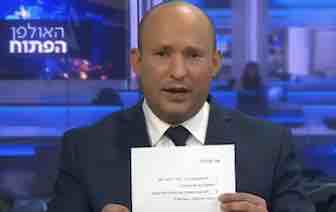
  • During the election campaign — Bennett signed a pledge on TV (pictured below) — making the following commitments:

“I won’t allow Yair Lapid to be prime minister, including in a rotation (agreement.)” and “I will not establish a government based on the support of Mansour Abbas from the Islamic Movement.”
Bennett’s credibility has been shot to pieces.
  • Bennett has long held the following views:
“The central problem is the failure of the Israeli leadership to simply state that the land of Israel belongs to the people of Israel. We have to say this to ourselves on Channel 2 and on CNN that Israel belongs to the Jews”
“We have to tell ourselves and the whole world that his land has belonged to us for 3,000 years. The most certain path to defeat is for Israel to forget its sense of justice. This is true historically and legally. There has never been a Palestinian state here.” 
 Can Bennett utter one word about these historic and modern-day legal claims without the leaders of Meretz and Ra’am threatening to pack their bags and bring down the Government?
  • Bennett has argued since 2012 in his detailed “Israel Stability Initiative” that Israel needs to extend its sovereignty into Area C of Judea and Samaria and that Gaza should be separated from Judea and Samaria. Advancing Bennett’s plan could see the Government’s downfall.
Israelis deserve a Government united in policy and possessing the firm resolve to combat their sworn enemies. This rancour-ridden Government — infected by deep political differences — is not the answer.


Author’s note: The cartoon—commissioned exclusively for this article—is by Yaakov Kirschen aka “Dry Bones”—one of Israel’s foremost political and social commentators—whose cartoons have graced the columns of Israeli and international media publications for decades.

Wednesday, April 21, 2021

Two-state solution sinks as Biden tries to resurrect it


Postponement of the upcoming Palestinian elections on May 22nd for the 132 member Palestinian Legislative Council (PLC) seems virtually assured with the report from an “unnamed US source” that Washington would not object to any such postponement.

The potential boost to Hamas’s power in winning this election at the expense of the Palestine Liberation Organisation (PLO) would spell the death knell for the creation of an independent Palestinian State located in all of Gaza, Judea and Samaria (West Bank) and East Jerusalem (“target area”).

Amazingly this failed solution still continues to be pushed by the international community 40 years after the Venice Declaration first embraced it.

President Trump’s plan to create another Arab State in about 70%—rather than 100% — of the target area — was effectively discarded by President Biden from the day he became President — rewarding the PLO for its unequivocal rejection of Trump’s proposal by resuming much of America’s financial largesse to the PLO and international organisations withdrawn by Trump.


Particularly noteworthy has been Biden’s failure to demand that the PLO end its “pay for slay policy” that rewards the killing and maiming of Jews with substantial payments to the perpetrators or their families — currently running in excess of $300 million per annum.

In agreeing to postpone the May 22 PLC elections — Biden is trying to keep alive the failed 40 years-old “two-state solution” that realistically has never had any chance of succeeding.

The PLC first met on March 7, 1996. Under the 1995 Oslo II Accord, the powers and responsibilities of the PLC are restricted to civil matters and internal security in Area A of the West Bank and Gaza, while in Area B they are restricted to civil affairs with security matters being shared with Israel. In Area C, Israel has full control.


The 2006 election for the second PLC was the last PLC election held. Hamas and Hamas-affiliated members won 74 of the 132 seats — whilst its main rival — Fatah — the dominant faction in the PLO— won 43 of the remaining 58 seats.

There seems little prospect of Hamas being overhauled if the May elections are held.

The PLO refusal to accept the 2006 election result saw the bitter internecine Hamas–Fatah split in 2007 with the PLC ceasing to function ever since.

The logos adopted by both Hamas and Fatah for the upcoming PLC elections indicate Hamas and the PLO — and many others — are still not prepared to abandon their claims to wipe Israel off the map –Palestine Media Watch pointing out:.
“The logos that are being used by the 36 parties in the PA parliamentary elections are a window to aspects of Palestinian ideology and goals. 11 of the lists include in their logos the PA map of “Palestine” that erases all of the State of Israel and includes it in “Palestine.” The two dominant Palestinian political movements, Fatah of Mahmoud Abbas that is the major party ruling the Palestinian Authority, and Hamas, that rules the Gaza Strip, include the map of “Palestine” that erases Israel. Fatah’s logo also includes two rifles and a grenade, indicating that the goal of liberation of “Palestine,” i.e., the destruction of Israel, will be through military means. The Future party of Muhammad Dahlan — a Fatah breakaway — likewise uses the map.
The following are the names of the 11 political parties and logos that include the PA map of “Palestine” that erases Israel and includes it in “Palestine.”

A picture is worth a 1000 words.

Biden’s foray into resolving the 100-years old Arab-Jewish conflict has got off to a disastrous start.


Author’s note: The cartoon — commissioned exclusively for this article — is by Yaakov Kirschen aka “Dry Bones”- one of Israel’s foremost political and social commentators — whose cartoons have graced the columns of Israeli and international media publications for decades.
Thursday, February 25, 2021

West Bank and Gaza Arabs need to be rescued from PLO and Hamas


The first Arab elections to be held in Judea and Samaria (West Bank) and Gaza on 22 May in more than 15 years — to be followed by a presidential vote on 31 July — in theory gives the long-suffering Arab residents in these areas the opportunity to get rid of their failed rulers — the Palestine Liberation Organisation (PLO) in the West Bank and Hamas in Gaza.

The remote chance of this happening however will require a citizens’ grass roots movement to contest the elections — promising a different way forward in reconciling their differences with Israel.

This seems extremely unlikely to happen.

Both the PLO and Hamas remain implacably opposed to making peace with Israel—as their respective constitutions make abundantly clear.

Article 11 of the 1988 Islamic National Resistance Movement (Hamas) is unequivocal:                           
“The Islamic Resistance Movement believes that the land of Palestine is an Islamic Waqf consecrated for future Moslem generations until Judgement Day. It, or any part of it, should not be squandered: it, or any part of it, should not be given up. Neither a single Arab country nor all Arab countries, neither any king or president, nor all the kings and presidents, neither any organization nor all of them, be they Palestinian or Arab, possess the right to do that. Palestine is an Islamic Waqf land consecrated for Moslem generations until Judgement Day.”
Article 13 is uncompromising in attaining Hamas’s goal:
“There is no solution for the Palestinian question except through Jihad. Initiatives, proposals and international conferences are all a waste of time and vain endeavors. The Palestinian people know better than to consent to having their future, rights and fate toyed with.”
The 1968 PLO Charter is also clear in its intentions — with Article 9 declaring:
“Armed struggle is the only way to liberate Palestine. This it is the overall strategy, not merely a tactical phase. The Palestinian Arab people assert their absolute determination and firm resolution to continue their armed struggle and to work for an armed popular revolution for the liberation of their country and their return to it. They also assert their right to normal life in Palestine and to exercise their right to self-determination and sovereignty over it.”
The last Palestinian parliamentary elections in 2006 saw a Hamas landslide victory.

The polls resulted in a brief unity government but it soon collapsed and —in 2007 — bloody clashes erupted in the Gaza Strip between Hamas and the PLO — with Hamas ultimately seizing control of Gaza — leaving the PLO governing 95% of the West Bank Arab population who reside in Areas A and B of the West Bank — the remaining 5% living in Area C being governed by Israel.

Numerous attempts at reconciliation between Hamas and the PLO — including a short-lived coalition government in 2014 — have failed to end the internecine power struggle between Hamas and the PLO.

No independent grass roots movement with a platform totally differentiating itself from the platforms of Hamas and the PLO is in the process of formation or likely to emerge — offering voters a real choice by including in its platform its readiness to seek an accommodation with Israel on the allocation of future sovereignty in the West Bank and Gaza. 

Replacing the current leadership in Hamas and the PLO cannot wipe out the Hamas and PLO Charters nor their sinister objectives.

The long-suffering Arab residents of the West Bank and Gaza will once again have to choose between Hamas and the PLO — if the long-overdue elections actually happen.

No knight in shiny armour is on the horizon.

Author’s note: The cartoon—commissioned exclusively for this article — is by Yaakov Kirschen aka “Dry Bones”- one of Israel’s foremost political and social commentators – whose cartoons have graced the columns of Israeli and international media publications for decades. His cartoons can be viewed at Drybonesblog


Saturday, May 16, 2020

Jordan’s King Abdullah tries to torpedo Trump peace plan


[Published 17 May 2020]


King Abdullah of Jordan has attempted to torpedo President Trump’s peace plan by falsely suggesting it could lead to a one-state solution — not the two-state solution Trump clearly envisages.

Abdullah’s intent became apparent in this interview with Der Spiegel:
DER SPIEGEL: In a few weeks’ time, the Israeli parliament plans to discuss U.S. President Donald Trump’s Middle East peace plan, which includes the annexation of the West Bank by Israel. What would it mean for Jordan if Trump’s plan for the Middle East were to be implemented?
The question was false in its content and framed in the language of the Palestine Liberation Organisation (PLO) — using the term “annexation of the West Bank” instead of “restoring Jewish sovereignty in 30% of the West Bank after 3000 years”.

Abdullah responded to this canard:
King Abdullah II: Is now, in the midst of the corona pandemic, really the time to discuss whether we want a one - or two - state solution for Israel and Palestine? Or should we be discussing how we can fight the pandemic together? The two-state solution is the only way for us to be able to move forward.
Why gratuitously throw in a one-state solution? Why no mention by Abdullah that the two-state solution could not move forward because the PLO has absolutely refused to negotiate with Israel?

The interviewer’s next question corrected his first — asking about Israel annexing “large parts of the Palestinian territories.”
DER SPIEGEL: Politicians like Israeli Prime Minister Benjamin Netanyahu want to take advantage of the opportunity presented by Trump and annex large parts of the Palestinian territories.
Abdullah ignored the correction — repeating his false one-state allegation:
King Abdullah II: Leaders who advocate a one-state solution do not understand what that would mean. What would happen if the Palestinian National Authority collapsed? There would be more chaos and extremism in the region. If Israel really annexes the West Bank in July, it would lead to a massive conflict with the Hashemite Kingdom of Jordan.
Neither Trump nor Netanyahu has advocated a one-state solution.

The “Palestinian Authority” no longer exists — Mahmoud Abbas having changed its name to the “State of Palestine” by decree on January 3, 2013.

Maybe a massive conflict if Israel “annexed” the West Bank — but 30% - an area of 1697 km??

The interviewer did not query Abdullah — but blithely continued:
DER SPIEGEL: You would suspend the peace treaty with Israel?

King Abdullah II: I don’t want to make threats and create a loggerheads atmosphere, but we are considering all options. We agree with many countries in Europe and the international community that the law of the strongest should not apply in the Middle East.
Empty posturing.

The Hashemites have controlled Jordan since 1920.

The PLO has controlled Areas A and B of Judea and Samaria since 2004 and allowed its hapless residents only one vote in 2006.

The law of the strongest is alive and kicking in the Middle East.

Abdullah faces Trump calling on him to fill the negotiating void left by the PLO jettisoning Trump’s plan — because:
1. Transjordan invaded Judea and Samaria in 1948 driving out every Jew living there

2. Transjordan and Judea and Samaria were merged into one territorial entity in 1950 and renamed “Jordan” whilst “Judea and Samaria” was renamed “West Bank”

3. “West Bank” Arab residents were granted Jordanian citizenship between 1954 and 1988

4. PLO made no claims to territorial sovereignty until Jordan lost Judea and Samaria to Israel in the 1967 Six Day War.
The one-state solution is a desperate Abdullah ploy to remain uninvolved.

The realistic two-state solution — Jordan and Israel — is coming.

Author’s note: The cartoon – commissioned exclusively for this article — is by Yaakov Kirschen aka “Dry Bones” – one of Israel’s foremost political and social commentators – whose cartoons have graced the columns of Israeli and international media publications for decades. His cartoons can be viewed at Drybonesblog

Monday, April 20, 2020

Trump-hatred divides American Zionists 100 years after San Remo


[Published 20 April 2020]


Celebrations marking the 100th Anniversary of the signing of the San Remo Resolution on 25 April 1920 by Britain, France, Italy and Japan will be marred by bitter confrontation between those American Zionists who support Jewish sovereignty being restored in 30% of Judea and Samaria (West Bank) and those who don’t.

Rejoicing was the order of the day as the Times of London pointed out on 26 April 1920.

Judea and Samaria – the Jewish People’s ancient and biblical heartland – was included in the land designated for “close settlement by Jews” whilst “ensuring that the rights and position of other sections of the population are not prejudiced” under article 6 of the 1922 League of Nations Mandate for Palestine.

Israel today exercises full security and administrative control in about 60% of Judea and Samaria – “Area C” – 150000 of whose residents are Arab and 464000 Jews - under the 1993 Oslo Accords. Negotiations to resolve the final status of Area C and the remaining 40% of Judea and Samaria – Areas “A” and “B” under control of the Palestine Liberation Organization (PLO) - have been non-existent since 2014.

President Trump’s Peace Plan - released on 28 January 2020 - provides the first realistic opportunity in 100 years since the San Remo Resolution to restore Jewish sovereignty in Judea and Samaria - and create a second Arab state in Mandatory Palestine never contemplated at San Remo.

The PLO and the Arab League have rejected Trump’s plan out of hand.

President Trump nevertheless has decided to proceed with Israel’s Prime Minister Benjamin Netanyahu to restore Jewish sovereignty in about 30% of Area C. A joint US-Israel mapping committee is presently finalising details identifying the particular areas.

American Zionist groups have attacked this Trump-Netanyahu plan of action – urging Benny Gantz –engaged in trying to form a Government of National Unity with Netanyahu - to not agree to change the existing status quo in Judea and Samaria.

One such group - the Israel Policy Forum (IPF) - has written to Gantz:
“We write to you as American Jewish communal leaders who are proudly Zionist, unquestionably pro-Israel, and who have devoted our lives to supporting the State of Israel and ensuring an ironclad relationship between Israel and Diaspora Jewry.”
IPF proclaims:
“We have strongly objected to Israel unilaterally annexing West Bank territory and applying sovereignty to Jewish settlements, whether according to the parameters of the Trump plan or any other similar proposal, at any point in time.”
IPF couches its plea in the language of the enemies of the Jewish people – “unilaterally annexing West Bank territory and applying sovereignty” - rather than “restoring Jewish sovereignty in 30% of Judea and Samaria”

138 prominent American Jewish Communal leaders including Charles Bronfman and Sir James Wolfensohn have signed this letter.

These Zionist naysayers are repudiating the miraculous restoration of long-lost sovereignty in Judea and Samaria promised at San Remo 100 years ago.

Trump-hatred has driven these American Zionists to sacrifice the Jewish People’s long-term national interest for short term partisan American politics.

Their pleas have failed.

Under the Government of National Unity just announced it is being reported that the Government will be applying sovereignty in the Jordan Valley and Judea and Samaria according to Trump’s Peace Plan from early July.

Hopefully these dissenting American Zionists will now relent and support the Trump-Netanyahu historic decision.

David Singer is an Australian Lawyer, a Foundation Member of the International Analyst Network and Convenor of Jordan is Palestine International — an organization calling for sovereignty of the West Bank and Gaza to be allocated between Israel and Jordan as the two successor States to the Mandate for Palestine. Previous articles written by him can be found at: jordanispalestine.blogspot.com

Wednesday, February 5, 2020

Trump Plan to end Jewish-Arab conflict sees PLO implode


[Published 5 February 2020]


The PLO will maintain its long-standing rejectionist policy of not recognising Israel as the Jewish State after Abbas panned the Trump plan in the following denigrating and unequivocal terms:
“They told me Trump wants to send me the deal of the century to read, I said I would not,” Abbas told the meeting of Arab League foreign ministers.

“Trump asked that I speak to him over the phone, so I said ‘no’, and that he wants to send me a letter, so I refused to receive it.”

Holding up a map that shows the gradual geographic reduction of Palestine through four stages from pre-1948 to Trump’s Middle East plan, Abbas said: “I challenge any of you, if you can even see us on the map. If you ask a child in first grade to draw Trump’s map he will never know how to.”


“This is a disgrace,” he added.

Abbas also said that he will cut security ties with both Israel and the US: “We’ve informed the Israeli side ... that there will be no relations at all with them and the United States, including security ties,” he said.
Abbas has lost the plot.

The map Abbas held up (pictured below) - was false and misleading — comprising only 23% - not 100% of Historic Palestine


Abbas’s map excluded Transjordan — 77% of the land in the League of Nations 1922 Mandate for Palestine. Transjordan was closed to Jews to reconstitute the Jewish National Home there under article 25 of the Mandate — reserving this 77% of Palestine for the Arab residents of Palestine.

Transjordan remained part of the Mandate until it was granted independence by Great Britain in 1946.

A textbook containing a similar map was trashed by Publisher McGraw Hill in 2016.

The following map accurately records these historical facts:


Jordan and Israel are the two successor States to the Mandate for Palestine — currently exercising sovereignty in 95% of former Palestine. Sovereignty in the remaining 5% — Judea and Samaria (West Bank) and Gaza — remains undetermined.

The PLO refusal to negotiate with Israel on the Trump plan will have the following results:
1. No second Arab state — in addition to Jordan — will be created in former Palestine

2. US$50 billion in development aid will not be required to build and develop that new State

3. Gaza and the West Bank will remain politically divided
Jordan should now replace the PLO in negotiations with Israel on Trump’s plan because:
1. Jordan was the last sovereign Arab state to occupy the West Bank between 1948 and 1967 when the PLO expressly rejected any claim to sovereignty.

2. Jordan conferred Jordanian citizenship on the Arab residents of the West Bank between 1950 and 1988

3. The 1994 Jordan-Israel Peace Treaty will ensure good-faith — not confrontational - negotiations
The areas designated for A Future State of Palestine in the Trump Plan (pictured below) now become possible areas for transfer to Jordanian sovereignty in negotiations with Israel.


Successful Israel-Jordan negotiations would be a real game changer — holding out great prospects that the long-running Jewish-Arab conflict could finally be achieved.

Failure by Jordan to negotiate with Israel could see Israel extend its sovereignty to all of Area C in the West Bank.

President Trump needs to phone King Abdullah of Jordan and persuade him to embrace Trump’s “deal of the century”.

The PLO has blown its chance to do so.

Tuesday, January 14, 2020

Israeli Right does not seek overthrow of Jordan’s Hashemite monarchy


[Published 15 January 2020]


The claim that:
“The Israeli right has no solution for civil rights for Palestinians after annexation, except for overthrowing Jordan’s Hashemite monarchy”
— is a canard that must be totally rejected.

This defamation of the Israeli right needs to be debunked before it is allowed to become accepted fact in the run up to Israel’s elections on 2 March.

I feel qualified to call out this baseless allegation as the founder of the “Jordan is Palestine Committee” (JIP) 40 years ago.

JIP was formed to inform public opinion that:
1. Jordan comprised 76.9% of the territory once called Palestine

2 The key to ending the conflict between Jews and Arabs required direct negotiations between Israel — 17.1% of former Palestine — and Jordan — to allocate sovereignty of the remaining 6% of former Palestine — Judea, Samaria and Gaza – between their two respective States

3. Jordan’s population alone should determine who Jordan’s ruler should be.
JIP constantly pointed out the role the Hashemite monarchy had played for 60 years in preserving the major part of Palestine as an exclusively Arab State in which Jews were not permitted to live. JIP contrasted this with the failed efforts of the Palestine Liberation Organisation (PLO) to secure sovereignty in one square metre of territory attempting to wipe Israel off the map.

JIP’s stated policy was actually challenged by one member who sought its replacement with a new policy calling for the overthrow of the Hashemites by replacing King Hussein with PLO leader Yasser Arafat.

JIP members rejected this argument and the disgruntled member quit the organisation.

However he did more — registering JIP in his name in Israel — then seeking to restrain my organisation using the name in Israel in connection with an international conference. This necessitated my taking Court proceedings in Israel at considerable expense. The judge ruled in my favour.

Further sensational claims have also been made that:
1. “the annexation the right plans has no chance of success without overthrowing the government in Amman and turning Jordan into Palestine."

2. “Destabilising the regime in Jordan can be expected to be a joint project of the settlers, the ayatollahs and the evangelists who support Trump.”

Extension of Israel’s sovereignty into Judea and Samaria can occur incrementally — starting in parts of Area C designated in the Oslo Accords which covers 60% of Judea and Samaria.

Area C is under Israel’s full administrative and security control and 50000 - 70000 Arabs live there. No Arab or Jew would have to move from his current house in Area C. Israeli residency or citizenship could be offered to those Arabs affected by Israel’s extension of sovereignty.

Israel could unilaterally extend its sovereignty to all of Area C and offer Israeli residency or citizenship to the Arabs affected — greatly enhancing their civil rights to those currently existing.

None of the above proposals requires the overthrow of Jordan’s King Abdullah or Jordan’s participation in negotiations with Israel.

However Jordan needs to negotiate with Israel on Judea and Samaria’s future after 40 years of refusing to take up the JIP solution to resolve a conflict now in its 100th year — if it wishes to regain any part of Judea and Samaria that was unified with Transjordan in 1950 and then renamed Jordan - with its Arab residents enjoying Jordanian citizenship until 1988.

Overthrowing the Hashemites is not the stated policy of any of Israel’s major political parties although some individuals and groups espoused it at a conference in 2017 — which I strongly opposed.

Jordan is the Arab State in former Palestine — and no amount of double talk can alter this historic, geographic and demographic fact.

Author’s note: The cartoon — commissioned exclusively for this article — is by Yaakov Kirschen aka “Dry Bones”- one of Israel’s foremost political and social commentators — whose cartoons have graced the columns of Israeli and international media publications for decades. His cartoons can be viewed at Drybonesblog

Friday, June 24, 2016

Palestine - Internet Intifada Denies Free Speech


[Published 27 March 2016]


Many Palestinian websites are stifling free speech by refusing to publish comments answering anti-Israel articles published on their sites.

The latest example is an article written by Rania Khalek on Electronic Intifada

Responding to the decision by McGraw Hill Education to destroy all copies of its text book Global Politics: engaging a complex world - containing the accompanying maps - Khalek claimed:
“The maps, which appear in chronological succession on page 123, show Palestinian land loss from 1946, one year before Zionist militias initiated the displacement of more than 750,000 indigenous Palestinians from historic Palestine, to the year 2000, by which point Palestinian land had been reduced to a handful of tiny non-contiguous enclaves in the occupied West Bank and a sliver of Gaza.”

I endeavoured to post the following comment in response on 21 March pointing out the misleading nature of these maps:
“Map 1:
The heading - “Palestinian and Jewish Land 1946” - is misleading for the following reasons:
(i) The map excludes Transjordan which in 1946 still comprised 78% of the territory of the Mandate for Palestine until granted independence by Great Britain in May 1946.

(ii) The land described as “Palestinian land” misleadingly implies legal ownership by the Palestinian Arabs of that land when in fact about 90% of it was State land under British Mandatory control and legal power of disposition.

Map 2:
(i) The legend “Palestinian land” is misleading.

(ii) The legend should have said “proposed Jewish State” and “proposed Arab State” - the terms used in the UN Partition Plan.

Map 3:
The heading “1949-1967” is misleading.

The map should have shown the unification of the West Bank with Transjordan between 1949 and 1967 and the change of name of Transjordan to Jordan in 1950.

It should also have designated the Gaza Strip as being under Egyptian military administration between 1948-1967.

Map 4:
One can only wonder why the year 2000 was chosen. Why not 2015 after Israel had already withdrawn from Gaza and four settlements in the West Bank in 2005 and dismantled many illegal outposts?

In any event the legend “Palestinian land” and “Israeli land” is again wrong and misleading in so far as it relates to the West Bank. The land there should have been shown as Areas “A”, “B” and “C”

As maps designed to be taught to students they are totally lacking in accuracy and ignore basic facts in their compilation.

Designating land as “Palestinian land” in any event implies that such land belongs to the “Palestinians”. Since there were no persons designated as “Palestinians” until the 1964 PLO Charter defined that term—the use of the term in maps before then smacks of an attempt to re-write history.

Mc Graw Hill had no option but to discard these maps”

My comments have not yet been published - and comes at a particularly sensitive time as Electronic Intifada Editor Ali Abunimah - a US citizen - has recently received a visa from the Australian Government - after waiting two months - to speak at a four day Marxism Conference and at other venues in Australia.

Abunimah posted the following tweet thanking the thousands who had petitioned the Australian Government supporting the grant of his visa:
“I’m so grateful to every person who stood up for free speech. Delighted that I just received my visa for Australia. See you Down Under!”

4:44 AM - 16 Mar 2016

Perhaps my comment inadvertently slipped through the cracks as Mr Abunimah was busy packing his bags for his visit to Australia.

Free speech means free speech for all Mr Abunimah.

Stand up, be counted, publish my comment.

Monday, May 30, 2016

Palestine - Elections Key To Ending Senseless Acts Of Self-Destruction


[Published 28 December 2015]


Elections in the West Bank and Gaza – last held in 2006 - increasingly appear to be the key to ending the past three months of random Arab stabbing and car ramming attacks on Israel’s Jewish civilian population, armed forces, border police and security guards.

97 stabbings were recorded – including at least 14 committed by Arab children aged between 11 and 16 and another 16 between ages 17 and 21. 19 cars were deliberately driven off the roads into crowds of people waiting at bus stops or assembly points.

These attacks occurred both in Israel and the West Bank.

Most of the perpetrators were killed or apprehended committing such acts – whilst a few remain at large.

Israel explains these latest tactics as forming part of the strategy of “popular resistance” adopted at the Sixth Fatah Conference in August 2009 by the Palestinian Authority (defunct since 2013) and Fatah – the dominant party in the Palestine Liberation Organization (PLO)

Such call to action resulted from continuing frustration that negotiations between Israel and the PLO under the 1993 Oslo Accords and the 2003 Bush Roadmap had failed to create a Jew-free Palestinian Arab State throughout the entire West Bank, East Jerusalem and Gaza.

The reality is that such a negotiated solution has always been an impossible pipedream that could never happen.

500000 Jews will not voluntarily vacate their homes nor abandon their livelihoods in the West Bank and East Jerusalem to satisfy these racist and totally unacceptable PLO territorial demands – a major stumbling block to successfully concluding any negotiated agreement.

At present:
1. The PLO exercises exclusive administrative control over 95% of the existing West Bank Arab population who live within about 40% of the West Bank (Areas “A” and “B”)

2. The PLO exercises exclusive security control in Area “A” and shares security control with Israel in Area “B”

3. Israel exercises exclusive administrative and security control over Area “C” – 60% of the West Bank - where 350000 Jews and 50000 Arabs currently reside

4. Hamas exercises complete administrative and security control in all of Gaza

5. East Jerusalem has been unilaterally declared to be part of Israel’s capital

6. The PLO and Hamas are still engaged in an internecine struggle extending over the last eight years to achieve complete political dominance over the other in the West Bank and Gaza whilst denying their long-suffering populations any say on who they want to govern them.
Given these unresolved political stalemates – between Israel/PLO and PLO/Hamas - one must legitimately question why those Arabs presently sacrificing their lives murdering Jews do not choose to vent their wrath against the PLO and Hamas by demanding long overdue elections.

The PLO and Hamas – like all previous Palestinian Arab leaders over the last 100 years - have refused any compromises with the Jewish people – inciting their own people to murder Jews and kill themselves in the process to advance their documented political objective of wiping Israel off the map.

Palestinian Arabs denied a vote for the last 10 years need the opportunity to express their continuing support or rejection of these policies.

Elections enabling fresh political parties to emerge with alternative leaderships offering new ideas on making peace with Israel appear as far away as ever.

The sorry story begun with the PLO in 1964 and Hamas in 1987 drags on with no hope for change.

“Popular resistance” in the West Bank and Gaza demanding long-overdue elections can achieve far better results than the spate of utterly futile and senseless acts of self-destruction directed against Jews during the last three months.

Casting a live vote always beats a dead end.

Tuesday, September 15, 2015

Palestine - European Union Can't Be Judge And Jury


[Published 22 July 2013]


The decision by the European Union (EU) to boycott Jewish organisations and institutions based in the West Bank and East Jerusalem will bring much joy to the Arab world’s on-going vicious hate campaign of denigration and demonization of the Jewish State.

The EU announcement heralds the end of any influence it has as a member of the Quartet - America, Russia, the United Nations and the EU - which itself can now no longer claim to act as an impartial negotiator seeking to bring about an end to the long running conflict between Jews and Arabs whilst the EU remains a member.

The EU cannot be surprised if Israel takes retaliatory action in response to its decision including any of the following:
1. Forbidding the transfer of EU funds to non-government organisations in Israel engaged in activities designed to advance the interests of the Israeli Arab population to the detriment of the Jewish majority.
2. Ending all co-operation with the EU in Area C of the West Bank by terminating existing development and infrastructure programs for the benefit of the Arab population and forbidding any such activities in the future.
3. Ordering the closure of the office of the Delegation of the EU to Israel.
A statement released by the EU Delegation on 16 July gave the following as one reason to justify the EU guidelines on the eligibility of Israeli entities and their activities in the West Bank and East Jerusalem for grants, prizes and financial instruments funded by the EU from 2014 onwards:
“The guidelines are also in conformity with the EU’s longstanding position that Israeli settlements are illegal under international law and with the non-recognition by the EU of Israel’s sovereignty over the occupied territories, irrespective of their legal status under domestic Israeli law.”

The illegality of Israeli settlements has never been the subject of any binding authoritative legal decision to my knowledge by any court anywhere in the world.

At best the EU longstanding position is an opinion - and nothing else. It is counterbalanced by other opinions that take the view that Jewish settlement in the West Bank and East Jerusalem is legal by virtue of the provisions of article 6 of the Mandate for Palestine and article 80 of the UN Charter.

In fact the courts of one of the EU member states - France - ruled that Israel did not violate international law by building a light rail line in eastern Jerusalem.

The ruling on March 22 by the Versailles Court of Appeals came in response to a lawsuit filed in 2007 by the Palestine Liberation Organization and the France-Palestine Solaridite association against three French firms that participated in the construction of the light rail network. The plaintiffs claimed that the firms were responsible for human rights and international law violations.

In the 32-page ruling, the judges wrote that international treaties applied to Israel’s occupation of lands captured in 1967 and that those conventions - including the Hague Convention of 1907 - state that:
“the occupying power can and even must establish normal, public activity in the occupied territory.”

The EU position is certainly on very shaky ground.

This latest decision by the EU is the first time the EU has acted to give teeth to the political decision taken by the foreign ministers of the EU Member States at the EU Foreign Affairs Council of 10 December 2012 - which stated
“all agreements between the State of Israel and the EU must unequivocally and explicitly indicate their inapplicability to the territories occupied by Israel in 1967”

The statement makes the EU intentions abundantly clear:
“The purpose of these guidelines is to make a distinction between the State of Israel and the occupied territories when it comes to EU support.”

In declaring that the EU does not recognise any claim by Israel to sovereignty in the West Bank and East Jerusalem - the EU has purported to pre-judge and dismiss Israel’s territorial claims to such areas in direct contravention of a joint statement issued by the Quartet on 10 April 2002:
“We reiterate that there is no military solution to the conflict and call on the parties to move towards a political resolution of their disputes based on UNSCR 242 and 338, and the principle of land for peace — which formed the basis for the Madrid Conference of 1991. We reaffirm our support for the objective expressed by President Bush and spelled out in UNSCR 1397, of two States, Israel and Palestine, living side-by-side within secure and recognized borders”

The EU decision has acted to interfere in the determination of secure and recognized boundaries between Israel and Palestine by pre-empting that Israel has no claim to sovereignty in any part of the West Bank and East Jerusalem.

The EU is free to pursue any policy it wants - but also must accept the responsibility for the fall - out and criticism that will inevitably follow.

Does the EU now take the gracious step and bow out of the Quartet due to this conflict of interest - or does it have to be told to go packing by the other members of the Quartet?

The EU clearly cannot be both judge and jury and the remaining three members of the Quartet must make that very clear immediately - if they themselves wish to retain any credibility and influence in resolving a satisfactory outcome to the Jewish- Arab conflict.

Monday, June 29, 2015

Palestine - Where To From Here?


[Published 24 August 2012]


Israel’s Foreign Minister - Avigdor Liberman - has written to Her Excellency Baroness Ashton - High Representative of the European Union for Foreign Affairs and Security:
“to demonstrate Israel’s goodwill, desire to build trust and sincere desire to create a positive atmosphere vis a vis the Palestinian Authority (PA), with the goal of bringing our neighbors back to the table of direct negotiations.“

The PA has refused to resume direct negotiations until Israel agrees to impose a construction freeze in the West Bank for the duration of such resumed negotiations - which Israel refuses to do.

Mr Liberman has listed the following “significant gestures” made by Israel to attract the PA to drop its demand for a freeze and return to the negotiating table - which he claims are “not properly represented or reflected in the policy of the European Union or the Quartet on this subject.”

1. Israeli Finance Minister Yuval Shteinitz and PA Prime Minister Salam Fayyad concluded (July 31) arrangements with respect to the transfer of goods between Israel and the PA and related tax procedures as recommended by the International Monetary Fund.
2. In light of the PA‘s budget crisis, Israel transferred at the beginning of the month of Ramadan (July 27) an advance of NIS 180 million (approximately USD 45 million) of August tax remittances. The money was intended to help the PA pay salaries in time to celebrate the holiday.
3. An agreement was concluded (July 14) to employ an additional 5,000 Palestinian construction workers in Israel;
4. The number of roadblocks was reduced to 10, most of which are normally open;
5. The remains of Palestinian terrorists were returned (May 31).
6. Israel agreed to develop the gas field off the Gaza shoreline.
7. Israel is promoting infrastructure projects in Area C, including completion of a master plan. In 2011, 119 infrastructure projects were approved, 58 of them with international financing. Fifteen projects relating to the construction and renovation of infrastructures for schools and clinics have received “fast-track” approval.


Mr Liberman complains that there has been no willingness or positive attitude on the part of the PA to reciprocate these moves - and has pointed to the following actions undertaken in the diplomatic and legal arenas against Israel:

1. Attempts to accelerate illegal construction in Area C of the West Bank where sole responsibility is vested in Israel (including dragging the EU into this problematic activity)
2. Encouraging an economic boycott on the Israeli economy in the West Bank
3. Generating repeated negative statements against Israel.
4. Blaming Israel for the murder of Yassir Arafat
5. Ongoing institutionalized incitement in the Palestinian media, attacking Israel and the legitimacy of the State’s existence.


Mr Liberman has also made a stinging attack on PA President Mahmoud Abbas claiming:

1. Mr. Abbas is apparently uninterested or unable—due to his standing in the domestic Palestinian scene vis a vis Hamas, and in light of the regional geopolitical situation—to reach an agreement which would bring an end to the conflict, including addressing all the core issues.
2. Mr Abbas is creating a culture of blaming Israel for delaying the process, while attempting to achieve advantages without negotiation via blackmailing and ongoing attempts to internationalize the conflict - which he says can be confirmed by the Jordanians.
3. In a calculated manner, Mr. Abbas is focusing his dialogue with the international community on the subject of settlements.


Unfortunately - Mr Liberman further claims - the international community tends to accept this discourse lock, stock and barrel, without criticism or a nuanced approach. This is a damaging attitude, which according to Mr Liberman does not reflect the reality on the ground.

Mr Liberman is at pains to further point out that:

1. The entire area of the settlements constitutes approximately one percent of the area of the West Bank.
2. The last settlement which Israel constructed was in 1991.
3. In the framework of the peace accord with Egypt (1979), Israel evacuated all the settlements and military bases in Sinai.
4. In 2005 - Israel evacuated all of its settlements from the Gaza Strip, as well as four settlements in the northern West Bank - and since such withdrawal 14,000 rockets and missiles have been indiscriminately shot at towns and villages in southern Israel from Gaza.


Mr Liberman makes the following further points in relation to the vexed issue of settlements:

1. Facts and history, as opposed to the simplistic stereotypes and political bias, contradict the idea that somehow the settlement enterprise is the main obstacle to renewing the negotiations. This premise simply does not stand up to the test of reality or the historic precedent of the peace process between Israel and its neighbors. Both peace accords, with Egypt and Jordan, were signed when settlements existed;
2. The claim that settlements are the obstacle to peace is unfounded


Mr Liberman’s prescription for restarting the stalled negotiations calls for fresh general elections for the PA to enable a new, legitimate, hopefully realistic Palestinian leadership to be elected. Such elections were due to be held in 2010 and have since been postponed several times. No new date has been set for such elections.

Israel’s Prime Minister Benjamin Netanyahu and Defence Minister Ehud Barak have since made it very clear that such a proposal does not represent Israel‘s official position. Clearly the European Union could not in such circumstances be expected to endorse Mr Liberman’s proposal as a possible circuit breaker to get negotiations started again.

However - the European Union cannot keep walking the diplomatic tightrope and simply ignore Mr Liberman‘s letter.

Surely the way forward now requires the European Union to indicate whether it considers that the PA should resume negotiations without preconditions in the light of the “significant gestures“ made by Israel.

If the answer is in the affirmative - then the European Union should indicate whether the PA’s refusal to do so would result in the PA being isolated from total or partial diplomatic and financial support from the European Union until the PA resumes such negotiations.

If the answer is in the negative - then the European Union should spell out what it considers needs to be further done by Israel to get the parties around the negotiating table - and whether Israel’s refusal to do so would result in Israel being isolated from total or partial diplomatic and financial support from the European Union until Israel meets the European Union’s requirements

A one line throwaway response from the European Union will not suffice. Baroness Ashton needs to pen a detailed reply to Mr Liberman without delay.

Mr Liberman has put Israel’s cards on the table. Now it is time for the European Union to do likewise.

Monday, June 22, 2015

Palestine - Foreign Political Interference Dressed Up As Humanitarian Aid


[Published 12 July 2012]


Attempts by foreign Governments and international aid agencies to politically influence the outcome of negotiations begun under the Oslo Accords in 1993 - now seriously threaten the total abandonment of those Accords.

The battleground for such foreign interference is Susiya village - located in Area C which comprises about 60% of the West Bank - but where only 5% of the current West Bank Arab population live.

Area C has remained under the total administrative and security control of Israel for the last 45 years.

All the Jewish towns and villages in the West Bank have been established in Area C.

Allocation of sovereignty in Area C was to be determined in negotiations between Israel and the Palestinian Authority under the Oslo Accords and the Bush Roadmap of 2002.

Those negotiations have hit a brick wall with the continuing refusal of the Palestinian Authority to resume such negotiations unless Israel places a total ban on further building in the West Bank for the duration of those negotiations.

The Governor of Hebron - Kamel Hamid - has highlighted Susiya’s problems in an open letter - stating
“I would like to draw your attention to the intention of the Israeli authorities to demolish Khirbet Susiya, located south of the town of Yatta in Hebron Governorate. The so-called Israeli “Civil Administration” has distributed final demolition orders on June 12, 2012, to 51 structures in the Khirbet while giving the population only 3 days to object to the decision. The demolition will devastate the lives of at least 160 Palestinians including 60 children. The lawyers of the Palestinian residents of the Khirbet, Rabbis for Human Rights, managed to get a freeze on the demolition for a period of 14 days from the Civil Administration only to find the decision reversed on June 17, 2012.”

Susiya has been the subject of many court cases before Israel’s High Court of Justice.

A brief - but incomplete - summary was presented to the Senate of the Australian Parliament by Senator Lee Rhiannon on 26 June 2012:
“ Since 1990 there have been a series of demolitions in Susiya and the Israeli authorities have never approved a master plan for Susiya, leaving residents unable to obtain permits for construction. In 2001 all structures were demolished and the residents were forcibly evicted. The residents’ appeal to the High Court of Justice against the action of the Israeli authorities was successful, allowing them to return to their land. In 2011 Susiya had four waves of demolition and, in 2012, the Israeli administration issued a new round of demolition orders.”

Surprisingly both the Hebron Governor and Senator Rhiannon fail to mention the current proceedings before the High Court of Justice relating to Susiya and the Court’s decision on 7 June 2012 in relation to the future conduct of those proceedings.

Foreign Governments and aid donors have been pouring millions of dollars into Susiya - despite its long running legal battles and the continuing uncertainty of tenure for its inhabitants.

Senator Lee Rhiannon told the Australian Senate:
“Right now many projects financed by overseas aid programs in Susiya in the West Bank are under threat from demolition orders issued by the Israeli civil administration. This includes an AusAID funded health clinic constructed through ActionAid’s local partners. Other projects at risk include a dairy production facility supported by the Polish Ministry of Foreign Affairs; the construction of four residential shelters funded with assistance from GVC, an Italian NGO; three animal shelters built in partnership with Save the Children UK and the Union of Agricultural Work Committees; and two water cisterns funded by the European Commission Humanitarian Aid Organisation and Action Against Hunger. Other aid projects which could be demolished include a community centre and a structure used to store sheep’s milk prior to sale, as well as granaries and shelters for sheep and chickens.”

Why would these foreign donors risk spending so much money in an area where they could possibly see the small population living there be declared as squatters and ordered by the Courts to move? Why commit internationally solicited aid funds to projects where no building approvals have been granted?

Would this money not be better employed in projects throughout the remaining 40% of the West Bank where 95% of the Arab population live under the administrative control of the Palestinian Authority or even in Area C where master plans for Arab villages have been approved by Israel?

The answer can be found in the following statement by the Rabbis For Human Rights:
“At first blush, it may seem that this is “only” about the threat to demolish the entire village of Susya, the homes of these simple cave dwellers of the South Hebron Hills. However, the truth is that the results will affect the fate of hundreds of Palestinian homes throughout the Occupied Territories, perhaps thousands. The outcome may well have an effect on our major appeal to return planning authority for Palestinian communities in Area C to Palestinian hands.”

The erection of illegal Arab structures has gathered pace in Area C as the Palestinian Authority pursues a policy of encouraging illegal land grabs, settlement and building on state lands in Area C.

Such land theft has consequences - and the Courts are increasingly being approached to have such activity declared illegal.

Illegal settlement - by either Arabs or Jews - should be regarded with equal severity.

Such conduct can be sought to be justified in the court of public opinion by organized demonstrations in front of demolished shelters using disputed facts - all dutifully recorded on television news and in sensational headlines around the world - or resolved by the Israeli courts.

Access to the Israeli Court system by Arab residents of the West Bank has always been available using the services of well funded and well resourced organizations such as Rabbis For Human Rights - whose donors include:.
1. Caritas Belgium
2. Church of Scotland
3. Church of Sweden
4. European Commission
5. Evangelical Church– Starkenburg West
6. Ford Foundation
7. New Israel Fund
8. Norwegian Church
9. Swedish Church
Rabbis For Human Rights are quite blunt and unapologetic as to the outcomes they are seeking in taking up the cudgels in Susiya to try and extend Palestinian Authority influence and control in Area C. They - and foreign Governments and aid donors - should let the Court rule on the disputes in Susiya and indicate their readiness to abide by the Court’s decisions.

Playing politics by building illegal structures that could face demolition is a reckless mismanagement of aid funds.

Foreign Governments and aid donors should not try to pretend that their interest in Susiya is purely humanitarian. It clearly is not

Sunday, June 21, 2015

Palestine - Rabbis For Human Rights Become Political Power Brokers


[Published 14 June 2012]


Rabbis for Human Rights (RHR) - a leading non-government human rights organization (NGO) in Israel - has made an unprecedented attack on the integrity of Israel’s High Court - whilst simultaneously attempting to undermine what little is left of the stalled Peace Process between Israel and the Palestinian Authority.

The Rabbis have opened themselves up to such criticism as a result of their involvement in a case before Israel’s High Court alleging illegal building activity in Susya – an Arab village located in Area C of the West Bank which is presently under Israel’s total administrative and security control.

RHR’s web site mandates the Organization
“advocating for the rights of marginalized members of society, in defending the rights of minorities in Israel and of Palestinians in the Occupied Territories”

RHR has, however, chosen to go beyond this human rights agenda by engaging in partisan political activity on behalf of the Palestinian Authority - using the Susya case as the catalyst and its residents as political footballs in the process.

RHR made this political objective very clear when warning:
“At first blush, it may seem that this is “only” about the threat to demolish the entire village of Susya, the homes of these simple cave dwellers of the South Hebron Hills. However, the truth is that the results will affect the fate of hundreds of Palestinian homes throughout the Occupied Territories, perhaps thousands. The outcome may well have an effect on our major appeal to return planning authority for Palestinian communities in Area C to Palestinian hands

Since more than 95% of the Palestinian Arabs already live in Areas A and B where – under the Oslo Accords - the Palestinian Authority – not Israel - has full administrative control over what is built and not built in those areas – this claim was both alarmist and unsustainable.

Stating that the Court decision could affect the fate of hundreds – if not perhaps thousands of houses - “throughout the Occupied Territories” - was worthy of the best propaganda efforts of Israel’s most vehement denigrators and detractors.

RHR’s understandable concern for the residents of Susya was being used as a battering ram to pursue a wider political agenda to force Israel to relinquish administrative control of Area C– wholly or partially – to the Palestinian Authority - where very few Palestinian Arabs presently live.

In pursuing this political objective RHR took deliberate aim at the High Court - urging it to adopt the position taken by RHR in the Susya case when arguing:
“We will do our best to insure that neither justice nor judges are mislead or subverted.”

RHR’s vote of no confidence in the ability of the High Court judges to avoid being mislead or subverted without the help of RHR to guide and protect them - was indeed a surprising display of hubris.

RHR was even more strident in the warning it sent to the Court and other state instrumentalities :
“It is extremely important that the High Court judges, the representatives of the army and the government internalize that we are not talking about a small matter that nobody cares about, and can therefore live and devour its prey in the darkness.”

To suggest the High Court judges or those others also mentioned could even be contemplating acting in such a manner could arguably justify a finding of contempt by the Court.

The use of such wild, emotive and unsubstantiated language by Rabbis is surely not to be expected or be part of any civilized discourse between them and a Court charged with hearing a case in which the Rabbis have a deep concern.

The Rabbis – of course - are perfectly entitled to engage in any activity they choose and say what they like – but must be prepared to face any criticism that is subsequently leveled at their conduct.

When such conduct also involves the possible use of funds donated to RHR to pursue human rights objectives – not political objectives – the actions of RHR are thrown more sharply under the public spotlight.

RHR is well-funded and received substantial donations in excess of $5000 each during 2011 from many external donors world wide including:
Caritas Belgium
Church of Scotland
Church of Sweden
European Commission
Evangelical Church– Starkenburg West
Ford Foundation
New Israel Fund
Norwegian Church
Swedish Church

Using those funds to undermine the impartiality of the legal system in Israel and the political processes laid down as a result of the Oslo Accords - seriously damages the credibility of RHR and compromises the humanitarian work it undertakes.

To be fair – RHR is not the only NGO in Israel undertaking a mix of political and humanitarian activities under the description of being a human rights organization.

If the Rabbis – or those other organizations - want to also be power brokers - then they should add this new job description to those listed on their websites – so that donors will be left in no doubt as to where their money is being spent.