Mandate for Palestine - July 24, 1922

Mandate for Palestine - July 24, 1922
Jordan is 77% of former Palestine - Israel, the West Bank (Judea and Samaria) and Gaza comprise 23%.
Showing posts with label One State Solution. Show all posts

Monday, October 5, 2020

Remembering Rabin’s 1985 legacy can end Arab-Jewish conflict

 [Published 6 October 2020]
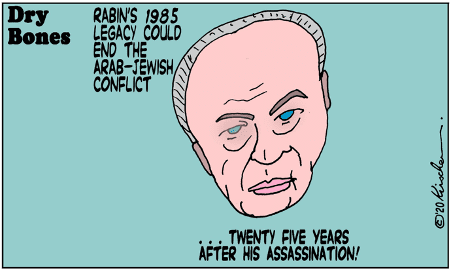

The 25th anniversary of Israeli Prime Minister Yitzchak Rabin’s assassination on 4 November 1995 has seen leading left-wing Democratic Party Congresswoman Alexandria Ocasio-Cortez (AOC) cancelling her planned attendance at a memorial event organized by Americans for Peace Now on 20 October.

Ocasio-Cortez withdrew after journalist Alex Kane tweeted and AOC replied:
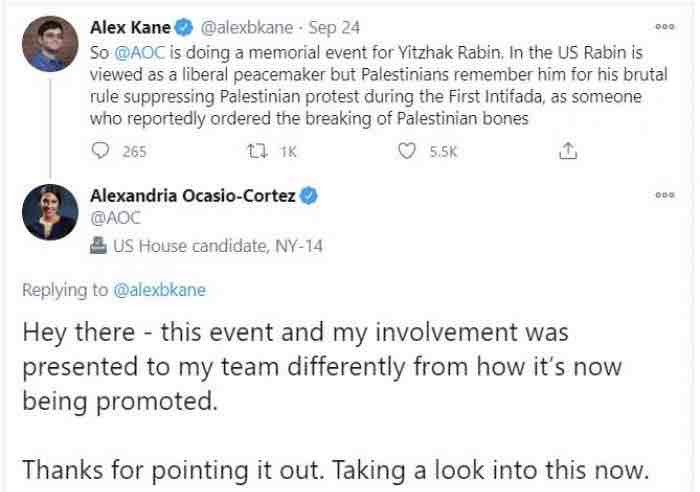


Rabin was indeed a liberal peacemaker and AOC’s decision is to be deplored.

Rabin – when Israel’s Defence Minister – stated on May 27, 1985:

“The Palestinians should have a sovereign State which includes most of the Palestinians. It should be Jordan with a considerable part of the West Bank and Gaza. East of the Jordan River there is enough room to settle the Palestinian refugees. One tiny State between Israel and Jordan will solve nothing. It will be a time bomb.”

One month before his assassination - Prime Minister Rabin sought approval for the 300 page “Israeli – Palestinian Interim Agreement on the West Bank and the Gaza Strip” (Oslo Accords)" - telling the Knesset on 5 October 1995:

“We are striving for a permanent solution to the unending bloody conflict between us and the Palestinians and the Arab states.
“In the framework of the permanent solution, we aspire to reach, first and foremost, the State of Israel as a Jewish state, at least 80% of whose citizens will be, and are, Jews.
“At the same time, we also promise that the non-Jewish citizens of Israel — Muslim, Christian, Druze and others — will enjoy full personal, religious and civil rights, like those of any Israeli citizen. Judaism and racism are diametrically opposed.
“We view the permanent solution in the framework of State of Israel which will include most of the area of the Land of Israel as it was under the rule of the British Mandate, and alongside it a Palestinian entity which will be a home to most of the Palestinian residents living in the Gaza Strip and the West Bank. 

We would like this to be an entity which is less than a state, and which will independently run the lives of the Palestinians under its authority. The borders of the State of Israel, during the permanent solution, will be beyond the lines which existed before the Six Day War. We will not return to the 4 June 1967 lines. 

And these are the main changes, not all of them, which we envision and want in the permanent solution:
First and foremost, united Jerusalem, which will include both Ma’ale Adumim and Givat Ze’ev — as the capital of Israel, under Israeli sovereignty, while preserving the rights of the members of the other faiths, Christianity and Islam, to freedom of access and freedom of worship in their holy places, according to the customs of their faiths. 

The security border of the State of Israel will be located in the Jordan Valley, in the broadest meaning of that term. 

Changes which will include the addition of Gush Etzion, Efrat, Beitar and other communities, most of which are in the area east of what was the “Green Line,” prior to the Six Day War.

The establishment of blocs of settlements in Judea and Samaria, like the one in Gush Katif.”

The Palestine Liberation Organization (PLO) rejected this Rabin 1995 “entity-only solution”.

President Trump’s 2020 “two-state solution” promising the Palestinian Arabs a demilitarized state for the first time in recorded history in Gaza and possibly 70% of Judea and Samaria (the West Bank) has also been rejected by the PLO.

Rabin’s 1985 “one-state solution”: “Peace with a Jordanian-Palestinian state under one government, one flag, one army” still remains the key to ending the 100-years old Arab-Jewish conflict.


Author’s note: The cartoon – commissioned exclusively for this article—is by Yaakov Kirschen aka “Dry Bones”- one of Israel’s foremost political and social commentators – whose cartoons have graced the columns of Israeli and international media publications for decades. His cartoons can be viewed at Drybonesblog


Thursday, November 15, 2018

Trump's one-state solution: A Jordan enclave in the West Bank


[Published 31 October 2018]


United States Secretary of Defense - James Mattis — remarkably failed to mention “the two-state solution”, or even the “Palestinian-Israeli conflict” in his keynote address — “US Policy in a Changing Middle East” — delivered at the International Institute for Strategic Affairs 14th Regional Security Summit in Manama, Bahrein held between 26-28 October.

Mattis’ pointed omissions can only fuel speculation that a “one-state solution — possibly involving the creation of a Jordan enclave in the West Bank - could now be uppermost in President Trump’s thinking.

Billed as “The Middle East’s premier security summit” —the attendees included some of the most powerful policymakers from the Middle East and beyond to address the region’s most pressing governance challenges.

Jordan’s King Abdullah in the opening address at the Summit - delivered by his Minister of Foreign Affairs and Expatriates Ayman Safadi — had warned:
“There have been many attempts to delay and subvert the hope the two-state solution offers. Today, these negative efforts include the fallacy of a single, bi-national state. Any such solution, based on unilateral acts and unequal rights, would be a moral disaster and a recipe for continued conflict.”

Safadi reinforced Abdullah’s message in his own speech the following day:
“As His Majesty said yesterday, the fallacy of one-state solution is something that we all need to keep our eyes wide open as it is being put on the table. If there is no two-state solution then one-state solution, then Israel is going to have to do determine whether it is going to be apartheid South Africa or a democratic Israel where Palestinians within Israel are going to have to exercise their political rights. So, this is the kind of situation that we are looking at.”

The King and his Foreign Minister’s gloomy prognostications would disappear in their entirety if that “one-state solution” did not comprise Israel and the entire West Bank - but comprised Jordan united with a Jordan enclave in part of the West Bank.

A Jordan enclave would:
1.Contain possibly 95% of the existing West Bank Arab population - once again being reunified in a single territorial entity with Jordan as existed between 1950 and 1967

2.Enable Jordanian citizenship to be restored to the enclave’s population - as previously existed between 1950 and 1988.

3.Remove apartheid fears — since the Jordan/enclave population would be entirely Arab with family ties extending over the two banks of the Jordan River

4. Be as democratic or undemocratic as the re-united populations wished — as occurred between 1950 and 1988

5. Complete the original two-state solution first contemplated by the 1922 League of Nations Mandate for Palestine:
(i) an Arab State — Jordan - sovereign in about 80% of the territory of the Mandate -and
(ii) a Jewish State—Israel — sovereign in about the remaining 20% of the Mandate
Interestingly — Safadi — in answering a question on resolving the seven-year old Syrian conflict — remarked:
“I think if we all look in the mirror and ask ourselves the question, have we been following the right approach to solving the problem, I think facts on the ground will tell us no. We need not double down on positions that have gotten us where we are now. We need to be more realistic. We need to follow new approaches that will bring about a political solution to that crisis.”

The single bi-national state is neither a fallacy nor a disaster - if both national entities are Arab.

A Jordan enclave in the West Bank — negotiated between Israel and Jordan under President Trump’s auspices — could indeed prove to be the new approach and realistic political solution to ending the 100 year-old Arab-Jewish conflict.

Author’s note: The cartoon—commissioned exclusively for this article—is by Yaakov Kirschen aka “Dry Bones”- one of Israel’s foremost political and social commentators—whose cartoons have graced the columns of Israeli and international media publications for decades. His cartoons can be viewed at: Drybonesblog

Tuesday, October 8, 2013

Palestine - Clinton Opens Up Alternatives To Two-State Solution


[Published 21 September 2010]


American Secretary of State Hillary Clinton has publicly canvassed the possibility of considering alternative solutions on the future sovereignty of the West Bank as the current negotiations between Israel and the Palestinian Authority to create a new Arab state between Israel and Jordan - the so called “two-state solution” - continue to go nowhere.

In an interview with ABC’s Christiane Amanpour in Jerusalem this week the following interesting exchange took place:

QUESTION: Do you believe you’ve convinced some of the skeptics - for instance, the [Israeli] Foreign Minister Avigdor Lieberman, who you also spoke to - have you convinced him that this two-state solution, this process, is the right one?

SECRETARY CLINTON: I don’t claim to convince someone whose views are very different from that position. I think that he and many Israelis are quite skeptical, just as many Palestinians are quite skeptical. But I’d ask them, what’s the alternative; I mean, what is the alternative? You need, if you are worried about Israel’s future and security, to be living peacefully with a neighbor who has the same aspirations for normal life.


Many commentators such as MJ Rosenberg and Robert Grenier have suggested that the only alternative solution is the “one state bi-national solution” which would see Israel securing sovereignty in 100% of the West Bank in some negotiated bi-national agreement with its West Bank Arab population.

Both Rosenberg and Grenier are equally firm in their prognosis.

Rosenberg writes:

“The alternative, looming just beyond the horizon, is the so-called one state—or bi-national—solution in which Israelis and Palestinians share all the land from the Jordan River to the Mediterranean Sea. How can it be more obvious? The alternative to two states is one state, which virtually all Palestinians would accept and virtually all Israelis reject”


Rosenberg’s own conclusion - that the Arabs would accept it and the Jews reject it - guarantees that such an alternative solution is dead in the water before it is even proposed.

Rosenberg offers no evidence to support his claim that virtually all the Palestinian Arabs will accept the one state bi-national alternative and so agree to abandon their 43 years old demand that a sovereign Palestinian Arab State be created for the first time ever in recorded history.

Rosenberg is on a trip to fantasyland.

Grenier’s pessimism in achieving the two state solution is succinctly expressed as follows:

“That the Israelis and Palestinians could reach agreement on a comprehensive two-state settlement under the current circumstances is hard to imagine. That they could actually implement such an agreement is impossible."


Grenier’s only alternative is also the one-state bi-national solution as he continues:

“The fact of the matter, however, is that the idea of a two-state solution in Palestine is finished. Israeli settlements in the West Bank and their attendant infrastructure have made a viable and independent Palestinian state impossible. The settlements, moreover, cannot be undone. Their existence obviates the need for formal Israeli annexation: The de-facto annexation of the West Bank has already taken place. The only remaining solution is a single, unified, bi-national state.”


The one-state bi-national alternative certainly will not dispel Clinton’s expressed concern for Israel’s future and security. It will become a demographic time bomb, a recipe for future conflict and an even more hopeless exercise to bring to fruition than the discredited two-state solution.

There is however another far more practical and readily achievable alternative solution to that suggested by Rosenberg and Grenier.

That solution involves the division of sovereignty of the West Bank between Israel and Jordan.

Separation of Arabs and Jews in Palestine - as far as is possible - has been the policy that has guided international diplomacy in the region since 1920. It has been sponsored by the League of Nations, the United Nations and several Commissions of Inquiry. It remains the policy currently favoured and supported by America, Russia, the European Union and the United Nations.

This policy - with one notable exception - has failed for one reason - Arab refusal to accept anything less than sovereignty in 100% of the territory available for allocation between Jews and Arabs.

That one exception was Arab acceptance of the League of Nations decision on 23 September 1922 denying the Jews any entitlement to reconstitute the Jewish National Home in 77% of Palestine - laying the groundwork for the creation of an exclusively Arab State there in 1946 that is today called Jordan.

It was not until 1948 that the Jews were able to create their own State in 17% of Palestine.

Sovereignty in the remaining 6% of Palestine - the West Bank and Gaza - is still up for grabs.

Although Jordan and Israel have fought several wars following the War of Independence in 1948 they have enjoyed a signed and sealed peace treaty between their respective states since 1994 - which has withstood many political and diplomatic pressures that could have heralded its demise.

Jordan indeed fits the Clinton mould of Israel “living peacefully with a neighbor who has the same aspirations for normal life.”

Presently stuck between their two respective States is the West Bank with a population of 2 million Arabs and 500000 Jews - whose territorial sovereignty remains undetermined.

Division of that sovereignty between Israel and Jordan resonates as a just and fair solution for the following reasons:

(i) It will restore Jordanian governance to the major part of the West Bank as existed from 1950 up to its loss to Israel in the Six Day War in 1967.
(ii) It will bring the overwhelming majority of its 2 million West Bank Arabs under Jordanian protection, free them from Israeli control and restore the freedom of movement and citizenship rights enjoyed by them between 1948 - 1967
(iii) Not one Jew or Arab will have to leave his present home or business in the West Bank
(iv) Issues presently seen as contentious such as water, refugees and Jerusalem have already been identified and proposed solutions flagged in the 1994 Treaty.
(v) Drawing the new international boundary between Israel and Jordan to end sovereignty claims by Jews and Arabs in the West Bank should be capable of being achieved within three months.
(vi) There will be a dramatic and immediate change in the current status quo which most agree is dangerous and untenable
(vii) Jordan is the only Arab partner that can honour and enforce any agreement on the West Bank that Israel is prepared to sign.
(viii) It will finalize the allocation of sovereignty of former Palestine between the two successor States to the Mandate for Palestine.


Jordan cannot be allowed to simply reject such an alternative out of hand and seek to walk away from the looming conflict that must inevitably fill the void after the collapse of the two-state solution.

Jordan has been part of the problem surrounding the issue of sovereignty in the West Bank since 1920. It now is time for Jordan to step up to the plate and take responsibility for being part of the solution in 2010.

Sunday, September 19, 2010

My letter published in Palestine Note

[Published 18 September 2010]

To: M J Rosenberg

Israel requires the PA to accept the existence of Israel as a Jewish State because the PLO Constitution contains the following clause:

"The Balfour Declaration, the Mandate for Palestine, and everything that has been based upon them, are deemed null and void. Claims of historical or religious ties of Jews with Palestine are incompatible with the facts of history and the true conception of what constitutes statehood. Judaism, being a religion, is not an independent nationality. Nor do Jews constitute a single nation with an identity of its own; they are citizens of the states to which they belong."

Perhaps if you can get them to unequivocally revoke this clause (and some other choice clauses) your argument [that Israel should not require acceptance and recognition by the PA of Israel as a Jewish State] might have merit.

And why is the only alternative to the "two-state solution" the "one state solution"?

What about dividing sovereignty of the West Bank between Israel and Jordan which would see Jordan probably getting sovereignty in about 90% of the West Bank, virtually return the West Bank territory to the status quo that existed in June 1967 and involve no Jew or Arab having to leave their current homes in the West Bank.

I bet you and King Abdullah could negotiate the new boundary in six weeks. There is already an existing peace treaty with Israel that deals with contentious issues such as water, refugees and Jerusalem.

The solution is in front of your eyes. Open them and see the possibilities.