Mandate for Palestine - July 24, 1922

Mandate for Palestine - July 24, 1922
Jordan is 77% of former Palestine - Israel, the West Bank (Judea and Samaria) and Gaza comprise 23%.
Showing posts with label Rabin. Show all posts

Monday, October 5, 2020

Remembering Rabin’s 1985 legacy can end Arab-Jewish conflict

 [Published 6 October 2020]
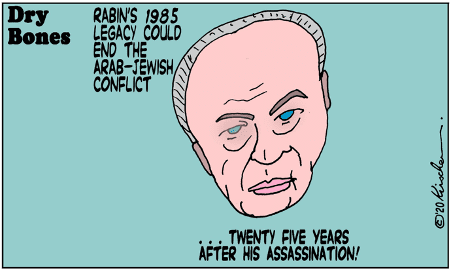

The 25th anniversary of Israeli Prime Minister Yitzchak Rabin’s assassination on 4 November 1995 has seen leading left-wing Democratic Party Congresswoman Alexandria Ocasio-Cortez (AOC) cancelling her planned attendance at a memorial event organized by Americans for Peace Now on 20 October.

Ocasio-Cortez withdrew after journalist Alex Kane tweeted and AOC replied:
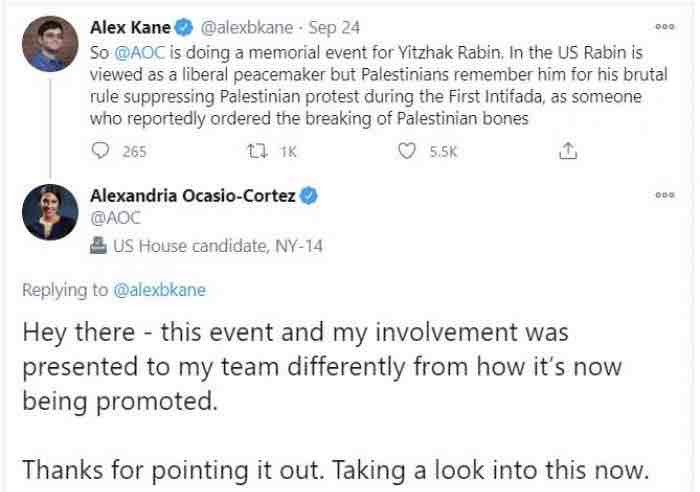


Rabin was indeed a liberal peacemaker and AOC’s decision is to be deplored.

Rabin – when Israel’s Defence Minister – stated on May 27, 1985:

“The Palestinians should have a sovereign State which includes most of the Palestinians. It should be Jordan with a considerable part of the West Bank and Gaza. East of the Jordan River there is enough room to settle the Palestinian refugees. One tiny State between Israel and Jordan will solve nothing. It will be a time bomb.”

One month before his assassination - Prime Minister Rabin sought approval for the 300 page “Israeli – Palestinian Interim Agreement on the West Bank and the Gaza Strip” (Oslo Accords)" - telling the Knesset on 5 October 1995:

“We are striving for a permanent solution to the unending bloody conflict between us and the Palestinians and the Arab states.
“In the framework of the permanent solution, we aspire to reach, first and foremost, the State of Israel as a Jewish state, at least 80% of whose citizens will be, and are, Jews.
“At the same time, we also promise that the non-Jewish citizens of Israel — Muslim, Christian, Druze and others — will enjoy full personal, religious and civil rights, like those of any Israeli citizen. Judaism and racism are diametrically opposed.
“We view the permanent solution in the framework of State of Israel which will include most of the area of the Land of Israel as it was under the rule of the British Mandate, and alongside it a Palestinian entity which will be a home to most of the Palestinian residents living in the Gaza Strip and the West Bank. 

We would like this to be an entity which is less than a state, and which will independently run the lives of the Palestinians under its authority. The borders of the State of Israel, during the permanent solution, will be beyond the lines which existed before the Six Day War. We will not return to the 4 June 1967 lines. 

And these are the main changes, not all of them, which we envision and want in the permanent solution:
First and foremost, united Jerusalem, which will include both Ma’ale Adumim and Givat Ze’ev — as the capital of Israel, under Israeli sovereignty, while preserving the rights of the members of the other faiths, Christianity and Islam, to freedom of access and freedom of worship in their holy places, according to the customs of their faiths. 

The security border of the State of Israel will be located in the Jordan Valley, in the broadest meaning of that term. 

Changes which will include the addition of Gush Etzion, Efrat, Beitar and other communities, most of which are in the area east of what was the “Green Line,” prior to the Six Day War.

The establishment of blocs of settlements in Judea and Samaria, like the one in Gush Katif.”

The Palestine Liberation Organization (PLO) rejected this Rabin 1995 “entity-only solution”.

President Trump’s 2020 “two-state solution” promising the Palestinian Arabs a demilitarized state for the first time in recorded history in Gaza and possibly 70% of Judea and Samaria (the West Bank) has also been rejected by the PLO.

Rabin’s 1985 “one-state solution”: “Peace with a Jordanian-Palestinian state under one government, one flag, one army” still remains the key to ending the 100-years old Arab-Jewish conflict.


Author’s note: The cartoon – commissioned exclusively for this article—is by Yaakov Kirschen aka “Dry Bones”- one of Israel’s foremost political and social commentators – whose cartoons have graced the columns of Israeli and international media publications for decades. His cartoons can be viewed at Drybonesblog


Monday, June 1, 2020

Trump needs to revise his vision for Judea and Samaria


[Published 1 June 2020]


President Trump’s deal of the century envisioning the creation of a second Arab state in former Palestine - in addition to Jordan – is in tatters following its absolute rejection by the PLO – requiring its urgent revision by the President.

Trump has vainly struggled to keep the statehood possibility alive despite PLO President Mahmoud Abbas having consigned it to the dustbin of history on the day of its publication - 28 January 2020 - but the PLO has refused to play ball.

Being a beggar does not fit Trump’s persona. He is allowing Israel to apply sovereignty in 30% of Judea and Samaria in July — with allocation of the remaining 70% requiring another Arab interlocutor to negotiate with Israel.

Trump’s vision was always a mirage — offering the PLO less than 100% of Judea and Samaria it had been demanding since 1967 - supported by the international community since the 1980 Venice Declaration.

Trump had predicated his vision without even defining who comprised the “Palestinians”.

In addition his plan had incorrectly asserted:
1. “Palestinians have aspirations that have not been realized, including self-determination”.

All West Bank Arabs became Jordanian nationals in 1954 until their nationality was revoked by Jordan in 1988.
2. “The State of Israel has also exchanged sizeable territories for the sake of peace, as it did when it withdrew from the Sinai Peninsula in exchange for peace with the Arab Republic of Egypt.”

Israel’s unilateral withdrawal from Gaza in 2005 didn’t rate a mention.
3. “One reason for the intractability of this problem is the conflation of two separate conflicts: a territorial, security and refugee dispute between Israel and the Palestinians and a religious dispute between Israel and the Muslim world regarding control over places of religious significance.”

There is only one conflict – between Jews and Arabs - fuelled by the Arab League’s refusal to recognise the State of Israel since its establishment in 1948.

The religious dispute was resolved under the 1994 Israel-Jordan Peace Treaty granting Jordan control over places of Islamic religious significance in Jerusalem.
4.Israeli Prime Minister Yitzchak Rabin’s proposal for ending the Jewish- Arab conflict.

Rabin actually said:
“We view the permanent solution in the framework of State of Israel which will include most of the area of the Land of Israel as it was under the rule of the British Mandate, and alongside it a Palestinian entity which will be a home to most of the Palestinian residents living in the Gaza Strip and the West Bank. We would like this to be an entity which is less than a state, and which will independently run the lives of the Palestinians under its authority. The borders of the State of Israel, during the permanent solution, will be beyond the lines which existed before the Six Day War. We will not return to the 4 June 1967 lines”.

Trump’s generous offer of statehood – rather than an entity less than a state – has gone begging with the PLO’s unbelievable rebuff of Trump’s proposal.
5. “This Vision addresses today’s realities, and provides the Palestinians, who do not yet have a state ...”

The “Palestinians” do have a state — called Jordan — created in 78% of former Palestine in 1946.

The key to ending this 100 years unresolved conflict now requires Trump to call on Jordan to replace the PLO as Israel’s negotiating partner to allocate between them the areas designated “Proposed future state of Palestine” in Trump’s vision for peace.

June 1967 marked Jordan’s loss of Judea and Samaria to Israel after 19 years of illegal occupation. June 2020 will hopefully signal Jordan’s agreement to peacefully return.


Author’s note: The cartoon – commissioned exclusively for this article — is by Yaakov Kirschen aka “Dry Bones”- one of Israel’s foremost political and social commentators – whose cartoons have graced the columns of Israeli and international media publications for decades. His cartoons can be viewed at Drybonesblog.

Wednesday, January 29, 2020

Trump's vision is a mirage based on shaky foundations


[Published 29 January 2020]


President Trump’s now released deal of the century – calling for the creation of a second Arab state in former Palestine in addition to Jordan (“the two-state solution”) – has predictably already been consigned to the dustbin of history by PLO President Mahmoud Abbas on the day of its publication.

Trump’s solution was a mirage based on the same shaky foundations unsuccessfully pursued by the international community since the 1980 Venice Declaration.

Trump’s failure to address the following issues ensured its collapse from the get go:

1. The term “Palestinians” is not defined in the plan’s Glossary.
Who comprise “the Palestinians” and what constitutes their common identity?
2. Trump’s plan states:
“Palestinians have aspirations that have not been realized, including self-determination”.

Trump ignores that the “Palestinians” right to self-determination was realized when all West Bank Arabs became citizens of Jordan between 1950 and 1967 – then continued to retain their Jordanian citizenship until revoked by Jordan in 1988.
3.Trump’s plan states:
“The State of Israel has also exchanged sizeable territories for the sake of peace, as it did when it withdrew from the Sinai Peninsula in exchange for peace with the Arab Republic of Egypt.”
Israel unilaterally withdrew from Gaza in 2005.Why was this not mentioned?
4.Trump’s plan states:
“One reason for the intractability of this problem is the conflation of two separate conflicts: a territorial, security and refugee dispute between Israel and the Palestinians and a religious dispute between Israel and the Muslim world regarding control over places of religious significance.”
There is only one conflict – between Jews and Arabs - fuelled by the Arab League’s refusal to recognise the State of Israel since its establishment in 1948.The religious dispute was resolved under the 1994 Israel-Jordan Peace Treaty granting Jordan control over places of Islamic religious significance in Jerusalem.
5. Trump’s plan states that Israel’s Prime Minister Yitzchak Rabin:
“envisioned Jerusalem remaining united under Israeli rule, the portions of the West Bank with large Jewish populations and the Jordan Valley being incorporated into Israel, and the remainder of the West Bank, along with Gaza, becoming subject to Palestinian civil autonomy in what he said would be something “less than a state.” Rabin’s vision was the basis upon which the Knesset approved the Oslo Accords, and it was not rejected by the Palestinian leadership at the time.”
Rabin actually said:
“We view the permanent solution in the framework of State of Israel which will include most of the area of the Land of Israel as it was under the rule of the British Mandate, and alongside it a Palestinian entity which will be a home to most of the Palestinian residents living in the Gaza Strip and the West Bank.We would like this to be an entity which is less than a state, and which will independently run the lives of the Palestinians under its authority. The borders of the State of Israel, during the permanent solution, will be beyond the lines which existed before the Six Day War. We will not return to the 4 June 1967 lines”.
6. Trump’s plan states:
“This Vision addresses today’s realities, and provides the Palestinians, who do not yet have a state ...”
The “Palestinians” do have a state — now called Jordan — created in 78% of former Palestine in 1946.
The key to successfully ending this 100 years unresolved conflict requires Jordan’s borders to be extended to incorporate those areas designated as “A Future State of Palestine” in Trump’s already-defunct proposal.

President Trump needs to go back to the drawing board and persuade Israel and Jordan to urgently negotiate those new borders.

Author’s note: The cartoon – commissioned exclusively for this article — is by Yaakov Kirschen aka “Dry Bones”- one of Israel’s foremost political and social commentators – whose cartoons have graced the columns of Israeli and international media publications for decades. His cartoons can be viewed at Drybonesblog.

Monday, November 4, 2019

Rabin's policies can help break Gantz-Netanyahu deadlock


[Published 5 November 2019]


The prospect of a third election in Israel within twelve months looms large — should Blue and White leader Benny Gantz be unable to form a Government of National Unity within the next two weeks.

To break the current deadlock — Gantz needs at least nine members to defect from the voting bloc of 55 seats led by Prime Minister Netanyahu.

Gantz’s cause could be considerably advanced were he to publicly endorse the policies pursued by the late Prime Minister — Yitzchak Rabin — who was assassinated on 4 November 1995.

Rabin made his intentions very clear in his last speech to the Knesset on 5 October 1995 when presenting the 300 page “Israeli-Palestinian Interim Agreement on the West Bank and the Gaza Strip” (Oslo Accords) for approval:
“Members of Knesset,

“We are striving for a permanent solution to the unending bloody conflict between us and the Palestinians and the Arab states.

“In the framework of the permanent solution, we aspire to reach, first and foremost, the State of Israel as a Jewish state, at least 80% of whose citizens will be, and are, Jews.

“At the same time, we also promise that the non-Jewish citizens of Israel — Muslim, Christian, Druze and others — will enjoy full personal, religious and civil rights, like those of any Israeli citizen. Judaism and racism are diametrically opposed.

“We view the permanent solution in the framework of State of Israel which will include most of the area of the Land of Israel as it was under the rule of the British Mandate, and alongside it a Palestinian entity which will be a home to most of the Palestinian residents living in the Gaza Strip and the West Bank.

“We would like this to be an entity which is less than a state, and which will independently run the lives of the Palestinians under its authority. The borders of the State of Israel, during the permanent solution, will be beyond the lines which existed before the Six Day War. We will not return to the 4 June 1967 lines.

“And these are the main changes, not all of them, which we envision and want in the permanent solution:

1. First and foremost, united Jerusalem, which will include both Ma’ale Adumim and Givat Ze’ev — as the capital of Israel, under Israeli sovereignty, while preserving the rights of the members of the other faiths, Christianity and Islam, to freedom of access and freedom of worship in their holy places, according to the customs of their faiths.

2. The security border of the State of Israel will be located in the Jordan Valley, in the broadest meaning of that term.

3. Changes which will include the addition of Gush Etzion, Efrat, Beitar and other communities, most of which are in the area east of what was the “Green Line,” prior to the Six Day War.

4. The establishment of blocs of settlements in Judea and Samaria, like the one in Gush Katif.”

Rabin had stated in The Australian newspaper on May 27, 1985:
“The Palestinians should have a sovereign State which includes most of the Palestinians. It should be Jordan with a considerable part of the West Bank and Gaza. East of the Jordan River there is enough room to settle the Palestinian refugees. One tiny State between Israel and Jordan will solve nothing. It will be a time bomb.”

Supporting Rabin’s proposals would stand Gantz in good stead as he seeks to form a Government of National Unity and — failing that — in the upcoming election that would hopefully end Israel’s current precarious political situation.


Author’s note: The cartoon — commissioned exclusively for this article — is by Yaakov Kirschen aka “Dry Bones”- one of Israel’s foremost political and social commentators — whose cartoons have graced the columns of Israeli and international media publications for decades. His cartoons can be viewed at Drybonesblog.

Tuesday, July 2, 2019

Netanyahu reaffirms that Israel is the Jewish State


[Published 12 March 2019]


It is amazing that Israel’s Prime Minister Benjamin Netanyahu still needs to reaffirm to Israelis that Israel is the Jewish State.

Yet Netanyahu was required to do just that after fashion model, actress and TV presenter Rotem Sela instagrammed:
“When in hell will anyone in this government tell the public that Israel is a state of all its citizens, and all human beings were born equal. And the Arabs, God forbid, are human beings. As are the Druze. And the homosexuals too, by the way, and the lesbians and also … what a shock … the leftists.”
Netanyahu’s response was swift:
“Dear Rotem, important correction: Israel is not a state of all its citizens. According to the Basic Law we have passed, Israel is the nation-state of the Jewish people — and only them.

As you wrote, there is no problem with the Arab citizens of Israel — they enjoy equal rights like all of us, and the Likud government invested more in the Arab sector than any other government.”
Netanyahu elaborated on his statement at last Sunday’s cabinet meeting:
“I would like to clarify a point that, apparently, is not clear to slightly confused people in the Israeli public. Israel is a Jewish, democratic state. This means that it is the national state of the Jewish people alone. Of course it respects the individual rights of all its citizens — Jews and non-Jews alike, but it is the national state, not of all its citizens, but only of the Jewish people.

Other peoples, other nationalities and other minorities — have national representation in other states. The national representation of the Jewish people is in the State of Israel. Israel is the national state of the Jewish people and of it alone.”
David Ben-Gurion and Yitzchak Rabin expressed much the same sentiments decades ago.

Ben-Gurion presciently defined the term “Jewish State” during his evidence before the United Nations Special Committee on Palestine on 7 July 1947:
“What is the meaning of a Jewish State? As I told you before, a Jewish State does not mean one has to be a Jew. It means merely a State - where the Jews are in the majority, otherwise all the citizens have the same status. If the State were called by the name “Palestine — I said if - then all would be Palestinian citizens If the State would be given, another name — I think it would be given another name — because Palestine is neither a Jewish nor an Arab name. As far as the Arabs are concerned, and we have the evidence of the Arab historian, Jew, that there was no such a thing as “Palestine” at all: Palestine is not an Arab name.

Palestine is also not a Jewish name. When the Greeks were our enemies, in order not to annoy the Jews, they gave different names to the streets. So, maybe the name of Palestine will be changed. But whatever the name of the country, every citizen of the country will be a citizen. This is what we mean. This is what we have to mean. We cannot conceive that in a State where we are not in a minority, where we have the main responsibilities as the majority of the country, there should be the slightest discrimination between a Jew and a non-Jew.”
Rabin stated in 1992:
“I don’t want to make Israel a bi-national state. I would like to keep Israel a Jewish democratic state. By that, I mean at least 80% of its population Jewish”.
Peace will only come when the PLO, Hamas and the UN General Assembly recognize that Israel is the Jewish State.

Thursday, September 13, 2018

Arab Summit helps Trump break Jordan-PLO-Israel impasse


[Published 22 April 2018]


The 29th Arab Summit - concluded in Dhahran on 15 April - has presented President Trump with a wonderful opportunity to circumvent the Palestine Liberation Organisation’s (PLO) refusal to consider Trump’s eagerly-awaited proposals to end the Arab-Jewish conflict.

Conflicts in Syria, Iraq, Yemen, Libya, Bahrain and Sudan received scant attention - the Summit’s final communique declaring::
“We reaffirm that the Palestine Cause is the entire Arab nation’s main priority, stressing the Arab identity of occupied East Al-Quds as the capital of the State of Palestine.”

Using the term “Palestine Cause” rather than “Palestinian cause” indicates the Arab world now intends focusing on recovering territory lost in the 1967 Six Day War without necessarily creating another Palestinian Arab state – in addition to Jordan - in former Palestine.

The communique further reinforced this interpretation when adding:
“The conflict could be ended through a two-state solution that guarantees the establishment of an independent Palestinian state on the borders of 4 July 1967 with East Al-Quds as its capital.”

Using the words “could be ended” rather than “can only be ended” is highly significant in the context of this long-running conflict where every word uttered is invariably scrutinised and analysed in great detail.

The Summit’s declared “two-state solution” - pressed for the last 25 years by the PLO and the Arab League and endorsed by the United Nations and the European Union as the only solution to end the Arab-Jewish conflict – is now being seen by the Arab world as just one possible solution.

The Dhahran Communique downgraded the PLO’s sole-spokesman status:
“We consider the Jordanian authorities as the only body in charge of the administration, maintenance and access to Al-Aqsa Mosque”.

This unequivocal Arab endorsement of Jordan challenges the PLO having any future control or influence in the most sensitive area of crucial concern to the Islamic world in Jerusalem - the Moslem holy sites.

Jordan has maintained its presence in Jerusalem as Islamic Holy Shrines Custodian for the last 24 years as a result of the 1994 Peace Agreement between Jordan and Israel – article 9 declaring:
"1.​ Each Party will provide freedom of access to places of religious and historical significance"
2.​ In this regard, in accordance with the Washington Declaration, Israel respects the present special role of the Hashemite Kingdom of Jordan in Muslim Holy shrines in Jerusalem. When negotiations on the permanent status will take place, Israel will give high priority to the Jordanian historic role in these shrines.
3.​ The Parties will act together to promote interfaith relations among the three monotheistic religions, with the aim of working towards religious understanding, moral commitment, freedom of religious worship, and tolerance and peace.”

The Washington Declaration - signed by His Majesty King Hussein and Israeli Prime Minister Yitzhak Rabin at the White House on July 25, 1994 in the presence of President Clinton - formally ended the 46-year state of war between Jordan and Israel.

The Washington Declaration is testament to America’s role as the only power possessing the prestige and clout to change Arab and Jewish perceptions on resolving their long-running conflict.

Jordan’s special role in Jerusalem recognised by the Summit closely follows PLO Chairman Mahmoud Abbas’s recent assertion that Jordanians and Palestinians are indeed one people.

Resolving the “Palestine Cause” remains more easily achievable in negotiations between Israel and Jordan within the framework of their existing peace treaty - rather than resuming fruitless negotiations pursued over the last 25 years between Israel and the PLO.

Ending the 100 years old “Palestine Curse” which has so terribly afflicted both Jews and Arabs could well be within Trump’s grasp thanks to the Dhahran Summit.

Trump pressure pushes Jordan to choose Israel or PLO


[Published 15 April 2018]


The Palestine Liberation Organisation (PLO) — refusing to bow to pressure by President Trump to cease payments to terrorists and their families currently exceeding US$400 million annually — is looming as a potential threat to end 96 years of unbroken Hashemite rule in Jordan.

PLO Chairman Mahmoud Abbas - addressing the ninth annual Islamic Beit al-Maqdes International Conference in Ramallah last week — has sent a veiled message of the PLO’s intention to challenge Jordan’s ruling Hashemite family if PLO demands for a State in the West Bank with Jerusalem as its capital are not met.

Jordan comprised almost 77% of Palestine between 1920 and 1946 until granted independence by Great Britain and being renamed The Hashemite Kingdom of Transjordan — subsequently being renamed Jordan in 1950 following Transjordan’s illegal annexation of Judea and Samaria in 1948 (redesignated the West Bank).

This semantic sleight of hand could never change the historic and demographic reality that Jordan formed part of the territory comprised in the 1922 Mandate for Palestine — Jordan’s Crown Prince Hassan declaring in the Foreign Affairs Review in 1982:
“the Jordanians and Palestinians are now one people, and no political loyalty, however strong, will separate them permanently.”

Abbas told the Ramallah Conference:
“In Palestine and Jordan, we are one people in two states and we will never accept an alternative homeland.”

Abbas’s statement mirrored PLO founder Yasser Arafat’s in Der Spiegel in 1986:
“Jordanians and Palestinians are indeed one people. No one can divide us. We have the same fate.”

Farouk Kadoumi - the Head of the Political Department of the PLO - told Newsweek on 14 March 1977:
“Jordanians and Palestinians are considered by the PLO as one people.”

Alleging flagrant bias towards Israel by the Trump Administration — Abbas defiantly declared:
“We are not expecting anything from them. We won’t accept anything from them.”

Abbas is being incredibly naïve if he believes he can now convince the international community into accepting that one people needs two states — and that pursuing that goal should be internationally supported at the expense of achieving an end to a conflict that originated with the 1917 Balfour Declaration.

Abbas’s categorical rejection of an American role in ending the conflict by calling on the international community to help create a second Arab state in former Palestine — in addition to Jordan—has little chance of success.

Jordan’s King Abdullah should by now be under no illusion that the PLO’s quest to create a PLO-ruled State is doomed to failure. Abdullah should view with apprehension that Abbas’s remarks at the Ramallah Conference could again be laying the groundwork for another PLO attempt to overthrow Hashemite rule in Jordan — as unsuccessfully occurred in September 1970 and is prescribed by article 2 of the PLO Charter.

The solution proposed by Israel’s late Prime Minister Yitzhak Rabin in The Australian on 27 May 1985 now takes on added significance:
“the Palestinians should have a sovereign State which includes most of the Palestinians. It should be Jordan with a considerable part of the West Bank and Gaza. East of the Jordan River there is enough room to settle the Palestinian refugees”
Such a solution - negotiated between Israel and Jordan under the framework of their 1994 Peace Treaty — would see continuing Hashemite rule in Jordan being backed by Israel and America - stability sadly lacking presently in many failed Arab States such as Syria and Libya.

Abbas’s Ramallah statement has presented Jordan with a stark choice - negotiate with Israel or continue supporting the PLO and face the prospect of another attempt to overthrow Jordan’s ruling Hashemite dynasty.

Jordan’s decision should be a no-brainer.

Monday, February 5, 2018

Israel-Jordan negotiations could follow PLO threat to boycott Trump


[Published 15 January 2018]


The Palestine Liberation Organisation (PLO) threat to refuse to negotiate with Israel unless President Trump withdraws his recognition of Jerusalem as the capital of Israel could see Jordan replacing the PLO as Israel’s negotiating partner to end the 100 years-old Arab-Jewish conflict.

This threat — unless unconditionally revoked — would give Trump the opportunity to consign the PLO to the political wilderness by inviting Jordan to step in and negotiate with Israel over Trump’s eagerly-anticipated “ultimate deal‚”.

Jordan-Israel negotiations would offer Jordan the opportunity to recover a substantial part of Judea and Samaria (“West Bank‚”) annexed by Jordan in 1950 — albeit illegally — but subsequently lost to Israel in the 1967 Six Day War (“disputed territory‚”).

Should Jordan buck at entering into such negotiations — some 60% of the disputed territory - under Israel’s full administrative and security control since the 1995 Oslo Accords and containing just 5% of the West Bank’s entire Arab population (“Area C‚”) - could be annexed by Israel.

PLO-Israel negotiations over the last twenty-five years — with United Nations, UNESCO and European Union backing — aimed at creating a 22nd Arab state in the disputed territory for the first time ever in recorded history - have failed abysmally.

Such a State was an artificially-contrived creation that could never be justified on historic, geographic or demographic grounds. It had actually been rejected by successive Arab leaderships on many occasions since first being proposed by the 1937 Peel Commission.

Joint 1994 Nobel Peace Prize winners — Israeli leaders Shimon Peres and Yitzchak Rabin and PLO Chairman Yasser Arafat — all understood Jordan’s pivotal role in ending the Jewish-Arab conflict:

1. Jordan is the major part (78%) of the Palestinian Arabs’ homeland according to article 2 of the PLO Charter.

Farouk Kadoumi - Head of the Political Department of the PLO — reinforced this reality - telling Newsweek on 14 March 1977:
“Jordanians and Palestinians are considered by the PLO as one people.”

2. Peres declared on 31 August 1978:
“Jordan is also Palestine… I’m against two Arab countries and against another Palestinian country, against an Arafat state. Today 50 percent of the inhabitants of Jordan are Palestinians and that is the Palestinian state…
Peres backed this up - telling the Jewish Telegraph on April 19, 1991:
“It is not obstinacy to regard the populations of Jordan, the West Bank and Gaza as having greater similarities than differences. The Jordan River is not deep enough to turn into a knife blade serving to cut one piece of territory into three slices. Most of Jordan’s population are Palestinians: the residents of the West Bank are Jordanian citizens and Jordan has distributed tens of thousands of passports to residents in the Gaza Strip. Jordan is therefore an existing State. It has an army. There is therefore no need to set up another State, another army."

3. Yitzchak Rabin told The Australian newspaper on May 27, 1985:
“One tiny State between Israel and Jordan will solve nothing. It will be a time bomb.”
Rabin’s solution to end the conflict:
”... the Palestinians should have a sovereign State which includes most of the Palestinians. It should be Jordan with a considerable part of the West Bank and Gaza. East of the Jordan River there is enough room to settle the Palestinian refugees.”
Jordan-Israel negotiations on the political future of the disputed territory open up options to resolve the Arab-Jewish conflict never before considered. If Trump’s Jerusalem Declaration helps bring such negotiations about - then Trump could well succeed where all other American Presidents before him have failed.

Taking on Trump could herald the PLO’s political demise after 54 years of failed leadership.

Wednesday, December 6, 2017

Trump, Kushner, Greenblatt flirt with phantom Palestinian Authority


[Published 26 June 2017]


President Trump has made a poor start in attempting to broker an end to the Jewish-Arab conflict by initially engaging with the “Palestinian Authority” —an entity that no longer legally exists.

Trump’s White House communique on 21 June highlights his glaring tactical error:
“Senior Advisor to the President Jared Kushner, Assistant to the President and Special Representative for International Negotiations Jason Greenblatt, and United States Consul General in Jerusalem Donald Blome met today in Ramallah with President Mahmoud Abbas of the Palestinian Authority and his senior advisors.”

The Office of the Historian in the State Department faithfully records the creation of the Palestinian Authority under “Milestones in the History of US Foreign Relations” (Milestones):
“On September 13, 1993, Israeli Prime Minister Yitzhak Rabin and Palestine Liberation Organization (PLO) Negotiator Mahmoud Abbas signed a Declaration of Principles on Interim Self-Government Arrangements, commonly referred to as the “Oslo Accord,” at the White House. Israel accepted the PLO as the representative of the Palestinians, and the PLO renounced terrorism and recognized Israel’s right to exist in peace. Both sides agreed that a Palestinian Authority (PA) would be established and assume governing responsibilities in the West Bank and Gaza Strip over a five-year period.”

However on 3 January 2013 Abbas unilaterally signed the Palestinian Authority’s death certificate when issuing the following Decree:
“Official documents, seals, signs and letterheads of the Palestinian National Authority official and national institutions shall be amended by replacing the name ‘Palestinian National Authority’ whenever it appears by the name ‘State of Palestine’ and by adopting the emblem of the State of Palestine.”

Quite bizarrely — the Palestinian Authority’s 2013 demise was never recorded in Milestones.

The reason was only made clear on 9 May 2017 when the Office of the Historian reported it had retired Milestones which was no longer being maintained or expanded. The Office explained that it had completed a review of its online offerings in Milestones and concluded that extensive resources would be needed to revise and expand its publication of any further developments in the subject matters dealt with up to 2000 to meet the Office’s standards for accuracy and comprehensiveness.

The timing of this announcement came just six days after the White House visit by “President Abbas of the Palestinian Authority”.

Indeed the full terms of the Abbas Decree - introduced with “minimal ceremony or fanfare” - can only be found to my knowledge in an article written by John Whitbeck - identified as having been:
“in Madrid in October 1991 to contribute ideas for the Palestinian speeches delivered at the conference which launched the “peace process,” in Cairo in April/May 1994 as a legal advisor to the Palestinian negotiating team which negotiated the Gaza/Jericho Withdrawal Agreement (the first “post-Oslo” agreement) with Israel and near Camp David in July 2000, when the “peace process” effectively ended, to be available to provide legal advice on any documents which emerged from the Arafat/Barak/Clinton summit.”

Whitbeck summarises the effect of the Abbas Decree:
“By this decree, the Palestinian Authority, created for a five-year interim period pursuant to the Oslo Declaration of Principles signed on the White House lawn in September 1993, has been absorbed and replaced by the State of Palestine, proclaimed in November 1988, recognized diplomatically by 131 of the 193 UN member states and supported in the recent General Assembly vote by an additional 28 states which have not yet formally recognized it diplomatically.”

Whitbeck’s article does not smack of “fake news”.

Either the Palestinian Authority was absorbed and replaced in 2013 or it still exists in 2017.

Flirting with phantoms is the height of folly and extremely foolish.

Saturday, March 18, 2017

Palestine: Correcting canards concerning Israel and vested Jewish legal rights


[Published 28 December 2016]


Australia’s former Foreign Minister and former head of Labor Friends of Israel — Bob Carr - has entered the debate concerning Security Council Resolution 2334 passed on 23 December with his article in the Sydney Morning Herald “The Genius of the UN’s Resolution on Israeli settlements” (December 27)

His contribution is riddled with the following errors that cannot be allowed to stand unanswered and uncorrected and need to be rectified.
I. He states that Levi Eshkol’s chief legal advisor Theodor Meron advised the Prime Minister in 1967 that the Geneva Convention says no nation may settle its own population on land it wins in war.

What Mr Carr omits to tell readers is that Mr Meron changed his opinion on the applicability of the Geneva Convention in 1968 when he co-signed the following advice to Israel’s then Ambassador to the United States — Yitzchak Rabin:
“to tell the Americans that there are unique aspects to the status of the territories and to our status in the territories. Before the Six-Day War, the Gaza Strip wasn’t Egyptian territory, and the West Bank, too, was territory that had been occupied and annexed by Jordan without international recognition. Given this ambiguous, indeterminate territorial situation, the question of the convention’s applicability is complex and unclear prior to a peace agreement that includes setting secure and recognized borders.”

2. Carr claims Meron is alive today, an eminent international jurist. He says he was right then and is right now.

No evidence is supplied by Carr to substantiate that claim — which is obviously rebutted by Meron’s revised 1968 opinion to Rabin. Why did Carr fail to mention Meron’s 1968 epiphany?

3. Carr claims all settlements in the West Bank are illegal.

Wrong — all those settlements are legal under article 6 of the Mandate for Palestine and article 80 of the United Nations Charter—territory-specific legislation dating back to 1922 that is still valid today.

4. Carr claims that Israel has been spreading settlements as fast as possible to render it impossible to achieve a two-state solution.

Wrong — the settlements cover only 5% of the West Bank territory. Israel made offers to cede its claims to 90% of the West Bank in 2000/1 and 95% in 2008.

There has been no settlement because the Arabs want 100%.

5. Carr claims Israeli Governments have gifted settlers the best land.

Wrong — the land given to settlers for which they pay has been land that has mainly remained unsettled and undeveloped for the last 3000 years. It comprises State lands and waste lands not required for public purposes as prescribed under Article 6 of the Mandate for Palestine.

6. Carr claims that if the Palestinian Arabs throw up a granny flat without approval in Area C it is promptly demolished by army bulldozers.

Wrong — the granny flats are being thrown up by the European Union without approval to create facts on the ground. Yes — they are being demolished as happens to any illegal structures built anywhere in the World.

The European Union has no legal right to charge in without authorisation.

7. Carr asks - If Israel is really open to giving the land back in a peace deal why allow settlements in the first place?

Because the Arabs refused to negotiate with Israel between 1967 and 1993 and Israel was legally entitled to settle there.

Israel did the same in Gaza and unilaterally disengaged from every square inch of land there as well as a part of the West Bank in 2005 to advance the two-state solution.

8. Carr relies on Obama’s envoy and former Ambassador Martin Indyk to confirm settlements destroyed the deal.

Yet between 1948 and 1967 there were no settlements - after all the Jews living in East Jerusalem, the West Bank and Gaza had been driven out by the invading Transjordanian and Egyptian armies. The Arabs could have had their state at any time during those 20 years with the stroke of an Arab League pen in precisely the same area they now claim for themselves.

They could have had an even greater area had they not rejected the 1947 UN Partition Plan

Carr finally twigs when he states that historically the aged and corrupt Palestinian leadership has to bear some responsibility and that they’ve let their people down.

Too many offers have gone begging and will not return again given the horrendous events being played out in the Middle East right now.

9. Carr claims the Palestinians are offering a demilitarised state — a Palestine without an army and Western peacekeepers within their borders. It is hard to imagine more explicit security guarantees.

Mr Carr provides no source for this very important information — which is new to me.

10. Carr claims the 83% Arab population of the West Bank is being ruled by a racial and religious minority of 17%.

Wrong — 95% of the Arab population live in Areas A and B and their daily lives are completely ruled by the PLO. Only 5% of the Arabs live in Area C under Israeli rule.

Bob Carr — like the United Nations Security Council - relying on these and similar incorrect and unsubstantiated facts — are in a state of complete denial about Jewish rights to settle in the West Bank and the legality of Jewish settlements.

Both should take the time to better acquaint themselves with fact — not fiction - if they ever want to be believed.

Monday, May 16, 2016

Palestine - Peres Trashes Rabin's Oslo Accords Vision


[Published 28 October 2015]


Former Israeli President Shimon Peres has pre-empted the memorial rally this Saturday evening to commemorate the 20th anniversary of the assassination on 4 November 1995 of Prime Minister Yitzchak Rabin - by writing – quite misleadingly - of Rabin’s vision in the Jerusalem Post this week.

Former US president Bill Clinton, Israel’s President Reuven Rivlin and Yitzchak Rabin’s daughter - former deputy defence minister Dalia Rabin - are scheduled to participate in the rally – and hopefully will set the record straight.

Peres claimed that Rabin’s Government – in which Peres was Foreign Minister
“sought peace at the price of a historic compromise: two states for two peoples. For, if there shall not be two countries, there shall be one continues [sic] tragedy for both peoples.”

Rabin never offered any such two-state compromise.

Peres repeated this disingenuous message again in the same article:
“We laid down the foundations for a two-state solution and began building our peace with Jordan.”

Rabin made his vision very clear in his last speech to the Knesset on 5 October 1995 when presenting the 300 page “Israeli - Palestinian Interim Agreement on the West Bank and the Gaza Strip” (Oslo Accords) for approval:
“Members of Knesset,

We are striving for a permanent solution to the unending bloody conflict between us and the Palestinians and the Arab states.

In the framework of the permanent solution, we aspire to reach, first and foremost, the State of Israel as a Jewish state, at least 80% of whose citizens will be, and are, Jews.

At the same time, we also promise that the non-Jewish citizens of Israel — Muslim, Christian, Druze and others — will enjoy full personal, religious and civil rights, like those of any Israeli citizen. Judaism and racism are diametrically opposed.

We view the permanent solution in the framework of State of Israel which will include most of the area of the Land of Israel as it was under the rule of the British Mandate, and alongside it a Palestinian entity which will be a home to most of the Palestinian residents living in the Gaza Strip and the West Bank.

We would like this to be an entity which is less than a state, and which will independently run the lives of the Palestinians under its authority. The borders of the State of Israel, during the permanent solution, will be beyond the lines which existed before the Six Day War. We will not return to the 4 June 1967 lines.

And these are the main changes, not all of them, which we envision and want in the permanent solution:

A. First and foremost, united Jerusalem, which will include both Ma’ale Adumim and Givat Ze’ev — as the capital of Israel, under Israeli sovereignty, while preserving the rights of the members of the other faiths, Christianity and Islam, to freedom of access and freedom of worship in their holy places, according to the customs of their faiths.

B. The security border of the State of Israel will be located in the Jordan Valley, in the broadest meaning of that term.

C. Changes which will include the addition of Gush Etzion, Efrat, Beitar and other communities, most of which are in the area east of what was the “Green Line,” prior to the Six Day War.

D. The establishment of blocs of settlements in Judea and Samaria, like the one in Gush Katif.”

The two-state solution was never entertained by Rabin.

Two separate countries - favoured by Peres - is irretrievably dead and buried. Rabin’s legacy should not be coupled with that failed diplomatic initiative.

Rabin’s vision should be faithfully preserved – not trashed.

Friday, May 6, 2016

Palestine - United Nations Bedazzled By Abbas Word Wizadry


[Published 4 October 2015]


PLO Chairman Mahmoud Abbas’s speech to the UN General Assembly last week contained a concoction of half-truths and outright lies that everyone who listened to him should question.

Here are some prize porkies:
1. “The question of Palestine was one of the first just issues brought before the United Nations from the time of its inception, and yet it remains unresolved until this moment”

Abbas failed to mention that it has remained unresolved since then because:
(i) The Arabs did not accept the 1947 UN Partition Plan to partition western Palestine into a Jewish State and an Arab State — whilst the Jews did.

(ii) The Arabs — instead - unsuccessfully sent six Arab armies to invade Palestine in May 1948 to rout the newly declared Jewish State — Israel - and drive its Jewish population into the sea

(iii) Jordan and Egypt successfully drove out and permanently expelled the Jewish population living in the Gaza Strip, East Jerusalem and Judea and Samaria (later termed “the West Bank”) - keeping those areas Jew-free from 1948 until 1967

(iv) No attempt was made between 1948 and 1967 to create the Palestinian state Abbas says he will now accept. That opportunity has been well and truly missed.
2. Abbas described the Palestinian Arabs as “a people that had lived peacefully in their land and made genuine intellectual, cultural and humanitarian contributions to mankind.”
Abbas was gilding the lily.
(i) The Arab riots in Jerusalem in 1920, the Hebron massacre of the Jewish community in 1929 and the Arab riot between 1936 and 1939 give the lie to his claims.

(ii) No genuine intellectual, cultural and humanitarian contributions have been made to mankind by the Palestinian Arabs — unless airline hijackings, suicide vests, and indiscriminate targeting of Jews is what Abbas had in mind
3. “While Palestine was partitioned into two states — according to which Israel was established 67 years ago - the second part of that resolution still awaits implementation.”

Abbas suffers from a selective memory.
(i) Palestine was effectively divided 92 years ago in 1923 - when 78% - originally designated for the Jewish National Home by the 1920 San Remo conference and the Treaty of Sevres — was denied to Jewish settlement by article 25 of the Palestine Mandate.

(ii) This area subsequently became the Jew-free independent Hashemite Kingdom of Transjordan in 1946 - renamed Jordan in 1950 after being unified with Judea and Samaria.
4. “We recall here the words of the late Israeli Prime Minister Yitzhak Rabin in 1976, when he stated that Israel will become an apartheid state if it continues its occupation of the Palestinian territory and described the Israeli settlements on Palestinian land as “cancer”.

Abbas misleadingly failed to tell the General Assembly that Rabin’s view had changed markedly just before his assassination in 1995 — after experiencing 19 years of unremitting terrorism and rejectionism by the PLO — telling the Knesset:
(i) The borders of the State of Israel would be beyond the lines which existed before the Six Day War. Israel would not return to the 4 June 1967 lines.

(ii) Jerusalem would be united and would include both Maale Adumim and Givat Zeev as the capital of Israel under Israeli sovereignty

(iii)The security border of Israel would be located in the Jordan Valley, in the broadest meaning of that term

(iv) Gush Etzion, Efrat, Beitar and other communities in the area east of what was the “Green Line” prior to the Six Day War would be included in the State of Israel;

(v) Blocs of settlements would be established in Judea and Samaria like the one in Gush Katif

(vi) No single settlement would be uprooted in the framework of the Interim Agreement, nor building hindered for natural growth
5. “Palestine is a country of holiness and peace. It is the birthplace of Christ, the messenger of love and peace, and the Isra’ and Mi’raj (ascension to heaven and night journey) of Mohammed”

Abbas omitted any mention of the Jews — the forebears of the Christians
6. “It is no longer useful to waste time in negotiations for the sake of negotiations; what is required is to mobilize international efforts to oversee an end to the occupation in line with the resolutions of international legitimacy.”

(i) Abbas supposedly supports “resolutions of international legitimacy” — yet the PLO he heads has declared that the Balfour Declaration, the Mandate for Palestine, and everything that has been based upon them, are deemed null and void.

(ii) The League of Nations Mandate for Palestine and article 80 of the United Nations Charter are resolutions of international legitimacy that cannot be swept away because Abbas does not like them.
7. "The state of Palestine, based on the 4th of June 1967 borders with East Jerusalem as its capital, is a state under occupation, as was the case for many countries during World War II.”

(i) “The state of Palestine” does not meet the legal requirements of customary international law as encapsulated in the 1933 Montevideo Convention.

(ii) There were no borders — only armistice lines.

(iii) How can “Palestine” be a state under occupation since there was no such State in existence prior to 1967?
The applause accorded Abbas in the UN General Assembly indicates how his deceptively misleading word wizardry continues to confound attempts to end the 100 years old Jewish-Arab conflict.

Exposing its false peddlers must never cease.

Time the United Nations woke up and restored its own credibility.

Thursday, September 10, 2015

Clinton's $500000 Speech Leaves One Speechless


[Published 21 June 2013]


The thought that anyone was prepared to contribute to paying former American President Bill Clinton $500,000 to deliver a 45 minute speech at the Peres Academic Centre during the festivities marking Israeli President Shimon Peres’s 90th birthday is truly staggering - especially after hearing what he had to say.

He regurgitated the now dead mantra that the only solution to end the conflict between Jews and Arabs was the “two state solution” - claiming:
“I just don’t think that in all these years a credible alternative has been presented that would preserve the essential character of the state of Israel — a Jewish but democratic state.”

That solution had first been formulated in 1922 by the Mandate for Palestine - then proposed in 1937 by the Peel Commission and in 1947 by the United Nations - only to be rejected by the Arabs on all three occasions.

That same solution was available between 1948-1967 when not one Jew lived in the West Bank or Gaza - and again that golden opportunity was not taken up by the Arabs.

Now in 2013 - Clinton was urging Israel to continue pursuing the same solution under the 1993 Oslo Accords and the 2003 Bush Roadmap - although such a successful outcome had not been achieved in the last 20 years notwithstanding unprecedented diplomatic pressure being applied by the Quartet - the UN, Russia, America and the European Union.

In a speech singularly lacking in vision - Clinton praised Peres - stating:
“He is one of the great men of vision in the world ... Peres lives in the future, and is always thinking about tomorrow… If you don’t have a vision of where you want to wind up, bad things are going to happen sooner or later… You have a better chance if you are driven by a vision of peace and reconciliation.”

Guest of honor Peres - together with Israel’s Prime Minister Benjamin Netanyahu sitting next to him - would surely have been miffed to think that visionary proposals suggested by each of them more than two decades ago - were not now considered credible alternatives by Clinton to fill the void left by the doomed two state solution.

On 11 December 1984 Netanyahu told the United Nations:
“Clearly, in Eastern and Western Palestine, there are only two peoples, the Arabs and the Jews. Just as clearly, there are only two states in that area, Jordan and Israel. The Arab State of Jordan, containing some three million Arabs, does not allow a single Jew to live there. It also contains 4/5 of the territory originally allocated by this body’s predecessor, the League of Nations, for the Jewish National Home. The other State, Israel, has a population of over four million, of which one sixth is Arab. It contains less than 1/5 of the territory originally allocated to the Jews under the Mandate…. It cannot be said, therefore, that the Arabs of Palestine are lacking a state of their own. The demand for a second Palestinian Arab State in Western Palestine, and a 22nd Arab State in the world, is merely the latest attempt to push Israel back into the hopelessly vulnerable armistice lines of 1949.”

Peres had expressed similar views to Netanyahu - telling the Jewish Telegraph on 19 April 1991:
”It is not obstinacy to regard the populations of Jordan, the West Bank and Gaza as having greater similarities than differences. The Jordan River is not deep enough to turn into a knife blade serving to cut one piece of territory into three slices. Most of Jordan’s population are Palestinians: the residents of the West Bank are Jordanian citizens and Jordan has distributed tens of thousands of passports to residents in the Gaza Strip. Jordan is therefore an existing State. It has an army. There is therefore no need to set up another State, another army.”

Clinton also spoke movingly of his relationship with assassinated Israeli Prime Minister Yitzchak Rabin:
“the saddest day of my presidency was the day prime minister Rabin lost his life ... never a week goes by, even now, that I don’t think of him ...”
Clinton had apparently not thought about Rabin’s vision of peace and reconciliation expressed in the Knesset on 5 October 1995 - just a few weeks before his untimely death.

In presenting the Israeli-Palestinian Interim Agreement on the West Bank and Gaza Strip for ratification - Rabin declared:
“We are striving for a permanent solution to the unending bloody conflict between us and the Palestinians and the Arab states.

In the framework of the permanent solution, we aspire to reach, first and foremost, the State of Israel as a Jewish state, at least 80% of whose citizens will be, and are, Jews.

At the same time, we also promise that the non-Jewish citizens of Israel—Muslim, Christian, Druze and others—will enjoy full personal, religious and civil rights, like those of any Israeli citizen. Judaism and racism are diametrically opposed.

We view the permanent solution in the framework of State of Israel which will include most of the area of the Land of Israel as it was under the rule of the British Mandate, and alongside it a Palestinian entity which will be a home to most of the Palestinian residents living in the Gaza Strip and the West Bank.

We would like this to be an entity which is less than a state, and which will independently run the lives of the Palestinians under its authority. The borders of the State of Israel, during the permanent solution, will be beyond the lines which existed before the Six Day War. We will not return to the 4 June 1967 lines.”

Alas - the visions of Rabin, Peres and Netanyahu were overtaken by the illusions of Oslo and the Roadmap - turning a backroom deal between Israel and the PLO - engineered by Peres - into a diplomatic nightmare and a political disaster.

Clinton still clings to the wreckage of an outdated and rejected proposal Peres helped revive - the creation of a second Arab state in Palestine for the first time ever in recorded history.

Clinton needs to articulate the earlier credible alternatives expressed by his dear friends and visionary heroes - Peres and Rabin - supported by their political opponent - Netayahu.

Jordan needs to become directly involved in turning their long standing visions into reality - if the Jewish-Arab conflict is to be peacefully resolved.

Indeed many Arab leaders including Yasser Arafat, King Abdullah 1, King Hussein and Crown Prince Hassan have expressed similar sentiments to Peres, Rabin and Netanyahu.

All the money in the world would not be enough to pay Clinton if he could turn their combined visions into a permanent agreement.

Saturday, August 1, 2015

Palestine - Obama Utters The Magic Word - "Annapolis"


[Published 25 March 2013]


President Obama’s use of just one word - “Annapolis” - stands out among the thousands he uttered during his three day visit to Jerusalem, Ramallah and Amman.

His highly significant use of this keyword on 21 March at the Jerusalem International Convention Centre constituted a diplomatic milestone in America’s quest to end the long running Jewish-Arab conflict.
"I know Israel has taken risks for peace. Brave leaders – Menachem Begin and Yitzhak Rabin – reached treaties with two of your neighbors. You made credible proposals to the Palestinians at Annapolis. You withdrew from Gaza and Lebanon, and then faced terror and rockets."

What were the “credible proposals” made to the Palestinians at Annapolis?

Why was the mention of “Annapolis” thought far more important to include in President Obama’ speech - rather than “Camp David” and the attempts to broker a two-state solution between Ehud Barak and Yasser Arafat by President Clinton in 2000?

The answer is to be found in the following statement made by Israel’s then Prime Minister - Ehud Olmert - at the international conference convened by President Bush on 27 November 2007 in Annapolis in the presence of some 40 world leaders including many from the Arab world:
"The (resumption of) negotiations will be based on previous agreements between us, UN Security Council Resolutions 242 and 338, the Roadmap and the April 14th 2004 letter of President Bush to the Prime Minister of Israel.

On conclusion of the negotiations, I believe that we will be able to reach an agreement which will fulfill the vision of President Bush: two states for two peoples.

A peace-seeking, viable, strong, democratic and terror-free Palestinian state for the Palestinian people.

A Jewish, democratic State of Israel, living in security and free from the threat of terror – the national home of the Jewish people."

President Obama’s Jerusalem speech is the closest he has come to publicly acknowledging that the following commitments laid out in President Bush’s letter to Israeli Prime Minister Ariel Sharon on 14 April 2004 constitute “credible proposals” to end the Jewish-Arab conflict:
1. As part of a final peace settlement, Israel must have secure and recognized borders, which should emerge from negotiations between the parties in accordance with UNSC Resolutions 242 and 338.

2. The United States is strongly committed to Israel’s security and well-being as a Jewish state.

3. It seems clear that an agreed, just, fair, and realistic framework for a solution to the Palestinian refugee issue as part of any final status agreement will need to be found through the establishment of a Palestinian state, and the settling of Palestinian refugees there, rather than in Israel.

4. In light of new realities on the ground, including already existing major Israeli populations centers, it is unrealistic to expect that the outcome of final status negotiations will be a full and complete return to the armistice lines of 1949, and all previous efforts to negotiate a two-state solution have reached the same conclusion.

5. It is realistic to expect that any final status agreement will only be achieved on the basis of mutually agreed changes that reflect these realities.
Yet President Obama has appeared to have given up one fundamental requirement of President Bush’s Road Map - that any Palestinian Arab state that emerges as part of the two-state solution must be “democratic”

In a carefully worded and crafted speech that spoke in glowing terms of Israel’s vibrant democracy - President Obama was noticeably silent in failing to endorse the same outcome as being necessary for the successful implementation and conclusion of President Bush’s two-state solution.

To this extent President Obama seems to have rejected as unnecessary the express Annapolis commitment made by Prime Minister Olmert to achieve one of President Bush’s most cherished objectives.

The PLO will no doubt see this concession by President Obama as a plus - since it appears to be the inevitable consequence of Hamas and the PLO being unable to end their six years long internecine struggle that has denied the Palestinian Arabs having any say in determining their own future.

America is apparently set on pressuring Israel to give up this demand as a condition of resolving the two-state solution.

Yet in another respect President Obama’s following statement has come down firmly in favour of the commitment made by President Bush in his letter to Prime Minister Sharon - endorsed in specific terms by Prime Minister Olmert at Annapolis - that the Arab world - and Jew-haters around the world - recognize that the Jewish people are entitled to a Jewish state in their ancient, historic and biblically recognized homeland.
"For the Jewish people, the journey to the promise of the State of Israel wound through countless generations. It involved centuries of suffering and exile, prejudice, pogroms and even genocide. Through it all, the Jewish people sustained their unique identity and traditions, as well as a longing to return home. And while Jews achieved extraordinary success in many parts. of the world, the dream of true freedom finally found its full expression in the Zionist idea – to be a free people in your homeland.

That is why I believe that Israel is rooted not just in history and tradition, but also in a simple and profound idea: the idea that people deserve to be free in a land of their own. And over the last 65 years, when Israel has been at its best, Israelis have demonstrated that responsibility does not end when you reach the promised land, it only begins."

President Obama reinforced that message with an unequivocal one liner:
"Palestinians must recognize that Israel will be a Jewish state."

The steadfast refusal by the Palestinian Arabs and the Arab world at large to acknowledge this simple proposition has been the major impediment to peace ever since its possibility was first suggested in 1920 at the San Remo Conference and confirmed in the 1922 Mandate for Palestine - then actually proposed in 1937 by the Peel Commission and endorsed by the United Nations in 1947.

Are the Palestinian Arabs now seriously ready to take up President Obama’s challenge to resolve their conflict with the Jews in accordance with the credible proposals made by Israel at Annapolis in 2007 - tempered with just one important concession by President Obama dispensing with the need for any agreement on the question of democracy?

That is the message President Obama has sent to President Mahmoud Abbas and Prime Minister Fayyad - persons whom President Obama personally identified as true partners for Israel in achieving the two-state solution during his Jerusalem speech.

I hope we will not have to wait too long for their answer.

Tuesday, July 21, 2015

Palestine - Creative Compromises Can Conquer Conflict


[Published 4 January 2013]


t has taken less than a month for the euphoria generated by the United Nations General Assembly Resolution conferring non-member observer status on the “State of Palestine” to dissolve into a farcical denouement.

Mahmoud Abbas’s folly in unilaterally approaching the United Nations in breach of the Oslo Accords has been neatly summed up by CBS News foreign affairs analyst Pamela Falk in her article “Is Palestine now a State?”
“In the end, the Resolution does not change the Palestinians lives on the ground, and it does not “recognize” Palestine as a state.”

UN Special Rapporteur for the West Bank - Professor Richard Falk - offered his own prognosis on 2 January on his blog page:
” At this point, I do not believe that the two-state consensus can be implemented, nor is the one-state alternative politically feasible.”

Demise of the two-state solution is confirmed by the following recent developments:

Firstly - Jamal Muheisen, a member of the Fatah Central Council, has reportedly told the Jerusalem Post that Hamas is conducting secret negotiations in an Arab country to reach agreement with Israel over the establishment of a Palestinian state with temporary borders in the Gaza Strip and Sinai.

Muheisen has claimed that the negotiations were being held under the auspices of the US claiming that:
“Hamas is seeking to establish its own emirate while leaving the West Bank as cantons that are separated by settlements. Hamas’s goal is to foil the establishment of a Palestinian state on all the territories that were occupied in 1967.”

Secondly - The 2003 United States Roadmap proposing a two- state solution has disappeared off the radar with State Department Spokeswoman Victoria Nuland only being able to offer this vision:
“As we turn the calendar to 2013… now is the time for leaders on both sides to display real leadership, to focus on the work that’s necessary to return to direct negotiations,”
That option is unlikely to happen.

Israel and the Palestinian Authority have not held direct high level talks since September 2010 - at the tail end of a 10- month Israeli settlement freeze to which Abbas failed to respond until the freeze had nearly expired.

The Palestinian Authority still demands that settlement construction stop once again before they engage in talks - which they have said should pick up where they left off with Israel’s then Prime Minister Ehud Olmert in 2008.

These demands will certainly not be met by Israel in the aftermath of November’s General Assembly Resolution.

Abbas has now become firmly stuck on his high horse with no way to get down without considerable loss of face and prestige.

Thirdly - Attempting to salvage something from the wreck - Abbas has let it be known that he would be prepared to consider a confederation with Jordan once a Palestinian State was recognised in the territory lost by Jordan to Israel in the 1967 Six Day War.

If the creation of such a state has not reached first base after twenty years of tortuous negotiations - then it certainly will not do so after Abbas’s foray at the United Nations.

Creative compromises are now urgently needed to determine the allocation of sovereignty in the West Bank and Gaza that do not involve the creation of a State between Jordan, Israel and Egypt for the first time in recorded history.

Seeds for some such compromises appear to be sprouting from two different sources.

Firstly - Reports emanating from Gaza suggest that discussions are underway with Egypt to supply electricity and natural gas to Gaza to reduce its dependency on Israel.

Egypt has also been permitting freer access and egress to and from the Gaza Strip.

Such moves would materially assist in restoring the close relationship Egypt had with Gaza when it occupied and administered Gaza from 1948-1967.

If this relationship can be creatively nurtured to enable Egypt to provide a sphere of influence that persuades Gaza to look to Egypt for its salvation - rather than targeting Israel in continuing conflict - then the prospects for an improved relationship between Israel and Gaza could well be the end result.

Secondly - Reunification of the West Bank with Jordan as existed between 1950-1967 has now been raised as a possibility by the well respected and well connected Palestinian Arab commentator Daoud Kuttab in his article published in the Atlantic on 26 December - “Are the Palestinians ready to share a State with Jordan?”

Kuttab recalls his exclusive interview in 1993 with Israel’s then Prime Minister Yitzchak Rabin - the first ever given to a reporter working for a leading Palestinian newspaper.

Kuttab writes:
“I asked Rabin for his vision as to the ultimate political status of the West Bank and Gaza in 15 or 20 years. Rabin, who at the time, we later discovered, had approved the Oslo back-channel, took a puff at a cigarette given to him by one of his aides, and answered that he envisions it being part of an entity with Jordan.”

Kuttab has also dismissed the confederation idea proposed by Abbas:
“Confederations are political systems that include two independent countries. For some time in the 1980s, this was the most talked-about term in the region. The late Salah Khalaf (Abu Iyyad), the former head of intelligence for the PLO, was quoted as saying that what Palestinians wanted was five minutes of independence and then they would happily agree to a confederation with Jordan. However, the issue became politically poisonous as soon as the late King Hussein of Jordan said publicly that he doesn’t want anyone to ever utter the term “confederation.” And so it has been for the past two decades.”

And so it will apparently continue - no matter what Abbas says.

Kuttab concludes:
“While it is unclear if Jordan will ever end up having any sovereign role in the West Bank, support for a greater role for Jordan in the Palestinian-Israeli conflict will no doubt increase in the coming months and years if the current decline of the PLO and the Palestinian Authority continues. The one determining factor in all of the discussions will have to come from the Israeli side, which has yet to decide whether it will relinquish sovereignty over the areas occupied in 1967 to any Arab party, whether it be Palestinian or Jordanian.”

Israel has already agreed to cede its claims to sovereignty in more than 90% of those areas in 2000 and 2008 and only needs a willing Arab partner to close the deal.

Jordan is rapidly readying itself to fill that role.

Creative compromises can indeed conquer conflict as a means of resolving even the most intractable and long running disputes.

Monday, July 20, 2015

Palestine - Cutting Abbas Down To Size


[Published 4 October 2012]


PLO Chairman and Palestinian Authority President — Mahmoud Abbas — continues to promote the deceptive and misleading claim that the areas lost by Jordan and Egypt to Israel in the 1967 Six Day War constituted 22% - not 5% - of historic Palestine..

His propagation of this dishonest fact was shamelessly repeated in the presence of world leaders at the United Nations last week:
”The two-State solution, i.e. the State of Palestine coexisting alongside the State of Israel, represents the spirit and essence of the historic compromise embodied in the Oslo Declaration of Principles, the agreement signed 19 years ago between the Palestine Liberation Organization (PLO) and the Government of Israel under the auspices of the United States of America on the White House Lawn, a compromise by which the Palestinian people accepted to establish their State on only 22% of the territory of historic Palestine for the sake of making peace.”

In fact:
1. Israel comprises only 17% of former Palestine,

2. The West Bank and Gaza 5%, and

3. Jordan makes up the remaining 78%.
Abbas’s spurious claim has been repeated on hundreds of Arab oriented web sites asserting that the Jews established the State of Israel on 78% of Palestine in the War of Independence in 1948 and subsequently conquered the remaining 22% - the West Bank and Gaza - in the Six Day War of 1967.

This propaganda has created the perception that Israel now occupies 100% of Palestine, the Arab residents of former Palestine have been deprived of a State of their own in Palestine, and that the only just solution to resolve Arab grievances is the creation of an Arab state in at least that 22% of Palestine captured by Israel from Jordan and Egypt in 1967.

Quarantining Jordan and Egypt from shouldering any responsibility in negotiating the resolution of a lasting two-state solution to the Jewish-Arab conflict has been the single most important factor leading to the failure of negotiations over the last 19 years designed to achieve the objectives of Oslo.

Instead the PLO has been seeking to create a “three state” solution in historic Palestine comprising two Arab states — Jordan and Palestine — and a third non-recognized Jewish state — Israel — 20% of whose population are currently of Palestinian Arab descent.

In addition the PLO is demanding that millions of other Arabs of similar descent be given the right to emigrate from their present countries of abode — not to the newly to be created state of Palestine or the existing state of Jordan - but to Israel.

Abbas has been acting in blatant contravention of the 1968 PLO Charter and 1971 Resolution of the Palestinian National Congress.

Article 2 of the PLO Charter states:
”Palestine, with the boundaries it had during the British Mandate, is an indivisible territorial unit.”

Jordan (then called Transjordan) was part of the British Mandate between 1920-1946 — when it ultimately was granted independence by Great Britain in dubious circumstances — since to do so breached article 5 of the Mandate document—which stated:
”The Mandatory shall be responsible for seeing that no Palestine territory shall be ceded or leased to, or in any way placed under the control of, the Government of any foreign Power.”

For the PLO - the sole spokesman of the Palestinian Arabs — its own Charter therefore makes it abundantly clear that Jordan remains an inseparable part of former Palestine.

The PLO’s stated position was reinforced at the 8th Palestinian National Council meeting in February-March 1971 - which declared:
” Jordan is linked to Palestine by a national relationship and a national unity forged by history and culture from the earliest times. The creation of one political entity in Transjordan and another in Palestine would have no basis either in legality or as to the elements universally accepted as fundamental to a political entity. .. In raising the slogan of the liberation of Palestine and presenting the problem of the Palestine revolution, it was not the intention of the Palestine revolution to separate the east of the River from the West, nor did it believe the struggle of the Palestinian people can be separated from the struggle of the masses in Jordan…”

Despite these clear and unrevoked declarations - the Quartet - Russia, America, the European Union and the United Nations - still remain foolishly fixated on creating an independent Arab State between Israel and Jordan in the West Bank and East Jerusalem - thus separating the East Bank of the Jordan River from the West Bank and dividing the Arabs who live on each side of the Jordan River from one another.

Israel’s then Defence Minister Yitzchak Rabin succinctly sized up the situation when declaring on 27 May 1985:
“The Palestinians should have a sovereign State which includes most of the Palestinians. It should be Jordan with a considerable part of the West Bank and Gaza. East of the river Jordan, there is enough room to settle the Palestinian refugees. One tiny State between Israel and Jordan will solve nothing. It will be a time bomb”

How right Mr Rabin was and how wrong the PLO, the Quartet and the UN will be in continuing to pursue an outcome based on propaganda and misinformation - not geography, history and demography.

Jordan - and possibly Egypt - must be brought into any future negotiations and not allowed to escape playing any part in finding a solution to the final carve up of historic Palestine — having been the last two sovereign Arab States to occupy Gaza, the West Bank and East Jerusalem between 1948-1967.

Jordan is part of the problem. It - and possibly Egypt - must become part of any solution.

Trying to achieve any resolution to the Jewish-Arab conflict within 22% of historic Palestine — whilst totally ignoring the other 78% - is — and has proved to be — a recipe for disaster.

Those who sat in the UN Chamber listening to President Abbas should be the first to repudiate his false statement and forcefully tell him so.

Size certainly does matter where “Palestine” is concerned.

Saturday, July 11, 2015

Palestine - A Match Made In Heaven


[Published 12 September 2012]

Yasser Arafat and Yitzchak Rabin were reportedly overheard having the following spirited conversation in heaven recently - frankly reflecting on the mistakes they both had made in trying to reach the “Peace of the Brave” for which they and the last surviving member of the trio - Shimon Peres—had received the Nobel Peace Prize in 1994.

Yitzchak:
I always thought that the way to peace between the Jews and the Arabs involved re-subdividing Palestine into two States with Jewish Israel sovereign in about 20% of Palestine and Arab Jordan sovereign in about 80% of Palestine.

Shimon persuaded me to pursue a different path by accepting Oslo.

In hindsight this was a terrible error of judgment by me and cost me my life, the lives of thousands of Jews and Arabs and the maiming, wounding and emotional scarring of our respective populations.

Yasser:
Look Yitzchak, I know you weren’t happy with Oslo. I felt it in that famous handshake at the White House. I was aware of your comment in The Australian newspaper on May 27, 1985:
“One tiny State between Israel and Jordan will solve nothing. It will be a time bomb.”

Oslo would have created just such a State.

Yitzchak:
I think my then prediction is more relevant today than ever - considering the collapse of Oslo, 9/11, your 2001 refusal of Barak’s offer, the second Intifada, the failed Roadmap, the 2006 Lebanon War, the 2008 Abbas rejection of Olmert’s offer, the 10000 rockets fired into civilian population centres in Israel from Gaza since 2007, Operation Cast Lead in 2008, what’s happening now in Iraq, Egypt, Libya, Syria, Jordan, Gaza, the West Bank and Iran’s nuclear threat to wipe out Israel.

The Quartet members are making a big mistake pursuing the two-state solution.

They supposedly respect my memory but not my opinions. They know I also said when making my prediction:
“the Palestinians should have a sovereign State which includes most of the Palestinians. It should be Jordan with a considerable part of the West Bank and Gaza. East of the Jordan River there is enough room to settle the Palestinian refugees.”

Yasser:
On June 25, 1987 I myself told the New York Review of Books that before the Second World War:
“Jordan was an emirate, completely part of Palestine.”

I know my history as well as you, my dear partner in peace. We both agreed that Jordan was part of Palestine - part of the problem and part of the solution…..

Yitzchak:
We really should have built on this common agreement when we finally decided to talk about peace.

Yasser:
I also told Der Spiegel in 1986:
“Jordanians and Palestinians are indeed one people. No one can divide us. We have the same fate.”

Yitzchak:
Even Jordan recognised the historic and demographic reality of what you were saying. As early as Spring 1982 Crown Prince Hassan of Jordan was quoted in the Foreign Affairs Review as endorsing the words of a leading Jordanian social scientist:
“the Jordanians and Palestinians are now one people, and no political loyalty, however strong, will separate them permanently.”

Yasser:
Farouk Kadoumi, the Head of the Political Department of the PLO, told Newsweek on 14 March 1977:
“Jordanians and Palestinians are considered by the PLO as one people.”

Farouk stood by my wife Suha during my dying days in hospital in France. Now there is more concern about whether I was poisoned than there is about the failed peace process.
Yitzchak:
So why did you insist on separate Palestinian and Jordanian delegations at the Madrid Conference in 1991 instead of a joint Jordanian-Palestinian delegation?
Yasser:
Come on Yitzchak. You know there had been a power struggle between King Hussein and myself for control of Jordan. Could I ever forget or forgive how my followers and I were driven out of Jordan in September 1970 and the slaughter that was inflicted on us at that time? Do you think it was fun being shunted to Lebanon and thence to Tunisia?
Yitzchak:
But surely you could have resolved your dispute by retaining King Hussein as Jordan’s monarch and appointing yourself as Jordan’s Prime Minister. By burying your differences you could have ended up as Prime Minister of 80% of Palestine instead of President of nothing.

Yasser:
That’s all water under the bridge. Now that I have been removed from the scene is there perhaps something we can do to influence those left behind down there to
re-subdivide Palestine along the lines you suggested 27 years ago?

Yitzchak:
Well I know Shimon is just as aware as you and I are of Jordan’s role in bringing peace to the region. Shimon told the Jewish Telegraph on April 19, 1991:
“It is not obstinacy to regard the populations of Jordan, the West Bank and Gaza as having greater similarities than differences. The Jordan River is not deep enough to turn into a knife blade serving to cut one piece of territory into three slices. Most of Jordan’s population are Palestinians: the residents of the West Bank are Jordanian citizens and Jordan has distributed tens of thousands of passports to residents in the Gaza Strip. Jordan is therefore an existing State. It has an army. There is therefore no need to set up another State, another army.”

Yasser:
Shimon might now be President—but he is not the Israeli Government.

Israel’s Prime Minister - Bibi Netanyahu - needs to endorse Shimon’s view and make it Israeli policy

Yitzchak:
Bibi’s view is very similar to Shimon’s. Bibi told the United Nations on 11 December 1984:
“Clearly, in Eastern and Western Palestine, there are only two peoples, the Arabs and the Jews. Just as clearly, there are only two states in that area, Jordan and Israel. The Arab State of Jordan…does not allow a single Jew to live there…It also contains 4/5 of the territory originally allocated by this body’s predecessor, the League of Nations, for the Jewish National Home. The other State, Israel… contains less than 1/5 of the territory originally allocated to the Jews under the Mandate‚Ķ. It cannot be said, therefore, that the Arabs of Palestine are lacking a state of their own. The demand for a second Palestinian Arab State in Western Palestine, and a 22nd Arab State in the world, is merely the latest attempt to push Israel back into the hopelessly vulnerable armistice lines of 1949."

Bibi eventually changed direction under extreme pressure from President Obama by proposing a demilitarized third state in former Palestine on 14 June 2009. That idea has gone down like a lead balloon.

He and Shimon need to resume enunciating their long held shared vision once again.

Shimon also needs to remind his Presidential confreres what Ariel Sharon - in an induced coma since 2006 - told Time on April 17, 1989:
“Jordan is Palestine! The capital of Palestine is Amman. If Palestinian Arabs want to find their political expression, they will have to do it in Amman.”

Ariel’s unilateral disengagement from Gaza and the building of a security fence in the West Bank has effectively divided former Palestine into Jewish and Arab sections - forming the basis for calling an international conference to re-subdivide Palestine along the lines I first suggested in 1985.

Yasser:
That’s all fine, but what about my beloved Jerusalem? Can I ever hope that my mortal remains will be reburied there?

Yitzchak:
Yes. It is possible. East Jerusalem was part of Jordan between 1948-1967 and would have been so today had King Hussein kept out of the Six Day War. The Holy Places are specifically to be dealt with in the Peace Treaty I signed with King Hussein in 1994.

We can’t solve all the problems from here. Those on earth are charged with negotiating the final outcomes. Now is a propitious time for them to attempt to do so.

Yasser:
How can we get the Quartet to abandon its plans to continue pursuing the impossible? Visions have a habit of turning into the worst nightmares.

Yitzchak:
The Quartet should heed the above things we said whilst on earth, but which we unfortunately failed to try to put into practice. This will be the finest tribute they can pay to our memories and will merit the Nobel Prize that we were in truth prematurely awarded. This will be the real peace of the brave. Pressure must be put on Jordan to
re-subdivide Palestine, the same kind of pressure that is being put on Israel to accept the badly flawed and thoroughly discredited Road Map. Then perhaps the peace we all desire will be attainable.

Yasser:
Shalom Yitzchak

Yitzchak:
Salaam Yasser.

It is hard to believe that I first published this conversation in 2004. Everything said then still remains true today in this updated version.

Re-subdivide Palestine into two states - one Jewish - one Arab. Two people need two states - not three.

Hopefully another update will not be necessary in 2020

Tuesday, June 9, 2015

Palestine - Bye Bye Oslo, Hello Jordan and Egypt


[Published 29 December 2011]


Veteran Middle East correspondent Robert Fisk may have been a little premature when he stated on 20 September:
"It’s over: the “peace process”, the “road map”, the “Oslo agreement”; the whole fandango is history. Personally, I think “Palestine” is a fantasy state, impossible to create now that the Israelis have stolen so much of the Arabs’ land for their colonial projects."

Fisk - in attributing this simplistic reason for signing Oslo’s death certificate - totally ignored the two offers made by Israel in 2001 and 2008 to cede its claims under the Mandate for Palestine and the United Nations Charter in more than 90% of the land won from Jordan in the 1967 Six Day War.

The real reasons for Oslo’s demise are far deeper and more complex - revealing unbridgeable gaps between Israel and the PLO in reaching any agreement with regard to the following issues after failed on and off negotiations extending over the last 19 years:

1.Israel’s demands that
(i) Israel be recognized as the Jewish State
(ii) Any Palestinian State be demilitarized
(iii)The final borders determined between it and a Palestinian State be secure and recognized boundaries as stipulated by United Nations Security Council Resolutions 242 and 338

2.The PLO’s demands that
(i) Israel cede its claims in 100% of the territory won from Jordan in the 1967 War - with possibly equivalent land swaps to negate the removal of Jews from their homes in the West Bank and East Jerusalem
(ii) Israel agree to accept millions of Palestinian Arabs - and their descendants - who became refugees as a result of the 1948 War


Fisk’s prediction has however been given added weight with the news this week that Hamas has agreed to join the PLO.

If this was to actually occur Israel’s Prime Minister made his government’s position very clear when Israel Radio reportedly quoted him as saying that if Hamas joins the Palestinian government, he would refuse to conduct peace negotiations with the Palestinian Authority.

Little comfort can be taken from the news that the Palestinian Authority might now be prepared to resume the long stalled peace negotiations with Israel if it released 100 prisoners. The parties can talk till the cows come in. But after 19 fruitless years - can sufficient pressure be put on both sides to come to an agreement on all their outstanding demands?

The Oslo Accords - and the Palestinian Authority - were born amid great enthusiasm in 1993.

The Chairman of the Norwegian Nobel Committee - Francis Sejersted - expressed the following hopes of the Committee when awarding the 1994 Nobel Peace Prize jointly to Yasser Arafat, Shimon Peres and Yitzchak Rabin:
"In the committee’s view, the so-called Oslo Accords concluded last year between Israel and the PLO meant that developments in the Middle East had taken a new turning. What was revolutionary about them was the de facto mutual recognition by the two parties. Not least by virtue of that recognition, the accords opened up a possible way out of the vicious circle of violence breeding violence, and towards peaceful co-existence."

The Nobel Committee’s optimism was misplaced.

Yasser Arafat had signed a side letter dated 9 September 1993 - nine days prior to signing the Declaration of Principles in which he assured Yitzchak Rabin:
"The signing of the Declaration of Principles marks a new era… I would like to confirm the following PLO commitments: The PLO recognizes the right of the State of Israel to exist in peace and security. The PLO accepts United Nations Security Council Resolutions 242 and 338. The PLO commits itself…to a peaceful resolution of the conflict between the two sides and declares that all outstanding issues relating to permanent status will be resolved through negotiations…the PLO renounces the use of terrorism and other acts of violence and will assume responsibility over all PLO elements and personnel in order to assure their compliance, prevent violations and discipline violators…the PLO affirms that those articles of the Palestinian Covenant which deny Israel’s right to exist, and the provisions of the Covenant which are inconsistent with the commitments of this letter are now inoperative and no longer valid. Consequently, the PLO undertakes to submit to the Palestinian National Council for formal approval the necessary changes in regard to the Palestinian Covenant."

In breach of those commitments:
1. The PLO Covenant still remains unchanged and unrevised in 2011.
2. The PLO has rejected the idea of Israel being entitled to secure and recognized borders as required under Security Council Resolutions 242 and 338
3. The PLO has unilaterally sought to gain statehood - not through negotiations - but by seeking recognition and admission to the United Nations and UNESCO.
4. The PLO is demanding pre-conditions for resuming the stalled negotiations with Israel.


Indeed one would be unable to find any improvement in the relationship between Israel and the PLO in 2011 to that which existed in 1994 when Mr Serjested declared:
"The situation is still full of tension, marked by violence, killings, and insecurity, and stability is still far to seek"

The PLO has been given its opportunity for the last 19 years to create a second Arab state in former Palestine - in addition to Jordan - but quite frankly has missed the boat.

Martin Sherman has summed up the current situation in these terms:
"For almost two decades after the Oslo Accords—despite massive financial aid and political support—they have produced nothing but a deeply divided entity, crippled by corruption and cronyism.

The result is a dysfunctional polity unable to conduct even the semblance of timely elections, and a puny economy, comprising a minuscule private sector and a bloated public one, totally unsustainable without massive infusions of foreign funds."

Sherman’s prescription to abandon Oslo and the two-state solution predicated by the Bush Roadmap is described by him as follows :
"Since the geography is immutable, the focus must be on the demography.

It is thus no more than “elementary” that the long-term preservation of the Jewish state must involve the relocation of the non-Israeli Arabs between the river and the sea. Any other option is self-deluded wishful thinking—or at least the burden of proof to show otherwise is on the proponents of such an option, especially in view of the post-Oslo/post-disengagement experiences."

I beg to differ.

Restoring the status quo at 4 June 1967 - as far as can now be done in direct negotiations between Israel and Jordan (and possibly Egypt) and within the framework of Security Council resolutions 242 and 338 and their existing peace treaties - will involve no-one - Arab or Jew - having to leave his current home unless he voluntarily wishes to do so.

This is not self-deluded wishful thinking - but It will need some pressure by the Quartet - America, Russia, the European Union and the United Nations - to be placed on Jordan and Egypt to sit down and negotiate with Israel if they refuse to do so voluntarily.

The alternative - continued tension, violence, insecurity, killings and instability - cannot be allowed to deteriorate into an inevitable slide into open warfare.

To hope for anything else as we usher in 2012 is pure folly.