Mandate for Palestine - July 24, 1922

Mandate for Palestine - July 24, 1922
Jordan is 77% of former Palestine - Israel, the West Bank (Judea and Samaria) and Gaza comprise 23%.

Tuesday, April 6, 2021

Israel's voting system needs urgent reform


A million or more Israelis did not vote in each of the four indecisive elections held in the last two years – costing Israel an estimated $4.24 billion - whilst causing political upheaval and electoral instability as a result.

The Central Elections Committee (CEC) sets out how Israel’s electoral system works:
“Israel has an electoral system based on nation-wide proportional representation. In other words, the number of seats that each list receives in the Knesset - the House of Representatives - is proportional to the number of votes it received…

... the only limitation placed on a list which participated in the elections that can keep it from being elected is that it must pass the qualifying threshold, which is currently 3.25%.”
The CEC explains the historical background for this unique voting system:

“The State of Israel inherited the rigid system of proportional representation from the political system of the yishuv (the organized Jewish community) in mandatory times. This system was based on the zeal with which the various political parties - in which ideology and personalities played a major role - fought to preserve their independence. The justification given for the large number of parties resulting from the system was, that in a period in which major, far-reaching and rapid changes were still taking place in the population make-up as a result of immigration, it was important to enable maximal representation for various groups and opinions.”

What was appropriate during the Mandate for Palestine (1920 – 1948) is clearly not working now.

The following Table highlights why Israel’s electoral system needs urgent reform:

Date of Election           04/09/2019     09/17/2019    03/02/2020    03/23/2021

Eligible Voters               6,339,729       6,394,030      6,453,255      6,578,084      

Valid Votes cast              4,309,270       4,436,806      4,553, 161       4,436,365

Qualifying 
threshold before 
any list can gain 
at least one seat 
(3.25% x Valid 
Votes Cast)                        140005          144197         147978          144182

Votes per seat 
(Valid Votes 
Cast/120 seats)                 32860             35917           37943           36969

    1. The threshold of 3.25% has enabled 13 lists securing more than 144182 votes each to be allocated the 120 seats in this current election. 
    2. If the threshold had been 5% - 221818 votes - 9 lists only would have passed the threshold and been allocated the 22 seats awarded to those 4 extra lists.
    3. Non-voter turnout this election will be less than the difference of 2,141,719 shown between Eligible Voters and Valid Votes Cast - since Eligible Voters living abroad or temporarily overseas on business or vacation cannot vote.
    4. Non-voters this election who also voted in March 2020 are considerably greater than the 116796 decrease in Valid Votes Cast in this election given:
      • Eligible Voters increased by 124819
      • The Arab Lists vote collapsed from 581507 votes in March 2020 to 379647 this election – a difference of 201860 votes
The large number of Israelis who failed to vote in the last four elections should sound alarm bells for Israel.

The threats to Israel’s very existence posed by Iran, the Palestine Liberation Organisation, Hamas and Hezbollah – and overtly-hostile international organisations such as the United Nations, the United Nations Human Rights Council, UNESCO and the International Criminal Court – makes it essential that Israel has a politically-stable and unified Government not beholden to kingmakers from small parties who end up exercising inordinate power in deciding the format and composition of the next Government – including the allocation of ministerial portfolios.

Electoral reform could include:
  • Allowing absentee voting outside Israel
  • Raising the qualifying threshold from 3.25%
  • Making voting compulsory
  • Adopting school programs emphasising the importance of voting in Knesset elections
Israel’s election train needs to be righted before it completely runs off the rails.

Author’s note: The cartoon — commissioned exclusively for this article — is by Yaakov Kirschen aka “Dry Bones”- one of Israel’s foremost political and social commentators — whose cartoons have graced the columns of Israeli and international media publications for decades. His cartoons can be viewed at Drybonesblog


Thursday, March 25, 2021

End Netanyahu-hatred: Start advancing Israel's national interest


It is surely time for Netanyahu-haters — Naftali Bennet and Avigdor Liberman — to end their feuds with Prime Minister Benjamin Netanyahu by joining a national right-wing coalition Government —headed by Netanyahu — to advance Israel’s national interest in Judea and Samaria — with the backing of a comfortable parliamentary majority.

Three elections held on April 9 2019, September 7, 2019 and March 2, 2020 failed to achieve this objective — principally because Liberman’s hatred of Netanyahu saw him choosing to enter Opposition on all three occasions — and Bennett once — rather than joining Netanyahu’s Governments.

The financial cost of holding four elections in 2 years is estimated to be $4.24 billion — a massive waste of money.

This madness needs to end — as pundits ponder the possibility of a fifth election as the sun is still setting on the fourth — which at the time of writing does not appear to have given Netanyahu and his political allies the 61 votes needed to govern in their own right.

Liberman and Bennett — both leaders of right wing parties — with similar policies and politics to Netanyahu — need to pull their heads out of the sand and join a Netanyahu-led coalition to ensure no fifth election is going to happen.

Israel’s failure to act on President Trump’s Deal of the Century which would have seen the extension of Israeli sovereignty in about 30% of Judea and Samaria allocated to Israel — was a missed opportunity whilst Trump was President. However Trump’s plan still remains best the way forward — whether the Biden administration endorses it or not.

Netanyahu, Liberman and Bennet and the parties they head have a common shared interest in seeing this extension of Israeli sovereignty happen.

With the PLO having rejected Netanyahu’s offer of a demilitarised Arab State in Gaza, 70% of Judea and Samaria and additional areas of territory under Israeli sovereignty — the opportunity has now arisen for Israel to reserve this designated territory or part thereof for another Arab claimant — most likely Jordan.

Netanyahu articulated the Jordan solution when he told the United Nations on December 11, 1984: 

“Clearly, in Eastern and Western Palestine, there are only two peoples, the Arabs and the Jews. Just as clearly, there are only two states in that area, Jordan and Israel. The Arab State of Jordan… does not allow a single Jew to live there… It also contains 4/5 of the territory originally allocated by this body’s predecessor, the League of Nations, for the Jewish National Home. The other State, Israel … contains less than 1/5 of the territory originally allocated to the Jews under the Mandate…. It cannot be said, therefore, that the Arabs of Palestine are lacking a state of their own. The demand for a second Palestinian Arab State in Western Palestine, and a 22nd Arab State in the world, is merely the latest attempt to push Israel back into the hopelessly vulnerable armistice lines of 1949.”

Bennett’s opposition to an additional Arab State between Israel and Jordan was expressed in 2013:
“There is not going to be a Palestinian state within the tiny land of Israel. It’s just not going to happen. A Palestinian state would be a disaster for the next 200 years.”
Liberman’s support for a land-swap of Israeli Arab towns — including Umm al-Fahm — to a future Palestinian state — while Israel would keep major settlement blocs in Judea and Samaria — has been superseded by Trump’s proposals.

Liberman and Bennett — and possibly some defectors from other political parties — need to bury their hatchets and join a Netanyahu-led Government to advance the Trump blueprint and Israel’s national interest.


Author’s note: The cartoon—commissioned exclusively by the author —is by Yaakov Kirschen aka “Dry Bones”- one of Israel’s foremost political and social commentators – whose cartoons have graced the columns of Israeli and international media publications for decades. His cartoons can be viewed at Drybonesblog.com


Thursday, March 18, 2021

Netanyahu's feats merit his being Israel's next Prime Minister


If results count for anything - Bibi Netanyahu will again be Israel’s next Prime Minister—heading a Government which hopefully will be more stable than the three previous short-lived coalition Governments he formed after elections held in April 2019, September 2019, and March 2020.

Netanyahu has told voters:
“I pledged to take care of the citizens of Israel and I do so with a deep mission. I brought vaccines and four peace agreements, there are four more on the way,”
This is not the self-promoting rant of a desperate politician seeking re-election—but an accurate description of what Netanyahu has personally done to protect the health, safety and security of every Israeli citizen—Jew and Arab—irrespective of their political or religious beliefs.

Sigal Atzmon—founder and CEO of Medix Global – has lauded Israel’s successful vaccine program:
“Firstly, Israel’s vaccine program is the envy of the world. As of Mar. 14, 59.7% of the 9.3 million population had received at least one dose of the Pfizer BioNTech vaccine.

Secondly, the successful rollout means that Israel is confident enough to start reopening its economy again. Citizens who have had both shots, or who have recovered from COVID-19, are eligible to download an app developed by the Ministry of Health. This gives them a unique QR code, which lasts for six months. Scanning it gains citizens entry to gyms, theatres, restaurants and bars. It is also helping to encourage greater vaccine take-up.”
Pfizer’s Chief Executive Officer - Albert Bourla — revealed Netanyahu’s personal involvement in achieving this spectacular result in this Bloomberg article:
”Pfizer Inc. chose Israel for a nationwide Covid-19 vaccination study, supplying enough shots to quickly inoculate the entire eligible population, after dozens of phone calls from its prime minister, sometimes in the middle of the night.

The country’s relatively small size and electronic health records that cover more than 99% of residents were two important reasons for siting the study in Israel, Pfizer Chief Executive Officer Albert Bourla said in an interview late Thursday with Israel’s Channel 12 news. But what tipped the scales in Israel’s favor was Prime Minister Benjamin Netanyahu’s persistence, which Bourla termed an “obsession.”

“He called me 30 times,” Bourla said. “He would ask me about the variants, what data we have. And I would say, ‘Prime Minister, it’s three o’clock.’ And he said, ‘No, no, don’t worry, tell me.’ Or he would call me to ask about the children, ‘I need to vaccinate the schools.’ Or to ask about pregnant women. So he convinced me, frankly, that he would be on top of it.”
Netanyahu’s unique personal relationship forged with President Trump has seen:
  • The United Arab Emirates (UAE), Bahrain, Sudan and Morocco establishing diplomatic relations with Israel under the Abraham Accords. 
  • Kosovo - one of the few Muslim countries in Europe - establishing an embassy in Jerusalem. 
  • The UAE announcing the setting up of a $10 billion fund to invest in Israel. 
  • Israelis visiting Dubai in their tens of thousands
  • Several more Arab countries reportedly on the brink of joining the Abraham Accords: Oman, Qatar and Mauritania. 
  • Normalization between Saudi Arabia and Israel beginning with Saudi Arabia granting overflight rights to Israel and allowing an Israeli racing team to participate in the Dakar Rally. 
  • An offer of Gaza, 70% of Judea and Samaria (West Bank) and areas of Israel’s sovereign territory being made to—but rejected by - the Palestine Liberation Organisation - for the creation of a second Arab State—in addition to Jordan—in the territory formerly comprised in the Mandate for Palestine.
Denigrators and detractors contesting Netanyahu’s re-election face an uphill battle.


Author’s note: The cartoon—commissioned exclusively by the author —is by Yaakov Kirschen aka “Dry Bones”- one of Israel’s foremost political and social commentators – whose cartoons have graced the columns of Israeli and international media publications for decades. His cartoons can be viewed at Drybonesblog.com


Saturday, March 6, 2021

Israel Arab human rights group fuels Jew-hatred


Israeli-based Arab human rights organisation – B’Tselem: The Israeli Information Center for Human Rights in the Occupied Territories - is becoming politically involved in the unresolved 100-years conflict between Jews and Arabs over sovereignty in the territory formerly called Palestine.

The beneficiary of substantial international financial largesse – B’Tselem has adopted a belligerent political anti-Jewish stance.

In a recent Position Paper headlined: ”A regime of Jewish supremacy from the Jordan River to the Mediterranean Sea: This is apartheid” – B’Tselem claims:

"More than 14 million people, roughly half of them Jews and the other half Palestinians, live between the Jordan River and the Mediterranean Sea under a single rule … the entire area between the Mediterranean Sea and the Jordan River is organized under a single principle: advancing and cementing the supremacy of one group – Jews – over another – Palestinians… There is one regime governing the entire area and the people living in it, based on a single organizing principle."
There is no single rule – no Jewish supremacy - no apartheid.

B’Tselem’s claim is patently false - as the Oslo Accords clearly attest: Area A of the West Bank is totally ruled by the Palestine Liberation Organisation – which also exercises full administrative and shared security control over Area B of the West Bank – these areas totalling 40% of the West Bank and housing 95% of the West Bank Arab population.

Gaza is totally ruled by Hamas.

B’Tselem’s last published list of international donors in 2017 included:

  • Bread for the World: a non-partisan, Christian organization based in the United States advocating for policy changes to end hunger.
  • Catholic Relief Services: carrying out the commitment of the Bishops of the United States to assist the poor and vulnerable overseas.
  • Christian Aid Ireland: a partnership of people, churches and local organisations committed to ending poverty worldwide.
  • The Church of Scotland: seeking to inspire the people of Scotland and beyond with the Good News of Jesus Christ through enthusiastic worshipping, witnessing, nurturing and serving communities.
  • The United Church of Christ (UCC): a distinct and diverse community of Christians coming together as one church to join faith and action - with over 5,000 churches and nearly one million members across the U.S.
  • Dan Church Aid (DCA): a Danish humanitarian, not for profit organisation based in Copenhagen - established in 1922 with its roots in the Danish Evangelical-Lutheran Church serving as a central pillar of DCA’s constituency
  • The European Commission: playing an active role in developing the EU’s overall strategy and in designing and implementing EU policies.
  • The European Endowment for Democracy (EED): an independent, grant-making organisation, established in 2013 by the European Union (EU) and EU member states as an autonomous International Trust Fund to foster democracy
  • The Euro-Mediterranean Foundation of Support to Human Rights Defenders (EMHRF): an independent regional foundation established and registered as a Danish foundation in 2004 by EuroMed Rights, a network of more than 80 human rights organisations
  • UNDP: The United Nations development agency helping to eradicate poverty, reduce inequalities and exclusion, and build resilience so countries can sustain progress.
These organisations are perfectly entitled to continue donating their money to B’Tselem.

But foreign entities - funding 69% of donations to B’Tselem in 2019 - must also expect to be subjected to trenchant criticism - knowing their future donations will be used to stir up resentment against the Jewish People and its legal right to reconstitute the Jewish National Home in Judea and Samaria (West Bank) and Gaza as authorised by the League of Nations Mandate for Palestine and article 80 of the United Nations Charter.

International donors funding Israeli-based Arab human rights organisations now need to tread very carefully.


Author’s note: The cartoon – commissioned exclusively for this article — is by Yaakov Kirschen aka “Dry Bones”- one of Israel’s foremost political and social commentators – whose cartoons have graced the columns of Israeli and international media publications for decades. His cartoons can be viewed at Drybonesblog


Thursday, February 25, 2021

West Bank and Gaza Arabs need to be rescued from PLO and Hamas


The first Arab elections to be held in Judea and Samaria (West Bank) and Gaza on 22 May in more than 15 years — to be followed by a presidential vote on 31 July — in theory gives the long-suffering Arab residents in these areas the opportunity to get rid of their failed rulers — the Palestine Liberation Organisation (PLO) in the West Bank and Hamas in Gaza.

The remote chance of this happening however will require a citizens’ grass roots movement to contest the elections — promising a different way forward in reconciling their differences with Israel.

This seems extremely unlikely to happen.

Both the PLO and Hamas remain implacably opposed to making peace with Israel—as their respective constitutions make abundantly clear.

Article 11 of the 1988 Islamic National Resistance Movement (Hamas) is unequivocal:                           
“The Islamic Resistance Movement believes that the land of Palestine is an Islamic Waqf consecrated for future Moslem generations until Judgement Day. It, or any part of it, should not be squandered: it, or any part of it, should not be given up. Neither a single Arab country nor all Arab countries, neither any king or president, nor all the kings and presidents, neither any organization nor all of them, be they Palestinian or Arab, possess the right to do that. Palestine is an Islamic Waqf land consecrated for Moslem generations until Judgement Day.”
Article 13 is uncompromising in attaining Hamas’s goal:
“There is no solution for the Palestinian question except through Jihad. Initiatives, proposals and international conferences are all a waste of time and vain endeavors. The Palestinian people know better than to consent to having their future, rights and fate toyed with.”
The 1968 PLO Charter is also clear in its intentions — with Article 9 declaring:
“Armed struggle is the only way to liberate Palestine. This it is the overall strategy, not merely a tactical phase. The Palestinian Arab people assert their absolute determination and firm resolution to continue their armed struggle and to work for an armed popular revolution for the liberation of their country and their return to it. They also assert their right to normal life in Palestine and to exercise their right to self-determination and sovereignty over it.”
The last Palestinian parliamentary elections in 2006 saw a Hamas landslide victory.

The polls resulted in a brief unity government but it soon collapsed and —in 2007 — bloody clashes erupted in the Gaza Strip between Hamas and the PLO — with Hamas ultimately seizing control of Gaza — leaving the PLO governing 95% of the West Bank Arab population who reside in Areas A and B of the West Bank — the remaining 5% living in Area C being governed by Israel.

Numerous attempts at reconciliation between Hamas and the PLO — including a short-lived coalition government in 2014 — have failed to end the internecine power struggle between Hamas and the PLO.

No independent grass roots movement with a platform totally differentiating itself from the platforms of Hamas and the PLO is in the process of formation or likely to emerge — offering voters a real choice by including in its platform its readiness to seek an accommodation with Israel on the allocation of future sovereignty in the West Bank and Gaza. 

Replacing the current leadership in Hamas and the PLO cannot wipe out the Hamas and PLO Charters nor their sinister objectives.

The long-suffering Arab residents of the West Bank and Gaza will once again have to choose between Hamas and the PLO — if the long-overdue elections actually happen.

No knight in shiny armour is on the horizon.

Author’s note: The cartoon—commissioned exclusively for this article — is by Yaakov Kirschen aka “Dry Bones”- one of Israel’s foremost political and social commentators – whose cartoons have graced the columns of Israeli and international media publications for decades. His cartoons can be viewed at Drybonesblog


Tuesday, February 16, 2021

Action - not platitudes - required from Jordan’s King Abdullah


Jordan’s King Abdullah continues to engage in platitudes - rather than concrete action - as he pontificates but does nothing to help resolve the 100 years-old Arab-Jewish conflict.

Jordan — called Transjordan between 1922 and 1949:
  • Comprises 78% of the territory of the League of Nations Mandate for Palestine
  • Is the key to resolving the long-running conflict.
Abdullah recently repeated one of his favourite mantras - insisting that peace should be:
“based on the two-state solution that guarantees the establishment of an independent, sovereign, and viable Palestinian state on the 4 June 1967 lines, with East Jerusalem as its capital, living in peace and security alongside Israel, in accordance with international law, recognized terms of reference, and the Arab Peace Initiative.”
This solution could have been implemented at any time between 1948 and 1967 after Transjordan had conquered and occupied East Jerusalem and Judea and Samaria (renamed the West Bank in 1950):
  • Driving out all the Jews living there and refusing to allow their return and
  • Unifying those territories with Transjordan into a single territorial entity - renamed “Jordan”.
That 19 years window of opportunity was squandered after Jordan lost those territories to Israel in the 1967 Six Day War. That opportunity is not going to return — no matter how many times Abdullah continues to repeat it as the solution.

Abdullah also asserts:
“The Palestinian cause is central to Jordan, and we continue to stand alongside our Palestinian brethren with all our power and capabilities as they seek to gain their just and legitimate rights. We are constantly communicating and coordinating with them in this regard”
Talk is cheap — action is necessary.

Abdullah could with the stroke of a pen — preferably with Palestine Liberation Organisation (PLO) approval - restore Jordanian citizenship to his “Palestinian brethren” living in the West Bank — a status they enjoyed from 1950 until Jordan revoked their citizenship on July 28, 1988 under article 2 of the Jordan: Disengagement Regulations for the Year 1988:
“Every person residing in the West Bank before the date of 31/7/1988 will be considered as Palestinian citizen and not as Jordanian.”
Restoring Jordanian citizenship to West Bank Arabs opens the way to a far more realistic and attainable solution than creating another Arab State between Jordan and Israel: The territorial subdivision of Judea and Samaria (West Bank) between Israel and Jordan as the two successor States to the Mandate for Palestine.

This solution would accord with the policy of the PLO enunciated in its founding 1964 Charter:
“Article 24. This Organization does not exercise any regional sovereignty over the West Bank in the Hashemite Kingdom of Jordan, on the Gaza Strip or the Himmah Area. Its activities will be on the national popular level in the liberational, organizational, political and financial fields.”
The present special role of the Hashemite Kingdom of Jordan in Muslim Holy shrines in Jerusalem under Article 2 (3) of the 1994 Washington Declaration signed between Israel, Jordan and the United States would become permanent.

Distinguishing between Arabs living in the West Bank and Arabs living in Jordan is an artificial construct that has no basis in history, geography or demography. They are one and the same people—not two separate nations.

Abdullah should stop sermonizing, roll up his sleeves and continue the work of Arab-Jewish reconciliation which has now seen Peace Treaties or diplomatic engagements between Israel and:
  • Egypt
  • Jordan
  • United Arab Emirates
  • Bahrain
  • Morocco
  • Sudan
Compromise between Israel and Jordan on the future sovereignty of the West Bank is the achievable way forward. The finishing line could be coming into sight if King Abdullah keep his eyes — and mind— open to this solution.


Author’s note: The cartoon—commissioned exclusively for this article—is by Yaakov Kirschen aka “Dry Bones”- one of Israel’s foremost political and social commentators—whose cartoons have graced the columns of Israeli and international media publications for decades. His cartoons can be viewed at Drybonesblog


Thursday, February 11, 2021

The 'State of Palestine' remains a United Nations mirage


The International Criminal Court (ICC) Pre-Trial Chamber 1 decision that the ICC has jurisdiction to investigate alleged war crimes committed in Gaza, the West Bank and East Jerusalem has infuriated Israel — but should bring no joy to Hamas, the Palestine Liberation Organisation (PLO) or the United Nations which continues to support the PLO’s claim for the creation of a second Arab State in former Palestine — in addition to Jordan.

The ICC Prosecutor believes:
"there is a reasonable basis to believe that members of Hamas and Palestinian armed groups […] committed the war crimes of: intentionally directing attacks against civilians and civilian objects (articles 8(2)(b)(i)-(ii), or 8(2)(e)(i)); using protected persons as shields (article 8(2)(b)(xxiii)); wilfully depriving protected persons of the rights of fair and regular trial (articles 8(2)(a)(vi) or 8(2)(c)(iv)) and wilful killing (articles 8(2)(a)(i), or 8(2)(c)(i)); and torture or inhuman treatment (article 8(2)(a)(ii), or 8(2)(c)(i)) and/or outrages upon personal dignity (articles 8(2)(b)(xxi), or 8(2)(c)(ii))’ (para 94)
The Prosecutor further concluded in para 94 that these potential cases would be currently admissible for prosecution once jurisdiction was established.

The Court noted:
“The identification of potential cases by the Prosecutor and her evolving investigation, which is likely to be protracted and resource-intensive, entails that the question of jurisdiction under consideration has concrete ramifications for the further conduct of the proceedings. The initiation of an investigation by the Prosecutor also means that States Parties are under the obligation to cooperate with the Court pursuant to part 9 of the Statute. It is, therefore, all the more necessary to place the present proceedings on a sound jurisdictional footing as early as possible.”(para 86)
The PLO and Hamas will be kept very busy answering the ICC Prosecutor’s enquiries regarding those Palestinian war crimes identified in para 94.

The Court further emphasised that:
“the present decision is strictly limited to the question of jurisdiction set forth in the Prosecutor’s Request and does not entail any determination on the border disputes between Palestine and Israel. The present decision shall thus not be construed as determining, prejudicing, impacting on, or otherwise affecting any other legal matter arising from the events in the Situation in Palestine either under the Statute or any other field of international law.”(para 60)
Any expectation Israel will return to the negotiating table after the PLO’s flirtation with the ICC is hard to visualise.

The 163 page partly dissenting opinion of Judge Péter Kovács’ dwarfs the Court’s actual 60 page decision. It is complicated and breathtaking in its scope and incredible research.

In it Judge Kovács’ made the following observations: 
“To sum up, no conclusion can be drawn that the ‘Non-Member Observer State’ status in the United Nations should be construed in abstracto to mean that its holder is a sovereign State.” (para 219) 
“Palestine is a State Party 9 (under the ICC Statute—ed) despite its current and perhaps peculiar international legal situation. As a State in statu nascendi, Palestine may also perform its rights and obligations. However, this does not mean that its ‘statehood’ has been achieved, that the issue of its territory as ‘territory of the State’ has been settled, or that its ‘borders’ can be conceived as State boundaries.” (para 267)
“Although Mr. Mahmoud Abbas is the Head of State of a State Party, Palestine has not yet achieved a full-fledged and sovereign State status” (Para 303)
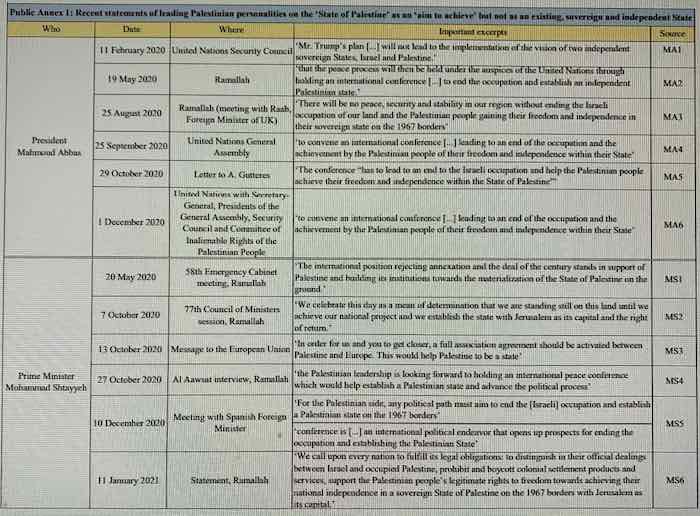
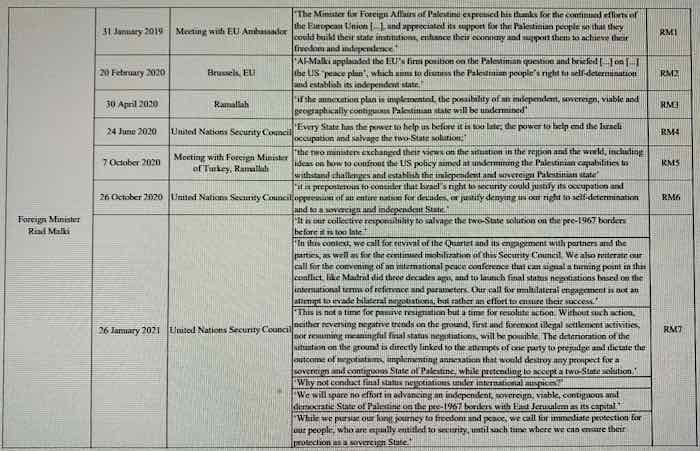
His Honour also listed the recent statements (below) of leading Palestinian personalities on the ‘State of Palestine’ as an ‘aim to achieve’ and not as an existing, sovereign and independent State.

The State of Palestine remains a United Nations mirage based on fiction—not fact.


Author’s note: The cartoon — commissioned exclusively for this article — is by Yaakov Kirschen aka “Dry Bones”- one of Israel’s foremost political and social commentators — whose cartoons have graced the columns of Israeli and international media publications for decades. His cartoons can be viewed at Drybonesblog