Mandate for Palestine - July 24, 1922

Mandate for Palestine - July 24, 1922
Jordan is 77% of former Palestine - Israel, the West Bank (Judea and Samaria) and Gaza comprise 23%.

Saturday, March 26, 2022

Jordan-PLO-Egypt negotiations with Israel could be key to peace


The Negev Summit (Summit) taking place on 27 and 28 March - hosted by Israel’s Foreign Minister Yair Lapid– could be the catalyst for promoting the beginning of direct negotiations - without preconditions - between Israel, Jordan, the Palestine Liberation Organisation (PLO) and Egypt - on the allocation of sovereignty in Judea and Samaria (West Bank) and Gaza.

Summit attendees will include:
  • US Secretary for State Antony Blinken
  • Minister of Foreign Affairs of the United Arab Emirates H.H. Sheikh Abdullah bin Zayed
  • Minister of Foreign Affairs of Bahrain Dr. Abdullatif bin Rashid Al Zayani, 
  • Minister of Foreign Affairs of Morocco Nasser Bourita, and 
  • Minister of Foreign Affairs of Egypt Sameh Shoukry.
Jordan’s Foreign Minister Ayman al-Safdi will be meeting PLO leader Mahmoud Abbas in Ramallah during the Summit. However - according to Israel’s Channel N12 - al-Safdi may join the Summit before the event is concluded. 

On March 18 Principal Deputy Spokesperson in the US State Department--Jalina Porter--had announced Blinken’s visit to the Middle East without mentioning the Summit.   

Porter articulated the Biden Administration’s views on creating a second Palestinian Arab State in former Palestine--in addition to Jordan:
... "the Biden-Harris administration believes that there should be a viable and democratic Palestinian state living in peace alongside a Jewish and democratic state. We believe that a negotiated two-state solution is the best way to resolve the Israeli-Palestinian conflict, and the administration has also made clear on numerous occasions that Israelis and Palestinians alike equally deserve to live in security, prosperity, and freedom."
Porter’s choice of the term "Israeli-Palestinian conflict" was unfortunate. 

A more appropriate term would have been the "Arab-Jewish conflict" which has been raging unresolved in former Palestine for more than 100 years - long before the terms "Israelis" and "Palestinians" were created in 1948 and 1964 respectively. 

In this long-running conflict - every word counts. 

United Nations General Assembly Resolution 181- passed in 1947 - had called for Western Palestine - today called Israel, Judea and Samaria (West Bank) and Gaza - to be partitioned into one Arab State and one Jewish State.  This area comprised 22% of the territory in the 1922 League of Nations Mandate for Palestine.  Jerusalem was to become a separate entity to be governed by a special international regime.  

The remaining 78% of former Palestine - Transjordan - today called Jordan - had already achieved its independence in 1946. This area was exclusively populated by Arabs - having been excluded from Jewish settlement in 1922 by article 25 of the Mandate for Palestine. 

The Jews accepted Resolution 181 - but it was rejected by the Arabs - resulting in the invasion of Western Palestine by the armies of six Arab States - Egypt, Syria, Transjordan, Lebanon, Saudi Arabia and Iraq. 

Transjordan conquered East Jerusalem, Judea and Samaria and unified those areas with Transjordan to form a new territorial entity - renamed Jordan in 1950 - until these areas were lost to Israel in the 1967 Six Day War.  

Egypt conquered Gaza and administered it between 1948 and 1967.  

Summit participant - Egypt’s Sameh Shoukry - held talks in Cairo three weeks ago  with Ziad Abu Amr — the Palestinian Deputy Prime Minister and PLO Executive Committee Member — and Palestinian Minister of Social Development Ahmad Majdalani. 

Shoukry then reportedly expressed the importance of continuing contact with various regional and international parties concerned in order to create the appropriate atmosphere for reviving the negotiations between the Palestinian and Israeli sides at the earliest opportunity. 

The Summit could well be creating that appropriate atmosphere which eventually sees Jordan-PLO-Egypt negotiations with Israel to finally complete the solution first contemplated in 1922 - the division of former Palestine between Arabs and Jews.

Author’s note: The cartoon — commissioned exclusively for this article — is by Yaakov Kirschen aka "Dry Bones"- one of Israel’s foremost political and social commentators — whose cartoons have graced the columns of Israeli and international media publications for decades.


Monday, March 21, 2022

Guterres dawdles as Russia-Ukraine war impacts other UN members


United Nations (UN) Secretary-General Antonio Guterres’ continuing failure to take any concrete action to help end Russia’s invasion of Ukraine has now seen that conflict threatening to seriously impact many of the other 191 member States of the UN. 

Guterres himself has warned of the problems faced by those member States: 

“This war goes far beyond Ukraine. It is also an assault on the world’s most vulnerable people and countries. While war rains over Ukraine, a sword of Damocles hangs over the global economy – especially in the developing world. Even before the conflict, developing countries were struggling to recover from the pandemic – with record inflation, rising interest rates and looming debt burdens.  Their ability to respond has been erased by exponential increases in the cost of financing. Now their breadbasket is being bombed.  Russia and Ukraine represent more than half of the world’s supply of sunflower oil and about 30 percent of the world’s wheat. Ukraine alone provides more than half of the World Food Programme’s wheat supply. Food, fuel and fertilizer prices are skyrocketing.  Supply chains are being disrupted.  And the costs and delays of transportation of imported goods – when available – are at record levels. All of this is hitting the poorest the hardest and planting the seeds for political instability and unrest around the globe. Grain prices have already exceeded those at the start of the Arab Spring and the food riots of 2007-2008. The FAO’s [UN Food and Agriculture Organization] global food prices index is at its highest level ever. Forty-five African and least developed countries import at least one-third of their wheat from Ukraine [or] Russia – 18 of those countries import at least 50 percent. This includes countries like Burkina Faso, Egypt, the Democratic Republic of the Congo, Lebanon, Libya, Somalia, Sudan and Yemen. We must do everything possible to avert a hurricane of hunger and a meltdown of the global food system.”

Guterres’ pathetic response involves:

  1. Establishing a Global Crisis Response Group on Food, Energy and Finance in the UN Secretariat – more bureaucracy – and 
  2. Allocating $40 million from the Central Emergency Response Fund to ramp up vital assistance to reach the most vulnerable as the UN waits for these nations to come begging. 

The UNGA has the power to end the conflict under UNGA Resolution 377 (V) A (1) dated 3 November 1950 – the “Uniting for Peace Resolution” - which provides: 

“That if the Security Council, because of lack of unanimity of the permanent members, fails to exercise its primary responsibility for the maintenance of international peace and security in any case where there appears to be a threat to the peace, breach of the peace, or act of aggression, the General Assembly shall consider the matter immediately with a view to making appropriate recommendations to Members for collective measures, including in the case of a breach of the peace or act of aggression the use of armed force when necessary, to maintain or restore international peace and security...” 
Use of armed force would be a last resort.  

Calling for a ceasefire or diplomatic negotiations is totally inadequate. 

Resolution 377 (V) also established a Peace Observation Commission of 14 member States - that could have been replicated  - to personally observe and report on the situation in Ukraine and pressure Russia to withdraw. 

Why hasn’t Guterres already activated such a Commission? Alleviating distress and hardship in the aftermath of conflict – rather than acting to prevent or end conflict occurring – is an abdication of the UNGA’s primary responsibility under the UN Charter.

 Guterres’ continuing inaction to try and end the Russia-Ukraine conflict is surely sowing the seeds of the UN’s and his own demise. 

Author’s note: The cartoon — commissioned exclusively for this article — is by Yaakov Kirschen aka “Dry Bones”- one of Israel’s foremost political and social commentators — whose cartoons have graced the columns of Israeli and international media publications for decades.


Tuesday, March 15, 2022

UNGA & Guterres fiddle while Ukraine & the UN Charter burn


It is incomprehensible that the United Nations General Assembly (UNGA) has held its Fifth Consultation on Our Common Agenda (Fifth Consultation) on March 10 at the same time as 2.597 million Ukrainians have been forced to flee their country which is being reduced to rubble following Russia's invasion on 24 February.  Our Common Agenda is an 85 page Report prepared by UN Secretary-General Antonio Guterres in 2021 following the seventy-fifth anniversary of the United Nations when:

"Member States agreed that our challenges are interconnected, across borders and all other divides. These challenges can only be addressed by an equally interconnected response, through reinvigorated multilateralism and the United Nations at the centre of our efforts. Member States asked me to report back with recommendations to advance our common agenda. This report is my response."

This utopian talkfest discussing Guterres' personal ego trip into fantasyland should have been postponed – using the precious time gained to formulate and recommend concrete action that can be taken by the UNGA against Russia's invasion of Ukraine - which mandates the UNGA:

"to take effective collective measures for the prevention and removal of threats to the peace, and for the suppression of acts of aggression or other breaches of the peace"

The UNGA and its Secretary-General are living in a dream world - whilst the real world is drifting dangerously towards World War III as US President Joe Biden warned on 12 March. In the midst of this worst turmoil in Europe since World War II – Guterres had the temerity to tell the Fifth Consultation:

"A multi-faceted war is raging in the heart of Europe, in violation of the United Nations Charter.  We need a serious effort to improve global governance, manage risks and safeguard the global commons and global public goods.   This is not only about the United Nations, or any other institution.   

Our Common Agenda

It is about working together to solve our biggest problems, through existing structures if they are fit for purpose, and new or reinvigorated frameworks where needed.   Failure to do so increases the likelihood that our children, or their children, are forced to rebuild the international order in the aftermath of catastrophe.   I have therefore asked my High-Level Advisory Board on Global Public Goods to provide us with concrete recommendations for improved global governance."

In Our Common Agenda – the Secretary-General had issued a call to identify and review the governance of global public goods (GPGs) and the global commons (GCs). Guterres announced the formation of a High-Level Advisory Board (HLAB) to develop an independent report in support of this objective. The report would reflect substantive research into GPGs and GC's ahead of the 2023 Summit of the Future.  GPGs are goods whose benefits cross borders and are global in scope. For example, reductions in carbon dioxide emissions that will slow global warming.  GCs describe international, supranational, and global resource domains in which common-pool resources are found - the earth's shared natural resources, such as the high oceans, the atmosphere and outer space and the Antarctic. 

The UNGA and Secretary-General Guterres have their heads and feet in the clouds pursuing Nirvana – whilst Ukraine goes up in smoke before their very eyes and they continue to do absolutely nothing to isolate Russia as an international pariah and hold Russia accountable for flagrantly violating the UN Charter. In his closing remarks to the Fifth Consultation Guterres arrogantly asserted:

"We cannot afford to be distracted or deterred from our essential work by the current crisis."

Guterres and the UNGA will receive no plaudits for this insensitive and highly offensive statement from 44 million Ukrainian citizens whose lives have become a living hell. 

Author's note: The cartoon — commissioned exclusively for this article — is by Yaakov Kirschen aka "Dry Bones"- one of Israel's foremost political and social commentators — whose cartoons have graced the columns of Israeli and international media publications for decades.


Sunday, March 6, 2022

UNGA action must now replace divisive Russia-Ukraine talkfest


United Nations (UN) Secretary-General Antonio Guterres has given credence to the oft-used statement that “Truth is always the first casualty of war”.

Addressing the media after the UN General Assembly (UNGA) had resolved by 141 votes to 5 to demand that Russia “immediately, completely and unconditionally” withdraw its military forces from Ukraine - Guterres stated:

“The General Assembly has spoken.  

As Secretary-General, it is my duty to stand by this resolution and be guided by its call.

The message of the General Assembly is loud and clear:

End hostilities in Ukraine — now.

Silence the guns — now.

Open the door to dialogue and diplomacy — now.

The territorial integrity and sovereignty of Ukraine must be respected in line with the UN Charter.

We don’t have a moment to lose.  

The brutal effects of the conflict are plain to see.

But as bad as the situation is for the people in Ukraine right now, it threatens to get much, much worse.

The ticking clock is a time bomb ... 

... Today’s resolution reflects a central truth.  

The world wants an end to the tremendous human suffering in Ukraine.  

UK Prime Minister Boris Johnson supported Guterres with this equally-misleading fatuous statement:

“Rarely has the contrast between right and wrong been so stark, 141 countries voted to condemn Putin.”

The General Assembly’s message was not that loud and clear - or as stark – as a closer analysis of the recorded votes reveals (See diagram): 


Notably:

  • The world’s two most populated countries – China and India – representing 36.1% of the world’s population - abstained from voting. 
  • 12 countries failed to vote.
  • 35 countries abstained from voting.
  • Those 47 countries abstaining or not voting represent 54.72% of the world’s population and 24.35% of the 193 member states in the United Nations.

U.S. ambassador to the U.N. - Linda Thomas-Greenfield - said before the vote:

“We believe this is a simple vote, Vote yes if you believe U.N. member states, including your own, have a right to sovereignty and territorial integrity. Vote yes if you believe Russia should be held to account for his [Putin’s] actions. Vote yes if you believe in upholding the U.N. Charter and everything this institution stands for.”

Thomas-Greenfield’s message obviously failed to resonate with those 47 abstaining or non-voting countries. 

Despite this embarrassingly-divisive vote – the UNGA can still act to protect and uphold the principles of the UN Charter by utilising that 141-5 majority to humiliate and isolate Russia whilst simultaneously supporting Ukraine in its struggle to regain its territorial sovereignty and independence.

That majority vote – if repeated – could see a range of UNGA bodies immediately established and funded by all 193 member States - including:

  • A Committee on the Exercise of the Inalienable Rights of the Ukrainian People:

To institute a programme that will enable the Ukrainian people to exercise their inalienable rights to self-determination, national independence and sovereignty without external interference; to return to their homes and property from which they have been displaced.

  • A United Nations Ukrainian Works and Relief Agency: To carry out direct relief and works programmes solely for Ukrainian refugees.
  • A Special Rapporteur to assess the human rights situation in the Occupied Ukrainian Territories, report publicly and work with governments and civil society to foster international cooperation.
  • A Special Committee to investigate Russian practices affecting the human rights of the Ukrainian People and other residents of the Occupied Ukrainian Territories
  • A United Nations Special Coordinator for the Russia-Ukraine conflict to report quarterly to the Secretary General, the General Assembly and the Security Council

The UN General Assembly and its Secretary-General now need to stop talking and start acting – or see their relevance and credibility sink from sight.

Author’s note: The cartoon — commissioned exclusively for this article — is by Yaakov Kirschen aka “Dry Bones”- one of Israel’s foremost political and social commentators — whose cartoons have graced the columns of Israeli and international media publications for decades.


Sunday, February 27, 2022

UN should use Israel-bashing model to oust Russia from Ukraine


The United Nations (UN) General Assembly needs to stop its pious bleating and move to immediately set up a network of Ukrainian-dedicated agencies to try and force Russia to end its invasion and occupation of Ukraine – adopting the same model it has established in trying to force Israel’s withdrawal from Judea and Samaria (West Bank) over the last 50 years.

The General Assembly has failed in Israel’s case – because:

  • Sovereignty remains unallocated and still in dispute between Jews and Arabs after 100 years
  • Israel has the legal right to reconstitute the Jewish National Home there pursuant to articles 6 and 25 of the League of Nations Mandate for Palestine and article 80 of the UN Charter
  • Any Israeli withdrawal can only occur after secure and recognised boundaries are fixed pursuant to UN Security Council Resolution 242.

However Russia’s invasion of the sovereign territory of another UN member state challenges the UN’s continued existence – as UN Secretary-General Assembly Antonio Guterres has pointed out: 

“It is wrong. It is against the Charter. It is unacceptable. But it is not irreversible”

Reversing Russia’s flagrant violation of the UN Charter justifies the General Assembly adopting its Israel-bashing model to establish the following Ukrainian-dedicated agencies to humiliate and bash Russia into withdrawing from Ukraine: 

  • Committee on the Exercise of the Inalienable Rights of the Ukrainian People (CEIRUP): To institute a programme that will enable the Ukrainian people to exercise their inalienable rights to self-determination, national independence and sovereignty without external interference; to return to their homes and property from which they have been displaced. 
  • Department for Political and Peacebuilding Affairs’ (DPPA) Division for Ukrainian Rights:To serve as the Secretariat of CEIRUP and provide the following core functions: 
  1. Organising the meetings of CEIRUP and its Bureau at UN Headquarters;
  2. Monitoring political and other relevant developments;
  3. Organising programmes of international meetings, conferences and CEIRUP delegation visits;
  4. Implementing a publications programme;
  5. Developing and maintaining the United Nations Information System on the Question of Ukraine (UNISUKR) and managing CEIRUP’s outreach efforts including via social media;
  6. Cooperating with civil society organizations active on the Russia-Ukraine issue;
  7. Organising an annual observance of the International Day of Solidarity with the Ukrainian People;

  • United Nations Ukrainian Works and Relief Agency:  To carry out direct relief and works programmes solely for Ukrainian refugees. 

  • Special Rapporteur: To assess the human rights situation in the Occupied Ukrainian Territories, report publicly about it, and work with governments, civil society and others to foster international cooperation.

  • Special Committee: To investigate Russian practices affecting the human rights of the Ukrainian People and other residents of the Occupied Ukrainian Territories

  • United Nations Special Coordinator for the Russia-Ukraine conflict: The Secretary-General’s Personal Representative and the focal point on the ground for UN support in all political and diplomatic efforts related to any peace process, responsible also for coordinating the activities of all UN Russia-Ukraine agencies, funds and programmes on humanitarian and development assistance to be set up to assist the Ukrainian People

These agencies will neutralise any Russian veto in the Security Council and reinforce sanctions and other decisions made by individual UN Member States to force Russia out of Ukraine.

Simultaneously the UN Human Rights Council should establish an ongoing independent, international commission of inquiry - appointed by the President of the Human Rights Council - to investigate in the Occupied Ukrainian Territories all alleged violations of international humanitarian law and all alleged violations and abuses of international human rights law by Russia leading up to and since 22 February 2022.

The UN will cease to have any credibility or relevance if the General Assembly fails to implement these measures. 


Author’s note: The cartoon — commissioned exclusively for this article — is by Yaakov Kirschen aka “Dry Bones”- one of Israel’s foremost political and social commentators — whose cartoons have graced the columns of Israeli and international media publications for decades.


Tuesday, February 22, 2022

Guterres changes course on UN Israel-PLO two-state solution


United Nations (UN) Secretary-General Antonio Guterres has had an epiphany—just four days after declaring on February 8th that there was no plan B to replace the UN-endorsed Israel-PLO two-state solution: Creating a second Arab State – in addition to Jordan—in the territory comprised in the 1922 League of Nations Mandate for Palestine.

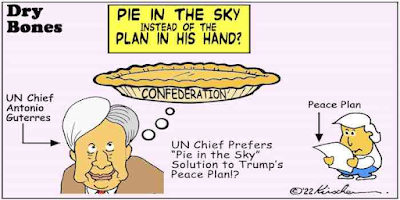
On February 12th Guterres spoke positively of a new grassroots Plan B - “The Holy Land Confederation” - creating an Israeli-Palestinian confederation - after meeting with its authors in New York.

Creation of The Holy Land Confederation involves:
  • the Palestine Liberation Organisation leadership (PLO) and the Israeli government negotiating a confederal peace agreement within one year on the future borders of the two States and on a future confederation - including its potential evolution and further stages of liberalization over another four years
  • If no confederal agreement is reached within one year then negotiations for a Peace Agreement will center on the two state solution only.
The authors of the confederation have conceded:

“No formal confederations exist today, and the few states that call themselves a “confederation” are in fact federations” (p.91)

Yet this pie in the sky, vague and nebulous confederation proposal has been deemed significant enough for Guterres to give it his endorsement.

Guterres’ spokesman Stephane Dujarric said after the February 12th meeting:

“The secretary-general received [former Israeli justice minister] Yossi Beilin and [former Palestinian negotiator] Hiba Husseini, who presented him with their report on the ‘Holy Land Confederation’ process ... He thanked them for their useful contribution to try and achieve a lasting solution to the conflict,”

The meeting with Guterres lasted just 40 minutes and included four of Guterres’ advisers. Guterres reportedly said the plan could perhaps help revive the peace process - expressing regret at the absence of negotiations.

Beilin reportedly said he asked Guterres if the confederation plan could be included in Guterres’ talking points with leaders in the region and if Guterres could help the group use the UN platform for debates and discourse on the confederation:

“He [Guterres] promised that in his talks with his interlocutors, as he said, he will raise this option of a confederation,” Beilin said, adding that separately, “for the first time after many years, [Guterres said] he can have a dialogue with the Israeli government.”

There is another – and far better - alternative plan waiting in the wings to revive the peace process and get negotiations started: The Trump-Israel-PLO-Jordan Initiative


  1. Israel and the PLO negotiate for the creation of a two-state solution on the basis of President Trump’s 2020 Peace Plan – and in default of their agreeing to do so or failing to reach agreement
  2. Israel and Jordan negotiate to redraw their current agreed international boundary designated under Clause 3(2) of the 1994 Jordan-Israel peace Treaty – based on Trump’s Plan
  3. 100% of Gaza and about 70% of Judea and Samaria (West Bank) containing 95% of its Arab population will in either scenario be internationally-recognised as being under Arab sovereignty and control.
  4. No Arab or Jew will have to leave his current home.
Israel has endorsed Trump’s Plan as a “historic opportunity” and “significant milestone” whilst the Arab League has rejected it.

The uncertainties and five year time frame involved in negotiations to establish The Holy Land Confederation stand in strong contrast to the immediate results that negotiations based on The Trump-Israel-PLO-Jordan Initiative could yield within months.

Guterres will be doing world peace a disservice if he ignores endorsing The Israel-PLO-Jordan Trump Initiative after endorsing The Holy Land Confederation proposal.

Guterres’ welcome change of course opens up a new horizon for finally resolving the 100 years old Arab-Jewish conflict.


Author’s note: The cartoon—commissioned exclusively for this article—is by Yaakov Kirschen aka “Dry Bones”- one of Israel’s foremost political and social commentators—whose cartoons have graced the columns of Israeli and international media publications for decades.

Tuesday, February 15, 2022

UN: End the jaw-jaw - use Trump to redraw the Israel-Jordan border


United Nations (UN) Secretary-General Antonio Guterres demonstrated that the UN has learnt nothing about resolving the 100 years-old Arab-Jewish conflict when he addressed the gabfest held by the UN Committee on the Exercise of the Inalienable Rights of the Palestinian People (Inalienable Rights Committee) in New York on  February 8th.

Guterres could only repeat the failed UN mantra once again:  
“The goal remains two States—Israel and an independent, democratic, contiguous, viable and sovereign Palestinian State—living side by side in peace within secure and recognized borders, on the basis of the pre-1967 lines, with Jerusalem as the shared capital of both States.  There is no plan B.”
No plan B? Is Guterres that blinkered?

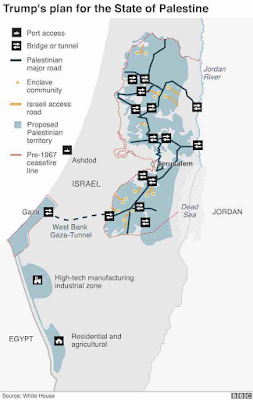
Guterres is ignoring the possibilities opened up by the most comprehensive plan ever presented for resolving this long-running conflict: President Trump’s January 28, 2020 Peace Plan (see following map) — released in the presence of Israel’s Prime Minister Netanyahu and the ambassadors from three Arab nations — Oman, the United Arab Emirates and Bahrain. 


Trump’s plan was openly embraced by Netanyahu:
“A great plan for Israel, a great plan for peace”
Palestine Liberation Organisation (PLO) leader Mahmoud Abbas refuses to negotiate with Israel on Trump’s Plan: 
“I say to Trump and Netanyahu: Jerusalem is not for sale, all our rights are not for sale and are not for bargain. And your deal, the conspiracy, will not pass,”
President Trump declared his plan: 
 “a win-win opportunity for both sides, a realistic two-state solution that resolves the risk of Palestinian statehood to Israel’s security.”
Guterres and the UN’s monolithic Jew-bashing Tower of Babble:
  • The General Assembly
  • The Security Council
  • The UN Human Rights Committee 
  • UNRWA
  • UNESCO 
  • The Inalienable Rights Committee 
  • The Fourth Committee (Special Political and Decolonization) 
  • United Nations Conciliation Commission for Palestine
  • The Working Group on the Financing of the United Nations Relief and Works Agency for Palestine Refugees in the Near East
  • Office of the United Nations Special Coordinator for the Middle East Peace Process
  • Special Rapporteur on the situation of human rights in the Palestinian territories occupied since 1967
  • Office of the United Nations High Commissioner for Human Rights 
  • United Nations Office for the Coordination of Humanitarian Affairs
  • Committee to Investigate Israeli Practices
  • Department of Political and Peacebuilding Affairs 
  • Special Committee to Investigate Israeli Practices Affecting Human Rights of Palestinian People and Other Arabs of Occupied Territories
have preferred to wring their collective hands, sit back and record the escalating violence between Arabs and Jews — issuing reams of reports condemning Israel for what is happening — yet taking no action to try and end that violence and eliminate the need for many of these voyeur groups to exist. 

The UN Security Council needs to urgently activate the following Plan B:
  • Call on Israel and the PLO to negotiate on the basis of Trump’s Plan—and in default of their agreeing to do so
  • Call on Israel and Jordan to redraw their current agreed international boundary — designated in the 1994 Jordan-Israel peace Treaty — by dividing sovereignty in Judea and Samaria (West Bank) and Gaza between their two States — based on Trump’s Plan 
About 70% of these territories will in either scenario be returned to Arab sovereignty after an absence of 55 years. No Arab or Jew will have to leave his current home.

The UN is charged under Article 1 of its own Charter: 
“To maintain international peace and security, and to that end: to take effective collective measures for the prevention and removal of threats to the peace”
Time for the UN to end the jaw-jaw and facilitate redrawing the Israel-Jordan border using Trump’s Plan. 

Author’s note: The cartoon—commissioned exclusively for this article—is by Yaakov Kirschen aka “Dry Bones”- one of Israel’s foremost political and social commentators—whose cartoons have graced the columns of Israeli and international media publications for decades.