Mandate for Palestine - July 24, 1922

Mandate for Palestine - July 24, 1922
Jordan is 77% of former Palestine - Israel, the West Bank (Judea and Samaria) and Gaza comprise 23%.
Showing posts with label China. Show all posts

Sunday, March 6, 2022

UNGA action must now replace divisive Russia-Ukraine talkfest


United Nations (UN) Secretary-General Antonio Guterres has given credence to the oft-used statement that “Truth is always the first casualty of war”.

Addressing the media after the UN General Assembly (UNGA) had resolved by 141 votes to 5 to demand that Russia “immediately, completely and unconditionally” withdraw its military forces from Ukraine - Guterres stated:

“The General Assembly has spoken.  

As Secretary-General, it is my duty to stand by this resolution and be guided by its call.

The message of the General Assembly is loud and clear:

End hostilities in Ukraine — now.

Silence the guns — now.

Open the door to dialogue and diplomacy — now.

The territorial integrity and sovereignty of Ukraine must be respected in line with the UN Charter.

We don’t have a moment to lose.  

The brutal effects of the conflict are plain to see.

But as bad as the situation is for the people in Ukraine right now, it threatens to get much, much worse.

The ticking clock is a time bomb ... 

... Today’s resolution reflects a central truth.  

The world wants an end to the tremendous human suffering in Ukraine.  

UK Prime Minister Boris Johnson supported Guterres with this equally-misleading fatuous statement:

“Rarely has the contrast between right and wrong been so stark, 141 countries voted to condemn Putin.”

The General Assembly’s message was not that loud and clear - or as stark – as a closer analysis of the recorded votes reveals (See diagram): 


Notably:

  • The world’s two most populated countries – China and India – representing 36.1% of the world’s population - abstained from voting. 
  • 12 countries failed to vote.
  • 35 countries abstained from voting.
  • Those 47 countries abstaining or not voting represent 54.72% of the world’s population and 24.35% of the 193 member states in the United Nations.

U.S. ambassador to the U.N. - Linda Thomas-Greenfield - said before the vote:

“We believe this is a simple vote, Vote yes if you believe U.N. member states, including your own, have a right to sovereignty and territorial integrity. Vote yes if you believe Russia should be held to account for his [Putin’s] actions. Vote yes if you believe in upholding the U.N. Charter and everything this institution stands for.”

Thomas-Greenfield’s message obviously failed to resonate with those 47 abstaining or non-voting countries. 

Despite this embarrassingly-divisive vote – the UNGA can still act to protect and uphold the principles of the UN Charter by utilising that 141-5 majority to humiliate and isolate Russia whilst simultaneously supporting Ukraine in its struggle to regain its territorial sovereignty and independence.

That majority vote – if repeated – could see a range of UNGA bodies immediately established and funded by all 193 member States - including:

  • A Committee on the Exercise of the Inalienable Rights of the Ukrainian People:

To institute a programme that will enable the Ukrainian people to exercise their inalienable rights to self-determination, national independence and sovereignty without external interference; to return to their homes and property from which they have been displaced.

  • A United Nations Ukrainian Works and Relief Agency: To carry out direct relief and works programmes solely for Ukrainian refugees.
  • A Special Rapporteur to assess the human rights situation in the Occupied Ukrainian Territories, report publicly and work with governments and civil society to foster international cooperation.
  • A Special Committee to investigate Russian practices affecting the human rights of the Ukrainian People and other residents of the Occupied Ukrainian Territories
  • A United Nations Special Coordinator for the Russia-Ukraine conflict to report quarterly to the Secretary General, the General Assembly and the Security Council

The UN General Assembly and its Secretary-General now need to stop talking and start acting – or see their relevance and credibility sink from sight.

Author’s note: The cartoon — commissioned exclusively for this article — is by Yaakov Kirschen aka “Dry Bones”- one of Israel’s foremost political and social commentators — whose cartoons have graced the columns of Israeli and international media publications for decades.


Tuesday, October 20, 2020

Trump/Biden China and Middle East policies need to be debated

 [Published 21 October 2020]

The Commission on Presidential Debates (CPD) failure to insist on foreign policy being top and centre of the final debate between President Trump and Joe Biden is contrary to America’s national interest and should be condemned.

The CPD self-describing itself as “non-partisan” on its web site is the very antithesis of that lofty principle.

Foreign policy goes to the heart of:
  • Maintaining America’s security,
  • Protecting US citizens against external threats and
  • Justifying billions of dollars being expended on the military annually at the expense of other worthy internal and foreign assistance demands where there is never enough money to go around.
The Trump campaign has written to the CPD blasting its decision:
“We understand that Joe Biden is desperate to avoid conversations about his own foreign policy record, especially since President Trump has secured historic peace agreements among Israel, the United Arab Emirates, and Bahrain. We recall that Biden’s former Secretary of Defense, Robert Gates, maintains that Biden has been “wrong on nearly every major foreign policy and national security issue over the past four decades.” Biden has supported endless wars and given aid and comfort to our adversaries, including Iran, which was delivered pallets loaded with mountains of cash just as four Americans were released from captivity in Tehran. Biden also has advanced the interests of China over his 47 years as a Washington politician, putting their concerns ahead of those of America workers. New information recently revealed indicates that Biden himself was mentioned as a financial beneficiary of a deal arranged by his son Hunter and a communist Chinese-related energy company. If a major party candidate for President of the United States is compromised by the Communist Party of China, this is something Americans deserve to hear about, but it is not surprising the Biden would want to avoid it. It is completely irresponsible for the Commission to alter the focus of this final debate just days before the event, solely to insulate Biden from his own history.”
Trump and Biden need to debate their very different policies on China and the Middle East.

Long before the recent emergence of Hunter Biden’s alleged email files — whose authenticity still remains undisputed — Biden’s relaxed attitude to China strongly differed from Trump’s no-nonsense confrontational approach to handling China during the last four years.

On October 23, 2019 Biden — vying for the Democratic Party Presidential nomination — said:
“We talk about China as our competitor. We should be helping and benefiting ourselves by doing that. But the idea that China is going to eat our lunch — I remember the debates in the late ’90s, remember, Japan was going to own us? Give me a break.”
The CPD decision will deny intending voters their right to know if this is still Biden’s China policy stance and the implications this has for America.

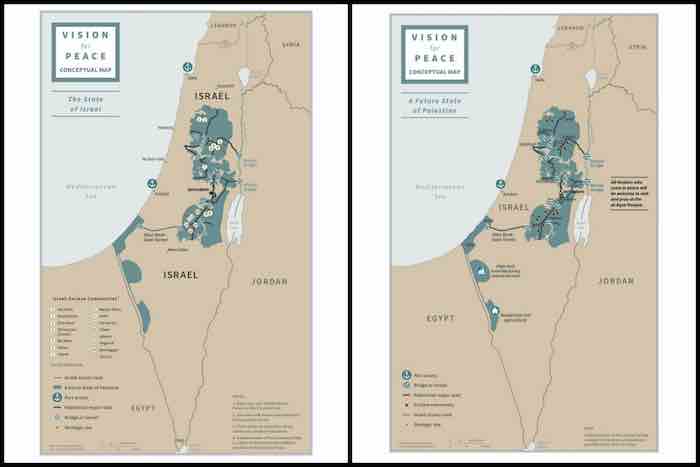
Trump’s 2020 peace plan — providing for an independent Palestinian State in Gaza and up to 70% of Judea and Samaria (West Bank) to be negotiated between Israel and the Palestine Liberation Organisation — offers a pathway to ending the 100 years unresolved conflict between Jews and Arabs.


Biden’s response:
“A peace plan requires two sides to come together. This is a political stunt that could spark unilateral moves to annex territory and set back peace even more. I’ve spent a lifetime working to advance the security & survival of a Jewish and democratic Israel. This is not the way”
CPD’s political stunt ensures Biden will escape explaining how his “way” will be better than Trump’s.

America’s voters are being taken for a ride by a highly-partisan Presidential Debates Commission.

Author’s note: The cartoon—commissioned exclusively for this article—is by Yaakov Kirschen aka “Dry Bones”- one of Israel’s foremost political and social commentators – whose cartoons have graced the columns of Israeli and international media publications for decades. His cartoons can be viewed at Drybonesblog


Sunday, February 10, 2019

Trump should reaffirm core Bush-Congress commitments to Israel


[Published 29 January 2019]


President Trump’s decision to reverse his partial US Government shutdown – the longest in history -could have important consequences for the release of his long-awaited plan to resolve the Arab-Jewish conflict – postponed yet again until after Israel’s elections in April.

Trump’s shut down – aimed at forcing Congress to negotiate on Trump’s election promises to build a wall to stop illegal immigration and drug smuggling through a porous border with Mexico – failed in the face of Congress’s unequivocal demand that Trump first reopen the Government.

Trump’s supporters are angry and confused at his cave-in to Congress’s demand whilst his detractors are jubilant - as three weeks of negotiations between Trump and Congress now try to resolve the Trump-Congress stand-off.

The Palestine Liberation Organisation (PLO) will feel vindicated – after Congresses’ resolute stance - in having refused – sight unseen - to negotiate Trump’s peace plan with Israel after Trump had recognized Jerusalem as Israel’s capital and relocated the US Embassy there from Tel Aviv.

The PLO will be emboldened to continue rejecting Trump’s proposals until Trump reverses his decisions on Jerusalem.

The Wall Street Journal on 11 November 2016 exclusively revealed President-elect Trump’s intentions to make an “ultimate deal” for “humanity’s sake” on “the war that never ends”.

The further delay in releasing his deal comes as the PLO now assumes virtual control of the United Nations General Assembly (UNGA) proceedings for 2019 - as Chairman of the 134 member Group comprising the G77 and China - ensuring a barrage of UNGA resolutions condemning Trump’s deal when published.

Trump’s attempts to woo Jordan, Egypt and possibly other Arab states to replace the PLO in negotiations with Israel remains a work in progress. Trump’s chances of now succeeding - after his surrender to Congress - appear to have diminished greatly.

The upcoming Israeli elections will give Israelis the chance to vote on the future direction Israel’s new Government should take in resolving the future of Judea and Samaria (the West Bank) and Gaza (“disputed territories”) – the last remaining 5% of the territory of the Mandate for Palestine where sovereignty still remains unallocated between Arabs and Jews.

The choices offered to Israeli voters should be explicitly spelled out by the political parties contesting the elections. The newly-elected Government’s stated policy should be implemented. This basic premise of democracy has been undermined in America as Trump’s election commitment to build his promised border wall remains unfulfilled because of Congress’ opposition.

Trump should not similarly attempt to thwart the mandate of Israel’s next Government.

Trump should shelve his long-overdue ultimate deal indefinitely - due to the changed circumstances that have demonstrably arisen since his well-intentioned thought bubble in November 2016.

Instead - Trump should:

1. Pledge his Government’s full support for Israel’s next duly elected Government

2. Reaffirm the core commitments made by President Bush to Israel's Prime Minister Ariel Sharon in Bush’s letter dated 14 April 2004 - endorsed overwhelmingly by the Congress by 502 votes to 12 ("Bush/Congress Commitments").
Those core American commitments - made to procure Israel’s unilateral withdrawal from Gaza - included:
1. Opposing any peace plan other than the 2003 Bush Roadmap

2. Being strongly committed to Israel's security and well-being as a Jewish state.

3. Not supporting any right of return by Palestinian refugees to Israel

4. Regarding as unrealistic a full and complete withdrawal from the disputed territories.
Congress could endorse this Trump initiative – reinforcing continuing bipartisan support for Israel.

Peace will remain elusive – but Trump will have saved himself from drowning in a cesspool that has swallowed previous American Presidents who believed they had the answer to ending this unresolved 100 years old conflict.

Author’s note: The cartoon — commissioned exclusively for this article — is by Yaakov Kirschen aka “Dry Bones”- one of Israel’s foremost political and social commentators — whose cartoons have graced the columns of Israeli and international media publications for decades. His cartoons can be viewed at Drybonesblog

Thursday, October 25, 2018

Jordan and Israel: Trump's only viable two-state solution


[Published 24 October 2018]


Four major developments in the past week have heightened expectations that President Trump will have no option but to call on Jordan and Israel to negotiate the allocation of sovereignty between their two respective States in the West Bank and Gaza — 5% of the territory comprised in the 1922 League of Nations Mandate for Palestine (Mandate).

Jordan and Israel are the two successor States to the Mandate currently exercising sovereignty in the other 95% of the Mandate territory — Jordan 78%, Israel 17%.

Jordan-Israel negotiations — if successfully concluded — would complete the two-state solution first contemplated under article 25 of the Mandate. Arab and Jewish claims to the Mandate territory would be finally resolved.

These four developments were:
1.The G77 and China — comprising 135 of the 193 United Nations member states — appointed the non-existing “State of Palestine” as Chairman of the G77 for 2019 and procured the passage of a United Nations General Assembly Resolution giving this phantom “State of Palestine” the right to:
(a) Make statements on behalf of the Group of 77 and China, including among representatives of major groups;
(b) Submit proposals and amendments and introduce them on behalf of the Group of 77 and China;
(c) Co-sponsor proposals and amendments;
(d) Make explanations of vote on behalf of the States Members of the United Nations that are members of the Group of 77 and China;
(e) Reply regarding positions of the Group of 77 and China;
(f) Raise procedural motions, including points of order and requests to put proposals to the vote, on behalf of the Group of 77 and China.
US Ambassador to the UN — Nikki Haley - re-iterated America’s long-standing position:
“The United States does not recognize a Palestinian state, notes that no such state has been admitted as a UN Member State, and does not believe that the Palestinians are eligible to be admitted as a UN Member State.”

The PLO has chosen the United Nations fantasyland to push its agenda in preference to negotiating with Israel under Trump’s proposed plan — simultaneously rejecting the Montevideo Convention requirements necessary for statehood in international law.

11 other UN member states embraced this nonsensical resolution, whilst the remaining 47 voted: Against (3), Abstained (15), or Did Not Vote (29).

2. US Secretary of State — Mike Pompeo — announced that the U.S. Embassy Jerusalem and U.S. Consulate General Jerusalem would be merged into a single diplomatic mission.

This was Trump’s response to the UN’s embrace of the “State of Palestine”.

3. President Trump sent World Jewish Congress President Ronald Lauder as his personal envoy to Jordan.

Lauder’s visit reportedly occurred without the knowledge of Israel or Trump’s Special Middle East Negotiators - Jared Kushner and Jason Greenblatt.

Jordan received $690 million in US aid in 2018 — to be boosted by a 27% increase for each of the next five years. Lauder would have reminded Jordan’s King Abdullah that Trump’s policy could see this aid reduced if Jordan refuses to negotiate with Israel.

4. King Abdullah gave Israel twelve months’ notice of Jordan’s intention to not renew twenty-five year leases of two areas denoted as “Special Regimes” in the Israel-Jordan peace Treaty.

Israel is entitled to request that consultations be entered into — as Israel undoubtedly will — since Israeli private land ownership rights and property interests are affected in one area and Israeli private land use rights in the other.

These Special Regimes would become important bargaining chips in Jordan—Israel negotiations on the West Bank and Gaza over the next 12 months.

Any Trump peace proposal not requiring direct Jordan—Israel negotiations will be dead in the water from the get-go.

Author’s note: The cartoon—commissioned exclusively for this article—is by Yaakov Kirschen aka “Dry Bones”- one of Israel’s foremost political and social commentators— whose cartoons have graced the columns of Israeli and international media publications for decades. His cartoons can be viewed at Drybonesblog
Thursday, September 13, 2018

Trump exposes United Nations hypocrisy on PLO, Hamas and Israel


[Published 25 July 2018]


President Trump has challenged United Nations (UN) member States to put their money where their mouths are in a hard hitting speech delivered by US Permanent Representative to the UN - Ambassador Nikki Haley – at a UN Security Council Open Debate on the Middle East on 24 July.

Following Trump’s recent dressing down of NATO – Haley attacked UN member States who are full of words but short on money when it comes to supporting the Palestinian Arabs.

Haley did not mince her words:
"Here at the UN, thousands of miles away from Palestinians who do have real needs, there is no end to the speeches on their behalf. Country after country claims solidarity with the Palestinian people. If those words were useful in the schools, the hospitals, and the streets of their communities, the Palestinian people would not be facing the desperate conditions we are discussing here today. Talk is cheap.

No group of countries is more generous with their words than the Palestinians’ Arab neighbors, and other OIC [Organisation of Islamic Cooperation – ed.] member states. But all of the words spoken here in New York do not feed, clothe, or educate a single Palestinian child. All they do is get the international community riled up."

Haley used members’ contributions to UNRWA to prove her case:
Last year, Iran’s contribution to UNRWA was zero. Algeria’s contribution to UNRWA was zero. Tunisia’s contribution to UNRWA was zero.

Other countries did provide some funding. Pakistan gave $20,000. Egypt gave $20,000. Oman gave $668,000.

Haley did not spare non-Arab and non-Islamic countries from similar naming and shaming:
Other countries talk a big game about the Palestinian cause. In 2017, China provided 350,000 to UNRWA. Russia provided two million dollars to UNWRA.

Haley contrasted America’s generosity:
Last year … the United States gave 364 million dollars… And that’s on top of what the American people give annually to the Palestinians in bilateral assistance. That is another 300 million dollars just last year, and it averages to more than a quarter of a billion dollars every year since 1993.

Haley delivered this stern warning:
“But we are not fools. If we extend a hand in friendship and generosity, we do not expect our hand to be bitten. And as we extend our hand, we also expect others to extend their hands as well.”

Haley emphasised that Arab countries’ giving more money was not the only issue confronting them:
Too often, the Arab countries give just enough money and mouth just enough uncompromising words to stay out of the crosshairs of Palestinian representatives. But if they really cared about the Palestinian people, they would not do that. Instead, they would condemn extremism and they would put forth serious ideas for compromises that could end this struggle and lead to a better life for the Palestinian people. They would tell the Palestinian leadership how foolish they look for condemning a peace proposal [Trumps’ “ultimate deal” – ed.] they haven’t even seen yet.

Haley called out both the PLO and Hamas:
The Palestinian leadership has been allowed to live a false reality for too long because Arab leaders are afraid to tell them the truth… It is time for the regional states in particular to step up and really help the Palestinian people, instead of just making speeches thousands of miles away.

Those regional States - Egypt, Jordan Syria and Lebanon – can help by sitting down with Israel and negotiating an end to the 100-years old Arab-Jewish conflict as prescribed 51 years ago by UN Security Council Resolution 242.

Delivering this message to the UN has been long overdue.

Monday, March 20, 2017

UN Security Council members trash Quartet Roadmap and Two-State Solution


[Published 18 January 2017]


Twelve of the fifteen members of the United Nations Security Council have apparently had a major rethink on the terms of Resolution 2334 which they approved 14-0 on 23 December 2016 with only America abstaining.

They were among those who issued the Joint Declaration following the Paris Conference held on 15 January — attended by delegations from 70 countries, the United Nations, the European Commission, the European Union, the Arab League and the Organisation of Islamic Cooperation.

Thirteen of the fifteen Security Council member States were in Paris including its five Permanent Members — China, France, Russia, United Kingdom and United States.

Absent were New Zealand and Malaysia — two of the four sponsors of Resolution 2334.

The Joint Declaration differs substantially from Resolution 2334 in three fundamental respects:
1. Resolution 2334 envisages a region where:
“two democratic States, Israel and Palestine, live side by side in peace within secure and recognized borders,”
The Joint Declaration shredded this objective by affirming:
“that a negotiated solution with two states, Israel and Palestine, living side by side in peace and security, is the only way to achieve enduring peace.”
The “two democratic states solution” in Resolution 2334 was replaced by a vague and nebulous “two state solution” in the Joint Declaration. Gone were "secure and recognised boundaries".

2. Resolution 2334 aims to achieve:
“without delay a comprehensive, just and lasting peace in the Middle East on the basis of the relevant United Nations resolutions, the Madrid terms of reference, including the principle of land for peace, the Arab Peace Initiative and the Quartet Roadmap and an end to the Israeli occupation that began in 1967”
The Joint Declaration more specifically calls for the resolution of:
“all permanent status issues on the basis of United Nations Security Council resolutions 242 (1967) and 338 (1973),”
The Quartet Roadmap - so painstakingly put together in 2003 by President Bush calling for negotiations to create a democratic Palestinian State — and under which negotiations had been conducted since then - was unceremoniously dumped in Paris.

This leaves no agreed negotiating framework under which to conduct any resumed negotiations.

3. Resolution 2234 underscored:
“the importance of the ongoing efforts to advance the Arab Peace Initiative,”
The Joint Declaration underscored:
“the importance of the Arab Peace Initiative of 2002 as a comprehensive framework for the resolution of the Arab-Israeli conflict, thus contributing to regional peace and security.”
Israel had agreed to negotiate under the Quartet Roadmap but listed 14 reservations — one of which required:
“The removal of references other than 242 and 338 (1397, the Saudi Initiative and the Arab Initiative adopted in Beirut). A settlement based upon the road map will be an autonomous settlement that derives its validity therefrom. The only possible reference should be to Resolutions 242 and 338, and then only as an outline for the conduct of future negotiations on a permanent settlement.”
Replacing the Quartet Roadmap with the Arab Peace Initiative guarantees no hope for the stalled negotiations to be resumed.

The United Kingdom refused to endorse the Joint Declaration.

It is incredible that the other twelve Security Council member States present — especially the five permanent members - could approve the terms of the Joint Declaration that so materially changes what they voted for or abstained on just three weeks earlier.

They obviously engaged in cherry picking bits and pieces of Resolution 2334 that they had rushed through with unseemly haste and now had second thoughts on.

A new agreed negotiating framework for any two-State solution now needs to be constructed to replace the trashed Quartet Roadmap.

The Security Council looks decidedly stupid and increasingly irrelevant.

Wednesday, July 13, 2016

China Can Exploit United Nations Double Standards On Palestine


[Published 14 July 2016]


International support for the Palestine Liberation Organisation (PLO) - despite its rejection of the 1922 League of Nations Mandate for Palestine and article 80 of the United Nations Charter – could be exploited by China to blunt international action following an unfavourable ruling by the Permanent Court of Arbitration against China in The Hague.

Having boycotted those proceedings - Chinese President Xi Jinping then immediately dismissed the decision – which denied China had any legal basis to claim historic rights to the bulk of the South China Sea:
"China will never accept any claim or action based on those awards”

His rejection was as peremptory as that of the PLO – which declared in Article 18 of its original 1964 Charter:
“The Balfour Declaration, the Mandate system and all that has been based upon them are considered fraud.”

This position was revised when the Charter was redrafted in 1968 – article 20 declaring:
“The Balfour Declaration, the Mandate for Palestine, and everything that has been based upon them, are deemed null and void.”

These provisions have been a major contributing factor in preventing a resolution of the Jewish-Arab conflict for the last 52 years.

The international community has not punished the PLO for its unilateral demolition of these international-law building blocks but to the contrary has granted the PLO diplomatic recognition whilst also welcoming the PLO into the United Nations.

Should China be demonised because it also chooses to ignore a determination in international law that it regards as inimical to its national interest?

Does size matter? Can one forgive small players who wilfully shred international law but demand big players conform to legal decisions not to their liking?

The international community has some serious soul-searching to do.

Vietnam may now be ruing its welcoming embrace of the PLO by:
•Establishing ties with the PLO in 1968
•Allowing the PLO to open its resident Representative Office in Vietnam in 1976
•Elevating the PLO's resident Representative Office to the status of Embassy in 1982
Clearly concerned by China’s response to The Hague decision – Vietnam’s Foreign Ministry spokesman Le Hai Binh has declared:
"Vietnam strongly supports the resolution of the disputes ... by peaceful means, including diplomatic and legal processes and refraining from the use or threats to use force, in accordance with international law,"

That response is what one would normally expect – but when you have not demanded the same of the PLO for the last 48 years then such statement amounts to an indefensible double standard.

Other countries vitally affected by the South China Sea ruling include the Philippines – the plaintiff in The Hague proceedings - Japan, Malaysia and Indonesia. They may find their long-standing ties with the PLO similarly embarrassing as they confront an angry China.

China on the other hand can argue that rejecting the South China Sea judgement is consistent with China’s recognition of the law-trashing PLO in 1988 – since International law means nothing to China and the PLO.

The Hague ruling is regarded as legally binding – but there is apparently no mechanism to enforce it.

Boycott Divestment and Sanctions programs against China will have little effect.

Rejecting China’s claim to any historic rights in the South China Sea stands in stark contrast to the acceptance of Jewish historic rights to reconstitute the Jewish National Home in Judea and Samaria (the West Bank) – recognised by the Mandate for Palestine and article 80 of the UN Charter – but erroneously claimed by the UN Security Council to be in violation of international law.

Double standards in the international community have a horrible way of coming back to bite those indulging in such dangerous games.

Friday, June 10, 2016

Syria - End The Diplomatic Doublespeak, Start Getting Serious


[Published 20 February 2016]


The deadline for a ceasefire in Syria by 19 February has passed with no indication that it will be achieved at any time in the foreseeable future.

Hopes for that ceasefire were high after the UN Security Council had unanimously passed Resolution 2254 on 18 December 2015 requesting:
“the Secretary-General to lead the effort, through the office of his Special Envoy and in consultation with relevant parties, to determine the modalities and requirements of a ceasefire as well as continue planning for the support of ceasefire implementation, and urges Member States, in particular members of the ISSG, to support and accelerate all efforts to achieve a ceasefire, including through pressing all relevant parties to agree and adhere to such a ceasefire;”

The ISSG mentioned in the Resolution is the International Syria Support Group – comprising the Arab League, China, Egypt, the EU, France, Germany, Iran, Iraq, Italy, Jordan, Lebanon, the Organisation of Islamic Cooperation, Oman, Qatar, Russia, Saudi Arabia, Turkey, United Arab Emirates, the United Kingdom, the United Nations, and the United States.

ISSG has proved totally ineffective in ending the five year conflict in Syria that has seen more than 300000 deaths and seven million Syrians internally displaced or fleeing to neighbouring States and swamping Europe to escape the horrific carnage unleashed in Syria during that time.

Islamic State was spawned in Syria and Iraq in July 2014 and now occupies more land than the area of Great Britain. Together with Al Nusra Front - a Syria-based Sunni extremist group that adheres to the global jihadist ideology of al-Qa’ida - both have been declared terrorist organisations by the UN Security Council.

Meeting in Munich on 12 and 13 February the ISSG members agreed that:
“The UN shall serve as the secretariat of the ceasefire task force. The cessation of hostilities will commence in one week, after confirmation by the Syrian government and opposition, following appropriate consultations in Syria.

During that week, the ISSG task force will develop modalities for the cessation of hostilities. The ISSG task force will, among other responsibilities continue to: a) delineate the territory held by Daesh [Islamic State], ANF [Al Nusra Front] and other groups designated as terrorist organisations by the United Nations Security Council; b) ensure effective communications among all parties to promote compliance and rapidly de-escalate tensions; c) resolve allegations of non-compliance; and d) refer persistent non-compliant behaviour by any of the parties to ISSG Ministers, or those designated by the Ministers, to determine appropriate action, including the exclusion of such parties from the arrangements for the cessation of hostilities and the protection it affords them.”

Meaningless gobbledygook.

The ISSG task force failed to meet once during that critical seven day period.

Whilst the UN and the ISSG task force mumbles, fumbles and stumbles – the carnage continues - as the ISSG members remain divided between those supporting Syria’s President Assad retaining power and those seeking his removal.

The ISSG is hopelessly conflicted and needs to adopt a different approach to begin ending the suffering of the Syrian people.

All ISSG members unanimously agree that Islamic State and Al Nusra Front represent a grave threat to world peace and security.

Russia, America, China, France and the United Kingdom – the five permanent members of the Security Council and all ISSG members - need to combine their diplomatic power to procure the passing of an unequivocal and unambiguous Security Council Resolution establishing a UN military force to confront and defeat Islamic State and Al Nusra Front.

Until these enemies are comprehensively defeated – all else is diplomatic doublespeak and a complete waste of time in ending the conflict in Syria.

Monday, May 16, 2016

Security Council Permanent Members Herald Armed Action Against Islamic State


[Published 3 November 2015]


An international conference in Vienna on 30 October — attended by all five Permanent Members of the UN Security Council — America, China, France, Russia and the United Kingdom - has made an important breakthrough towards defeating the Islamic State and ending the conflict in Syria and Iraq.

Together with Egypt, the EU, Germany, Iran, Iraq, Italy, Jordan, Lebanon, Oman, Qatar, Saudi Arabia, Turkey, United Arab Emirates and the United Nations — the Permanent Members reached a mutual understanding that
“Da’esh (Islamic State), and other terrorist groups, as designated by the U.N. Security Council, and further, as agreed by the participants, must be defeated."

This is the first time the five Permanent Members have reached such a consensus — acknowledging that prior measures not involving the use of armed force under Security Council Resolutions 2170 and 2178 have failed to defeat the Islamic State and other designated terrorist groups — a prerequisite before there can be any hope of restoring stability and reaching lasting political solutions in Syria and Iraq.

International co-operation to defeat the Islamic State through a Security Council Resolution authorising the use of armed force had previously risked being vetoed by either Russia or America in the face of earlier American objections against co-operating with any armed force which included President Assad’s troops.

Russia’s Foreign Minister — Sergei Lavrov - had declared as recently as 29 September.
“We think it is an enormous mistake to refuse to cooperate with the Syrian government and its armed forces, who are valiantly fighting terrorism face to face. We should finally acknowledge that no one but President Assad’s armed forces and Kurds militias are truly fighting the Islamic State and other terrorist organizations in Syria.”

However speaking at a joint press conference with US Secretary of State — John Kerry - after the historic Vienna meeting - Lavrov made an important concession to America’s stance of non-co-operation with Assad - opening the way for the passage of a Security Council Resolution authorising the use of armed force under article 42 of Chapter VII of the UN Charter:
“Russia is committed to fighting terrorism based on the solid basis of international law, whether we’re talking about the military interventions from air or the ground operations. These need to be conducted in agreement with the [Assad] government or with the UN Security Council.”

Lavrov signalled an early end to the current separate American-led coalition and Russian-Iranian interventions in Syria aimed at defeating Islamic State:
“I believe that neither the U.S. nor Russia want to go back to the so-called proxy war, but the fact that this situation makes the cooperation between the militaries ever more important is very apparent to me. We have a common enemy and we need to make sure that this enemy does not come to power in Syria or in any other country.”

Agreement by the five Permanent Security Council Members calling for armed action by air, sea and land forces against Islamic State and other designated terrorist groups has now become a distinct possibility — meeting President Obama’s preferred position as expressed by him on 6 September 2013:
“And I respect those who are concerned about setting precedents of action outside of a U.N. Security Council resolution. I would greatly prefer working through multilateral channels and through the United Nations to get this done.”
The Vienna participants reconvene within the next ten days to continue their crucial discussions.

Hopefully they will agree on pursuing the long-awaited and elusive Security Council Resolution authorising armed action - with the long-suffering Syrian people being its ultimate beneficiaries after five horrific years of war, 250000 deaths and millions being internally displaced and externally dispersed.

Monday, March 21, 2016

Iran Deal Presages UN Military Action Against Islamic State


[Published 24 July 2015]


China, France, Germany, Russia, the United Kingdom, America and the European Union (E3/EU+3) — the Septet — have shown a rare degree of international cooperation in signing the Joint Comprehensive Plan of Action (JCPOA) with Iran aimed at limiting Iran’s nuclear horizons.

Such unanimity presages the possibility of a United Nations Security Council Resolution under Chapter VII of the UN Charter authorizing military action against Islamic State — already declared a threat to international peace and security in Security Council Resolutions 2170 and 2199.

The Security Council’s inability to commence military action to free vast tracts of Syria and Iraq and its captive civilian populations from Islamic State rule — has been frustrated by the following conflicting national interests of Septet members and Iran:
1. Russia and Iran backing the Assad regime in Syria

2. America, France, Germany and the United Kingdom forming part of the London 11 supporting rebels attempting to overthrow the Assad regime

3. China and Russia vetoing Security Council resolutions aimed at resolving the Syrian conflict.

4. Shiite Iran — backed by Russia - focusing on preserving its interests in Iraq - the first Arab country to be ruled by a Shia government since Saladin overthrew the Fatimids in Egypt in 1171.
Preserving these competing interests could explain the deliberate and extraordinary decision by the Septet to not demand changes in Iraq’s current aggressive and hostile behaviour — as President Obama’s remarks at a news conference hailing the JPCOA make clear:
“And my hope is that building on this deal, we can continue to have conversations with Iran that incentivize them to behave differently in the region, to be less aggressive, less hostile, more cooperative, to operate the way we expect nations in the international community to behave. But we’re not counting on it."

So this deal is not contingent on Iran changing its behavior. It’s not contingent on Iran suddenly operating like a liberal democracy. It solves one particular problem, which is making sure they don’t have a bomb. And the point I’ve repeatedly made and I believe is hard to dispute is that it’ll be a lot easier for us to check Iran’s nefarious activities, to push back against the other areas where they operate contrary to our interests or our allies’ interests if they don’t have the bomb.

And — and so will they change their behavior? Will we seek to gain more cooperation from them in resolving issues like Syria or what’s happening in Iraq, to stop encouraging Houthis in Yemen, we’ll continue to engage with them.

Although keep in mind that unlike the Cuba situation, we’re not normalizing diplomatic relations here. So the contacts will continue to be limited, but will we try to encourage them to take a more constructive path? Of course. But we’re not betting on it. And in fact, having resolved the nuclear issue, we will be in a stronger position to work with Israel, work with the Gulf countries, work with our other partners, work with the Europeans to bring additional pressure to bear on Iran around those issues that remain of concern.”

Iran - diplomatically unscathed, emboldened and financially enriched once the current international sanctions omelette has been unscrambled — will not change its behaviour — nor will the Septet members have to abandon their perceived national interests.

Iran’s macabre dance with death will assuredly continue in the Middle East.

Obama could be betting this latest show of Septet-Iranian co-operation will finally procure Security Council approval to destroy their common enemy - Islamic State — which Obama’s American-led coalition of 62 States has spectacularly failed to accomplish.

Hopefully Obama’s giant gamble pays this huge dividend.

Tuesday, March 8, 2016

Netanyahu Puts Behaviour Change By Iran On Negotiating Agenda


[Published 9 March 2015]


Israeli Prime Minister Benjamin Netanyahu – addressing the American Congress - has made behaviour change by Iran an essential pre-requisite to the successful conclusion of negotiations between Iran and the P5+1 – France, Germany, United Kingdom, China, Russia and the United States.

Those negotiations - designed to curb Iran procuring a nuclear bomb - have a deadline expiring on March 24.

The threat Iran’s behaviour poses to peace and security in the Middle East and the world’s oil supply was starkly laid out by Netanyahu:
"Iran’s goons in Gaza, its lackeys in Lebanon, its revolutionary guards on the Golan Heights are clutching Israel with three tentacles of terror. Backed by Iran, Assad is slaughtering Syrians. Back[ed] by Iran, Shiite militias are rampaging through Iraq. Back[ed] by Iran, Houthis are seizing control of Yemen, threatening the strategic straits at the mouth of the Red Sea. Along with the Straits of Hormuz, that would give Iran a second choke-point on the world’s oil supply."

Iran’s past attacks on Americans did not escape Netanyahu’s notice:
"Iran took dozens of Americans hostage in Tehran, murdered hundreds of American soldiers, Marines, in Beirut, and was responsible for killing and maiming thousands of American service men and women in Iraq and Afghanistan".
Netanyahu spelled out Iran’s ever-increasing quest for domination and influence outside its own national borders:
"In the Middle East, Iran now dominates four Arab capitals, Baghdad, Damascus, Beirut and Sanaa. And if Iran’s aggression is left unchecked, more will surely follow"

So, at a time when many hope that Iran will join the community of nations, Iran is busy gobbling up the nations.
Netanyahu warned against the P5+1 agreeing to any 10 year moratorium on Iran gaining a nuclear bomb - without imposing strict conditions requiring an end to such behaviour by Iran:
"Iran could get to the bomb by keeping the deal. Because virtually all the restrictions on Iran’s nuclear program will automatically expire in about a decade.

Now, a decade may seem like a long time in political life, but it’s the blink of an eye in the life of a nation. It’s a blink of an eye in the life of our children.
We all have a responsibility to consider what will happen when Iran’s nuclear capabilities are virtually unrestricted and all the sanctions will have been lifted. Iran would then be free to build a huge nuclear capacity that could produce many, many nuclear bombs."

Netanyahu’s solution to preventing this catastrophe occurring requires Iran meeting three conditions in any concluded negotiations – each enthusiastically endorsed by a standing ovation from the Congress as Netanyahu declared:
"First, stop its aggression against its neighbors in the Middle East. 


Second, stop supporting terrorism around the world.


And third, stop threatening to annihilate my country, Israel, the one and only Jewish state."

Behaviour change by Iran has thus been firmly put on the negotiating agenda – and overwhelmingly endorsed by the Congress – with Netanyahu warning:
"If the world powers are not prepared to insist that Iran change its behavior before a deal is signed, at the very least they should insist that Iran change its behavior before a deal expires.

If Iran changes its behavior, the restrictions would be lifted.

If Iran doesn’t change its behavior, the restrictions should not be lifted.


If Iran wants to be treated like a normal country, let it act like a normal country"

Significantly Netanyahu stressed that these three conditions would represent:
"A better deal that Israel and its neighbors may not like, but with which we could live, literally".

The P5+1 must ensure that Iran abandons its belligerent behaviour – or terminate the negotiations.

Tuesday, February 23, 2016

Pope Calls On World To End Islamic State Barbarism


[Published 6 December 2014]


Pope Francis has considerably upped the ante in enlisting spiritual leader of the world’s Orthodox Christians - Ecumenical Patriarch Bartholomew I — to sign a joint Common Declaration demanding an end to international indifference regarding Islamic State barbarism being perpetrated against religious minorities in Syria and Iraq.

The Common Declaration constitutes an impassioned plea on behalf of 1.2 billion Catholics and 300 million Orthodox Christians world-wide for concerted international action to eradicate Islamic State.

Whilst two seemingly indifferent Permanent UN Security Council members - Russia and China — and another 129 member States of the UN stand on the sidelines - an American-led coalition comprising the remaining 62 UN member States has been doing the heavy lifting confronting Islamic State outside United Nations authorisation — prompting the Pope and Bartholomew to declare:
“While recognizing the efforts already being made to offer assistance to the region, at the same time, we call on all those who bear responsibility for the destiny of peoples to deepen their commitment to suffering communities, and to enable them, including the Christian ones, to remain in their native land. We cannot resign ourselves to a Middle East without Christians who have professed the name of Jesus there for two thousand years. Many of our brothers and sisters are being persecuted and have been forced violently from their homes. It even seems that the value of human life has been lost, that the human person no longer matters and may be sacrificed to other interests. And, tragically, all this is met by the indifference of many.”

The Pope and Bartholomew have demanded this shocking state of affairs be met by:
“an appropriate response on the part of the international community.”

No nation should shirk from its duty to eradicate the threat Islamic State poses to the breakdown of world peace and security.
“The grave challenges facing the world in the present situation require the solidarity of all people of good will,”

Islamic State needed to be confronted by Muslims and Christians together:
“Inspired by common values and strengthened by genuine fraternal sentiments, Muslims and Christians are called to work together for the sake of justice, peace and respect for the dignity and rights of every person, especially in those regions where they once lived for centuries in peaceful coexistence and now tragically suffer together the horrors of war”

In a further pointed criticism of Russia — the Declaration stated:
“We also remember all the people who experience the sufferings of war. In particular, we pray for peace in Ukraine, a country of ancient Christian tradition, while we call upon all parties involved to pursue the path of dialogue and of respect for international law in order to bring an end to the conflict and allow all Ukrainians to live in harmony.”

The grim situation facing Christians in Iraq has been confirmed in a video released on the Orthodox Christian Network by Canon Andrew White - the Vicar of Baghdad.

Canon White — who was ordered to leave Iraq for his own safety by the Archbishop of Canterbury — speaks movingly of the plight of Christians there. Around 250,000 have been displaced by Islamic State in the north of the country - all that remained from the 1,500,000-strong Christian population.

He said:
“Things were bad in Baghdad, there were bombs and shootings and our people were being killed, so many of our people fled back to Nineveh, their traditional home. It was safer, but then one day, ISIS — Islamic State. They came in and they hounded all of them out. They killed huge numbers, they chopped their children in half, they chopped their heads off, and they moved north and it was so terrible what happened.”

Islamic State forced Christians to convert to Islam on pain of death—Canon White added.

He told of the fate of a group of Christian young people:
“Islamic State turned up and said to the children, you say the words that you will follow Mohammed. The children, all under 15, four of them, said no, we love Yesua, we have always loved Yesua, we have always followed Yesua, Yesua has always been with us. They said, ‘Say the words.’ They said, ‘No, we can’t.’ They chopped all their heads off. How do you respond to that? You just cry.”

Meanwhile US Secretary of State — John Kerry — was depressingly telling a meeting of the US led coalition that the limited military action being undertaken against Islamic State could see the Coalition’s commitment being:
“measured most likely in years…”

Kerry however left no doubt on the Coalition’s mission:
“Our coalition does not summon hate, but rather the courage to build a future that is based on shared interests, shared values, and a shared faith in one another.That contrast in goals marks the dividing line between barbarism and civilization, and it explains both why we dare not fail and why we will succeed.”

The dividing lines have been drawn - demanding that every member state of the United Nations declares on which side it stands and what it will contribute towards eliminating Islamic State.

The international community needs to shed its present indifference and unanimously take up the call of the Pope and Bartholomew to put an end to the horrors represented by the Islamic State and those who are flocking to fight under its flag.

Time to end this reprehensible international indifference — and time to stop crying.

Monday, February 22, 2016

Islamic State - Pope Calls For International Consensus


[Published 28 November 2014]


Pope Francis has made public his thoughts on the action necessary to counter Islamic State.

Speaking to Vatican Radio after his return from a visit to the EU parliament in Strasburg, he said:
“I never say all is lost, never. Maybe there cannot be a dialogue but you can never shut a door. It is difficult, one could say almost impossible, but the door is always open.”

Responding to a question about whether or not it would be possible to communicate with rather than fight the militants, the Pope said:
“I repeat what I have said: when you want to stop an unjust oppressor, you must do so with international consensus.”

Since dialogue is realistically impossible — only an international consensus expressed in a Security Council resolution under Chapter V11 of the United Nations Charter can achieve the Pope’s clearly enunciated position.

So far two Security Council Resolutions have been passed — Resolution 2170 adopted on 15 August and Resolution 2178 adopted on 24 September

These two Resolutions were passed under the provisions of Article 41 of the UN Charter:
"The Security Council may decide what measures not involving the use of armed force are to be employed to give effect to its decisions, and it may call upon the Members of the United Nations to apply such measures. These may include complete or partial interruption of economic relations and of rail, sea, air, postal, telegraphic, radio, and other means of communication, and the severance of diplomatic relations."

Neither Resolution has acted as a brake to stop Islamic State in its tracks — let alone bring about its downfall.

An American led coalition has undertaken military intervention in Syria and Iraq to degrade and destroy Islamic State but its objectives have not succeeded by any stretch of the imagination.

The State Department has announced that over 60 coalition partners have committed themselves to the goals of eliminating the threat posed by Islamic State and had already contributed in various capacities to the effort to combat Islamic State in Iraq, the region and beyond.

The State Department outlined five areas of possible involvement by coalition members as formulated by Secretary of State John Kerry and recently resigned Secretary of Defence Chuck Hagel:
1. Providing military support ;
2. Impeding the flow of foreign fighters;
3. Stopping Islamic State financing and funding;
4. Addressing humanitarian crises in the region; and
5. Exposing Islamic State’s true nature.

Not all coalition partners have participated in the countless aerial bombing attacks on Islamic State forces.

As at 6 November Australian fighter jets had flown 144 missions against Islamic State and dropped twenty-five 500-pound laser and GPS-guided bombs on 14 ISIL targets, with 11 destroyed and three damaged.

Belgium, France, Netherlands, Canada and the United Kingdom have also been involved in aerial strikes against Islamic State fighters.

However the two notable omissions from this international coalition ranged against Islamic State are China and Russia — both members of the Security Council holding the power to veto any stronger action by the Security Council up to now.

Such action is becoming increasingly urgent as an unknown number of foreign fighters flock to join Islamic State and a pledge of allegiance has been made by Ansar Beit Al-Maqdis— a Jihadi based organisation based in the Sinai Peninsula.

Islamic State head Abu Bakr al-Baghdadi declared on November 10:
“We announce to you the expansion of the Islamic State to new countries, to the countries of the Haramayn [Saudi Arabia], Yemen, Egypt, Libya and Algeria,”

Baghdadi claimed them as new provinces under Islamic State.

This may indeed be all propaganda — but the Pope has clearly shown his concern.

The only real basis for international consensus rests on the Security Council passing a resolution under Article 42 of the UN Charter:
"Should the Security Council consider that measures provided for in Article 41 would be inadequate or have proved to be inadequate, it may take such action by air, sea, or land forces as may be necessary to maintain or restore international peace and security. Such action may include demonstrations, blockade, and other operations by air, sea, or land forces of Members of the United Nations."

A Papal plea made directly to China and Russia to join in drafting a resolution under Section 42 could just prove to be the catalyst to persuade these two recalcitrant nations into authorizing military action under the United Nations Charter against Islamic State.

Having supported Security Council Resolutions 2170 and 2178 — China and Russia now need to go that extra mile to defeat what they have already declared to be a grave threat to international peace and security.

Russia’s President Putin has a chance to come in out of the cold caused by his growing international isolation over Crimea, Ukraine and Syria. China would enhance its international reputation enormously by acceding to the Pope’s request.

A Papal miracle is within reach.

Tuesday, February 9, 2016

Skirt-fronting Putin Can Help Eradicate Islamic State Crisis


[Published 22 October 2014]


The possibility of Australian Prime Minister Tony Abbott shirt-fronting Russian President Vladimir Putin at the G20 Summit in Brisbane next month over the downing of Malaysian Airlines flight MH17 in Ukrainian sovereign territory with the loss of all on board - including 38 Australians - has receded following Australian Foreign Minister Julie Bishop’s 25 minute meeting with Putin on the sidelines of the Asian Europe Summit held in Milan this week.

Abbott had vowed:
“I’m going to shirtfront Mr Putin. I am going to be saying to Mr Putin Australians were murdered. There’ll be a lot of tough conversations with Russia and I suspect the conversation I have with Mr Putin will be the toughest conversation of all.”

“Shirtfront” is an Australian slang term used in Australian Rules football to describe;
”a head-on charge aimed at bumping an opponent to the ground”

ABC News reported on Bishop’s meeting with Putin:
“The Foreign Minister said she received assurances from Mr Putin that he would help facilitate access to the crash site for international investigators but could not confirm a timeframe in which the Russian president would act.

“I had a very detailed discussion with him. I expressed our concerns about the Malaysia Airlines crash. He said that he would seek to respond to my request by asking the separatists to provide that access.

I announced to the gathered world leaders that I’d had a conversation with President Putin and that he had been most cooperative and had responded very constructively to my request that Russia use its influence to ensure that the independent investigators can have access to the crash site of MH17.”

Hopefully such access will have occurred well before the G20 leaders meet.

Putin however should not believe he will have a trouble free ride in sunny and welcoming Brisbane.

Australia punches well above its weight and is a member of the American-led coalition fighting Islamic State (IS) in Iraq — whilst carefully avoiding confronting IS in neighbouring Syria.

Australia - also currently a member of the United Nations Security Council - should be increasingly concerned at the lack of a specific Security Council Resolution authorising the use of force against IS.

Bishop was alerted to Iraq’s frustrations with the Security Council - when Iraqi Foreign Minister Al-Ja’afari stated at a joint press conference with Bishop in Baghdad on 18 October:
“We have requested assistance with air strikes, logistic preparations, and the provision of intelligence information from the Head of UN Security Council and all the member countries. We also asked for their help with humanitarian assistance for 100,000 people who have been internally displaced from Mosul and other areas in Iraq. We have asked a number of countries to help us in rebuilding infrastructure, especially in Mosul…

...The clear message we send to the Head of the UN Security Council was that any country that wants to work with us needs to coordinate and communicate closely with the relevant authorities. The main points we have mentioned in our letter to the Head of the UN Security Council and to coalition member countries and non-member countries such as China and Iran are that they must avoid striking civilian targets and residential areas. China and Iran have offered to help Iraq. China is not a member of the coalition. We will work with any countries that want to help and assist Iraq even if they are not members of the coalition”

The idea that China and Iran should offer any help to Iraq outside the American—led coalition — which itself is operating without Security Council authorisation — seems a recipe for disaster.

Only a UN Security Council mandated force—backed by Russia-can degrade and destroy IS and end what has become a crisis of increasing international concern.

Putin - from his perspective - needs to ensure that the passage of any such Security Council resolution does not result in Syria’s President Assad being removed from power.

Russian and Iranian national interests in Syria dictate that Assad remains in power - whilst his American-supported opponents attempt to overthrow him in a conflict that has raged for more than three years and seen over 200000 deaths and three million refugees - with no end in sight.

Putin has previously supported a Security Council resolution that removed a common threat to both American and Russian interests — Syria’s chemical weapons arsenal — whilst leaving Assad untouched.

The looming threat that battle-hardened Chechens fighting for IS represent for Russia is made chillingly clear in this report:
“When the Islamic State commander known as “Omar the Chechen” called to tell his father they’d routed the Iraqi army and taken the city of Mosul, he added a stark message: Russia would be next.

“He said ‘don’t worry dad, I’ll come home and show the Russians,’” Temur Batirashvili said from his home in Georgia’s Pankisi Gorge, on the border with the Russian region of Chechnya. “I have many thousands following me now and I’ll get more. We’ll have our revenge against Russia.”

Iran’s Shiite population has no illusions about the threat the Sunni ideologically-based Islamic State poses.

America and Russia face that same common threat.

Ms Bishop—meeting Putin again in Brisbane on the sidelines of the G20 Summit - could be the catalyst persuading Putin to back a Security Council resolution to eradicate the Islamic State.

“Skirt-fronting” could well become the new buzz word in international diplomacy.

Monday, October 5, 2015

Syrian Free Army Signing Own Death Warrant


[Published 15 September 2013]


The swift agreement between Russia and America to collect and destroy Syria’s chemical weapons has been an impressive diplomatic achievement - marred only by the fact that it has taken three weeks longer to reach this point because of their joint failure to focus on ending the use of chemical weapons in Syria - rather than focusing on who was responsible for the atrocity that caused the deaths of 1429 Syrians on 21 August.

Speculation is rife that Syria may have spirited away some part of its chemical weapons arsenal to Iraq and Lebanon in those lost crucial three weeks. Hopefully further joint action by America and Russia in conjunction with UN inspectors can establish the truth or otherwise of this claim.

Equally impressive is the news is that Syria has met its obligations in applying for membership in the Organisation for the Prohibition of Chemical Weapons (OPCW) - as advised by UN spokesperson Martin Nesirky.
“The secretary-general, in his capacity of the depositary of the 1992 Convention on the Prohibition of the Development, Production, Stockpiling and Use of Chemical Weapons and on their Destruction, has received the formal instrument of accession to the convention by the Syrian Arab Republic… The convention will enter into force for the Syrian Arab Republic on the 30th day following the date of deposit of this instrument of accession, namely on October 14 2013.”

Remarkably - the rebel forces fighting the Assad regime for the last 30 months seem to have set the stage for their demise - by indicating they will not accept the terms of the agreement reached between America and Russia - that should be translated into a binding Security Council Resolution within the next seven days calling for the collection and destruction of all chemical weapons in Syria.

The Kuwaiti News Agency has reported:
"The flagship accord was also applauded by several nations including Arab states namely Egypt and Algeria, but in Istanbul, the Syrian Free Army commander Major-General Saleem Idrees rejected the US-Russian agreement, saying it “will not solve the crisis” in Syria.” He added that the opposition Syrian Free Army would not implement any part of the accord.

“Me and my brother fighters will continue fighting until the removal of the regime. We can’t approve” this agreement, he said and criticized the deal which did not mention a single word on Al-Assad.”

This report - if accurate - could well signal the end of armaments supplies, funding and promised diplomatic support from America and the West for the Syrian Free Army.

It is clear that Russia has fairly and squarely attached the blame for the 21 August atrocity on the rebels - whilst America has been blaming the Assad regime.

Now America and Russia have procured Syria to come to the party and agree to destroy its chemical weapons - the suspicion must still exist - certainly according to Russia - that the rebels are also still in possession of such weapons.

Refusing to surrender any chemical weapons the Syrian Free Army has - or in case of denying it has any such weapons then allowing UN inspectors to verify this fact - will lead to the swift withdrawal of some of the the lifelines that has given the Syrian Free Army the ability to wage the civil war for the last 30 months.

In a roundup of statements supporting the historic agreement reached between America and Russia - the Kuwaiti news agency reported:
“The use of chemical weapons anywhere in the world is an affront to human dignity and a threat to the security of people everywhere,” the President (Obama) said. “We have a duty to preserve a world free from the fear of chemical weapons for our children. Today marks an important step toward achieving this goal.” UN Secretary General Ban Ki-moon welcomed understanding reached by Lavrov and Kerry regarding the safeguarding and destruction of Syria’s chemical weapons stockpiles. “The Secretary General looks forward to learning more of this framework agreement and pledges the support of the United Nations in its implementation,” a UN statement said.

The agreement was applauded by NATO Secretary General Anders Fogh Rasmussen. “This is an important step towards the goal of ensuring the swift, secure and verifiable elimination of Syria’s stocks of chemical weapons. Full and unreserved Syrian compliance is now key,” he said in a statement tonight.

He stressed that the international community has a responsibility to make sure that the long-standing norm and practice against the use of chemical weapons is maintained, and violators are held accountable.”

It is inconceivable that the Syrian Free Army will be able to escape full compliance with the obligation to surrender all chemical weapons in its possession without paying a heavy price politically for continuing support in its civil war against the Assad regime.

America and Russia must now both remain focused on collecting and destroying all chemical weapons in Syria - in whoever’s possession they happen to be.

Continuing failure by the Syrian Free Army to co-operate in achieving this objective could lead to a swift collapse of the uprising and leave Assad in charge - vindicating the political support given to him unswervingly by Russia, China and Iran.

This may be an unpalatable result for the West to swallow - but it’s inevitability now seems to be well on the cards.

In failing to co-operate with the America-Russia initiative - the Syrian Free Army may well be signing its own death warrant.

Syria - Obama Left Red-Faced Over Red Line


[Published 1 September 2013]


President Obama has tripped over his own red line - leaving the prestige and authority of his Office and America’s reputation in tatters.

The President’s statement last year on the possible use of chemical weapons - supposedly then awash in Syria whilst a civil war had been raging for eighteen months between the Assad regime and a rebel group comprising Syrian civilians, deserting Syrian soldiers and foreign insurgents - was spot on:
“A red line for us is we start seeing a whole bunch of chemical weapons moving around or being utilized.”

No mention was made by President Obama of the need to identify who was utilizing such weapons.

“Utilized” was the operative word - not “utilizer”

That red line appears to have been definitely crossed on 21 August 2013 with a claimed chemical warfare attack using sarin causing more than 1429 confirmed deaths - including 426 children.

USA Today reported on 23 August:
“Syria’s chemical weapons program stretches back decades, allowing the country to amass a supply of nerve and blister agents capable of being mounted on long-range missiles that could reach neighboring countries, according to government and independent analysts.

Its program stretches back to the 1970s or ‘80s — experts disagree on the precise time — as a means of developing a deterrent against Israel’s presumed nuclear capabilities, according to analysts and a Congressional Research Service report.

... Syria has stocks of sarin and VX, which attacks the nervous system, and mustard gas, which burns the skin, according to the Defense Intelligence Agency.

... Syria has generally denied having any chemical weapons, but a spokesman for the Syrian Foreign Ministry, Jihad Maqdisi, said last year that Syria would never use chemical weapons and they were secured.

... Syria is one of a handful of nations that the United States says is pursuing an active chemical weapons program, along with Iran and North Korea.

... Syria has not signed the Chemical Weapons Convention, which was ratified by the United States in 1997. It is an international agreement banning the production of chemical weapons and calling for the destruction of stockpiles.”

Syria’s stockpile of any such suspected chemicals cache could have been accessed by the rebel forces during the long running conflict or additional supplies procured by them from other sources.

But did it matter who used chemicals on 21 August? Wasn’t there real urgency now to ensure they could never be used again in this conflict?

Wasn’t the Obama red line crossed because such weapons had in fact been used in Syria on Syrian civilians - no matter which side had launched such attack?

Instead of focusing on the actual use of such chemical weapons - Obama and his Western allies chose to waste valuable time by accusing the Assad regime as the user of those chemical weapons.

UK Prime Minister David Cameron announced that a resolution would be tabled with the UN Security Council.

Cameron said the resolution would condemn “the chemical weapons attack by Assad” and authorize “necessary measures to protect civilian lives.” He also stressed that any intervention in Syria would have to be “legal, proportionate” and aimed at minimizing further loss of life.

Russia and China indicated they would veto such resolution.

The UN has since been sidelined as the UK and USA have threatened action without any UN Security Council Resolution as legal backing to justify any action they and their Allies might undertake.

Such action has so far proved illusory as both Cameron and Obama hesitated to initiate any action without the consent of their Legislatures. Indeed the British Parliament has already voted against intervening and any Congress decision will be at least seven days away.

Any vote by Congress for unilateral action would be fraught with difficulty and possibly invite retaliation on a massive scale.

Surely consideration should now be given to urgently securing Security Council approval to a resolution that:
1. Deplores the use of chemical weapons against the Syrian civilian population on 21 August 2013
2. Calls on Syria and the rebel forces to surrender control and custody over any chemical weapons in their possession within 72 hours to the United Nations
3. Reserves the right to take such further action as it considers fit in the event of non- compliance with the Security Council resolution.

There is evidence Russia and China would not veto such a Resolution

On 18 June 2013 - The Group of 8 (G8) — consisting of the United States, United Kingdom, France, Germany, Italy, Canada, Japan, and Russia — issued a statement in which they:
“condemn in the strongest terms any use of chemical weapons and all human rights violations in Syria.”

The document pointedly refrained from the need to assign blame for their use.

Australia - now occupying the Presidency of the Security Council - could be a driving force in resurrecting this G8 resolution as the basis for the necessary first step in disarming both sides of chemical weapons.

Precious time is being lost as the conflicting parties in Syria continue their war with increasing death and suffering to its hapless civilian population - with the threat of further chemical warfare now being a distinct possibility instead of a theoretical probability.

The UN Security Council must find common ground on this issue between its 5 permanent members - or be condemned for being totally unable to deal with this humanitarian outrage.

Like its predecessor - the League of Nations - the UN could be writing its own death certificate if it fails to rise to this challenge.

Monday, June 29, 2015

Palestine - Don't Repeat The Syrian Fiasco


[Published 9 August 2012]


Australia’s Foreign Minister - Senator Bob Carr - has been visiting Israel and in the time honoured tradition of all such visiting dignitaries - has met with Israel’s Prime Minister Benjamin Netanyahu.

The usual motherhood statement that normally follows such meetings was issued:
“In discussions with Prime Minister Netanyahu, Senator Carr underscored the importance of reaching a negotiated two state solution to the Israeli-Palestinian conflict and emphasised the urgent need for resumption of negotiations.”

Australia - like most countries around the world - has put its credibility, money and prestige on the line in wanting to see this outcome - even though 19 years of fruitless negotiations have failed to get the proposal to first base.

The key to such a solution is that it must be “negotiated” and for that to happen there is an “urgent need for resumption of negotiations”.

The problem is that Israel is ready to resume such negotiations without preconditions - but the Palestinian Authority will not resume those negotiations unless Israel imposes a building freeze in the West Bank for the duration of the resumed negotiations.

A 10 month moratorium imposed by Israel in November 2009 on new residential building in the West Bank proved to be a complete waste of time - as the Palestinian Authority only returned to the negotiating table one month prior to the moratorium’s expiry - and then tried to get an extension - which was rejected and has been refused ever since.

Australia and other like-minded nations must now actively and urgently engage in trying to break this impasse by getting Israel and the Palestinian Authority back to the negotiating table as soon as possible - if the two-state solution so earnestly desired is ever to be achieved.

There is no prospect of such a solution whilst Australia and many other countries of influence become more frustrated crossing their arms and furrowing their brows in making similar ineffectual statements.

At the same time these same countries are also wringing their hands at the murder and mayhem that has been going on before their very eyes in Syria for the last 18 months. Any action by them to halt the slaughter there - short of military intervention - is apparently beyond contemplation.

These countries can now only sit helplessly by and pray that there will be sufficient defections from the Assad regime to make his continuing grip on power untenable.

Iran, Russia and China - and the Alawite ruling minority - however have different ideas. The end of bloodbath is nowhere in sight.

Faced with this humanitarian tragedy in Syria - Australia and those other countries seeking the resumption of negotiations between Israel and the Palestinian Authority need to seriously reflect on the responsibility they will ultimately have to bear should violence shatter the present relative calm and lead to a strong military response by Israel in the West Bank or Gaza.

They should give serious consideration to implementing some of the following measures to try and get Israel and the Palestinian Authority back to the negotiating table immediately:
1. America could offer to pardon Israeli-American spy Jonathan Pollard after being imprisoned for the last 27 years - in return for Israel agreeing to a limited moratorium on building in the West Bank.

Pollard has renounced his United States citizenship and is now an Israeli citizen. He would be deported to Israel if he were released from prison.

President Obama has been opposed to such a move - but the deteriorating situation in Syria and the continuing stalemate between Israel and the Palestinian Authority could be the catalysts for the President changing his mind - not to mention the boost that such a decision would give to his chances of re-election in November.

An offer to release Pollard would prove virtually impossible for Israel to refuse.

2. Australia and the European Union Member States could withhold any further funding to Israeli based non-government organisations financially assisting the 5% of the Palestinian Arabs who presently live in Area C - some 60% of the West Bank.

Much of this money has gone to fund illegal Arab building activity in Area C. Israel is acting through the Courts to end such illegal building and there is growing confrontation between the civil administration and the Arab residents,

Keeping the money flowing at least for humanitarian - if not building - purposes could be an incentive to the Palestinian Authority to return to the negotiating table.

3. Some EU member states have formed an interest group to advocate a change in Israeli policy in Area C including Germany, the UK, Belgium, Denmark, France, Sweden and the EU Commission. These countries could indicate they will not pursue their agenda whilst the Palestinian Authority remains absent from the negotiating table.

4. Withdrawing all diplomatic and financial support should the Palestinian Authority continue to pursue its quest to be recognized as a non-member observer state at the United Nations in September in breach of its agreement to not take such unilateral action.

5. Cutting funding to the Palestinian Authority for use in Areas A and B where the remaining 95% of the West Bank Arab population reside.

6. Those 87 countries that did not vote to admit Palestine as a member State of UNESCO could begin a diplomatic campaign to terminate Palestine’s membership of UNESCO by securing a resolution requiring UNESCO to seek an advisory opinion from the International Court of Justice as to the legality and constitutionality of the decision to admit Palestine as a member state of UNESCO.


Whether any of these suggestions will have the desired effect of convincing Israel and the Palestinian Authority to resume negotiations can only be determined once they have been put in motion.

The real question is - can the world afford to sit by and do nothing but utter platitudes such as those expressed by Australia’s Foreign Minister?

If that is all they continue to do - then the prospect of negotiations resuming again is bleak indeed.

The consequences and repercussions that could follow will bring home to the international community the folly of their inaction and the threat to human life their indecision helped incubate.

Another potential Syria with the world sitting by on the sidelines as the Israeli/Arab conflict spirals out of control - unable to do anything but call for a ceasefire that the international community is unable to enforce - is a horrible scenario.

It hopefully can be avoided - if the international community acts now