Mandate for Palestine - July 24, 1922

Mandate for Palestine - July 24, 1922
Jordan is 77% of former Palestine - Israel, the West Bank (Judea and Samaria) and Gaza comprise 23%.

Wednesday, January 31, 2018

United Nations loses the plot in ignoring Israel-Jordan reality


[Published 27 November 2017]


29th November 2017 marks the 70th anniversary of United Nations General Assembly Resolution 181 (II) (Resolution) calling for the creation in Western Palestine of independent Arab and Jewish States and a Special International Regime for the City of Jerusalem (Partition Plan).

The Resolution did not mention:
1. the “West Bank” (a term dreamed-up in 1950) — using instead the terms “Judea” and “Samaria” - their correct geographical place names for the previous 3000 years

2. a “Palestinian State” - only an “Arab State”

3. one Arab State had already been created in Eastern Palestine on 25 May 1946 named the Hashemite Kingdom of Transjordan covering 78% of the territory comprised in the 1922 League of Nations Mandate for Palestine (Mandate).
The Partition Plan was accepted by the Jews but vehemently rejected by the Arabs.

H. R. H. Amir FAISAL AL SAUD (Saudi Arabia) fulminated:
"We have felt, like many others, the pressure exerted on various representatives of this Organization by some of the big Powers in order that the vote should be in favour of partition. For these reasons, the Government of Saudi Arabia registers, on this historic occasion, the fact that it does not consider itself bound by the resolution adopted today by the General Assembly. Furthermore, it reserves to itself the full right to act freely in whatever way it deems fit, in accordance with the principles of right and justice"

Mr. JAMALI (Iraq) protested:
"In the name of my Government, I wish to state that it feels that this decision is antidemocratic, illegal, impractical and contrary to the Charter. It contradicts the spirit and letter of the Charter. Therefore, in the name of my Government, I wish to put on record that Iraq does not recognize the validity of this decision, will reserve freedom of action towards its implementation, and holds those who were influential in passing it against the free conscience of mankind responsible for the consequences"

Amir ARSLAN (Syria) joined the chorus:
"Gentlemen, the Charter is dead. But it did not die a natural death; it was murdered, and you all know who is guilty.

My country will never recognize such a decision. It will never agree to be responsible for it. Let the consequences be on the heads of others, not on ours"

H. R. H. Prince Seif El ISLAM ABDULLAH (Yemen) was just as condemnatory:
"The Yemen delegation has stated previously that the partition plan is contrary to justice and to the Charter of the United Nations. Therefore, the Government of Yemen does not consider itself bound by such a decision for it is contrary to the letter and spirit of the Charter. The Government of Yemen will reserve its freedom of action to-wards the implementation of this decision."

This implacable Arab rejectionism was the catalyst for the 1948 invasion of Western Palestine by six Arab armies and the perpetuation of the Arab-Jewish conflict for the next 70 years.

2017 sees:
1. Iraq, Syria and Yemen as failed states - with Saudi Arabia in danger of joining them.

2. The General Assembly sinking in quicksand of its own making after creating “The Committee on the Exercise of the Inalienable Rights of the Palestinian People” in 1975 and adopting countless resolutions using emotive and artificially-contrived terms such as:
“West Bank”
“Occupied Palestinian Territory”
“historic Palestine”
“Palestinian People”
“Palestinians”
“Palestinian State”
“two-state solution”
The United Nations continues to lose the plot whilst it:
1. Uses such deceptive and misleading language

2. Fails to recognise that Jordan and Israel are the two successor states currently exercising sovereignty in 95% of former Palestine.
The United Nations must resurrect 1947 reality and abandon 2017 fiction.

Tuesday, January 30, 2018

Israel, Jordan and PLO apprehensive about Trump peace plan


[Published 20 November 2017]


President Trump has appeared to dampen expectations that his “ultimate deal” to resolve the Arab-Jewish conflict will shortly emerge.

The only clue given so far is this statement from the White House:
“What we can say is we are engaged in a productive dialogue with all relevant parties and are taking a different approach than the past to create an enduring peace deal. We are not going to put an artificial deadline on anything and we have no imminent plans beyond continuing our conversations. As we have always said, our job is to facilitate a deal that works for both Israelis and Palestinians, not to impose anything on them.”

Israel, Jordan and the PLO each have their own reasons to be apprehensive as to the different approach that Trump might be contemplating.

The approach for the last 24 years has concentrated on implementing:
1. The 1993 Oslo Accords (Oslo) signed between Israel and the Palestine Liberation Organisation (PLO) and

2.The 2003 Bush-Quartet Roadmap endorsed by America, Russia, the European Union and the United Nations (Roadmap) - agreed to by Israel – albeit with 14 reservations – and the PLO
These two internationally-sanctioned agreements sought to create a second independent Arab state – in addition to Jordan – in the territory comprised in the 1922 Mandate for Palestine.

Sovereignty in 95% of the Mandate territory had already been vested in:
1. Jordan since 1946 (78%) and

2. Israel since 1948 (17%).
Sovereignty remained unallocated in just 5% of the Mandate territory – Judea and Samaria (West Bank) and Gaza (“the unallocated territories”).

Under Oslo - 40% of the unallocated territories containing 95% of the Arab population living there are currently under PLO or Hamas administration – whilst 5% are under Israel’s administration in the remaining 60%.

The Roadmap’s attempt to convert Oslo’s achievement into a “three-state” subdivision of the Mandate territory has failed.

Offers by Israel in 2000/1 and 2008 to cede its claims to sovereignty in more than 90% of the unallocated territories were rejected by the PLO – which demanded 100%.

The idea of territorial swaps was unsuccessfully floated by President Obama.

Negotiations to create this third state - suspended since April 2014 - appear dead and buried.

Trump’s different approach from these past failures could lead him to revisiting the following viewpoint enunciated by Ronald Reagan on 4 September 1980 – when seeking election as President:
“Israel and Jordan are the two Palestinian states envisioned and authorized by the United Nations. Jordan is now recognized in some 80% of the old territory of Palestine. Israel and Jordan are the parties primarily authorized to settle the future of the unallocated territories in accordance with the principles of the mandate and the provisions of Resolutions 242 and 338.”

President Reagan after his election however adopted a different stance when declaring on 1 September 1982:
1. The United States would not support the establishment of an independent Palestinian state in the West Bank and Gaza, and would not support annexation or permanent control by Israel.

2. Self-government by the Palestinians of the West Bank and Gaza in association with Jordan offered the best chance for a durable, just, and lasting peace.
Israel rejected this proposal. The PLO refused to allow Jordan to negotiate on its behalf.

An amalgam of Reagan’s 1980 and 1982 positions could break the current negotiating stalemate by proposing that:
1. Jordan be allocated sovereignty in areas of the West Bank and Gaza agreed with Israel and

2. Jordanian citizenship be granted to the entire Gazan and West Bank Arab populations.
There is no substitute for a solution based on history, geography, demography and international law.

“Human error” wipes Israel off the map


[Published 13 November 2017]


Australia’s national news broadcaster (“ABC”) has belatedly admitted that “human error” wiped Israel off this map

This admission came during the investigation of a complaint lodged by me concerning a segment aired on Media Watch featuring the above map titled “Misplaced map outrage”

Audience and Consumer Affairs (“AACA”) - a unit separate to and independent of the content making areas of the ABC – dealt with my complaint alleging that Media Watch had breached the ABC’s editorial standards of accuracy.

Media Watch had focused on a Daily Mail story dated 19 August which accused the ABC of wiping Israel off the map.

Media Watch sought to provide the context missing from the Daily Mail article – namely, that the ABC report was about repealing a law which allows rapists to escape punishment if they marry their victims, that Israel had never had that law whereas such laws had been applied in Palestinian territories.

The ABC had responded to the Daily Mail on 21 August:
“[t]he graphic did not represent a map of the Middle East but a visual representation of the countries relevant to the story”.

Media Watch presenter Paul Barry justified Israel’s omission from the map:
“But two days is obviously an age in the Mail’s hectic newsroom. And clearly no one bothered to watch the ABC report.

Because if they had they would have known that the nations in blue are where this law has been abolished. And the nations in yellow are those that still have it on their books.And Israel was not on the map because it never had the offending statute.”

AACA’s investigation found otherwise:
“With regards to the original image used on The World, we have sought additional information from ABC News who have advised that unfortunately due to human error the yellow shading covered a larger area than where the laws are applicable. But as marry-your-rapist laws have never been enacted in Israel, Israel was not labelled on the map so as not to mislead viewers that Israel had or has any such laws. However, this was not an implicit political comment or any attempt to delegitimise Israel.”

AACA determined:
“Within the context of the Media Watch segment which especially sought to provide context to the Daily Mail’s article, Audience and Consumer Affairs are satisfied that viewers would not be materially misled by the inclusion of the graphic from The World. Nevertheless, we have noted your concerns and made them available to the program, ABC Television and ABC News for their consideration.”

Challenging AACA’s determination as “perplexing” – I responded:
“The yellow shading in covering a larger area than where the laws are applicable was not accurate because:
1. the yellow shaded area mistakenly included Israel and
2. the yellow shaded area mistakenly identified and clearly labelled “Israel” as “Palestine”
Surely this admitted “human error” needs to be publicly acknowledged by the ABC and a public correction or clarification issued.

I would further submit that this human error comes within part 2.1 of the ABC’s editorial standards - which you do not appear to have even considered:
“2.1 Make reasonable efforts to ensure that material facts are accurate and presented in context”

AACA replied:
"We have nothing further to add to our substantive response.”

This dismissive response coming from the annual $1 billion taxpayer-funded ABC is not acceptable.

Reprimanding those responsible for this “human error” and those who sought to publicly justify Israel’s exclusion from the map using artificially-contrived reasons is surely warranted – particularly as the ABC has been recently accused of anti-Israel bias.

Media Watch certainly needs to issue a clarification and apology.

Sunday, January 28, 2018

Palestine - France Farce And Folly


[Published 9 June 2016]


France embarked on a journey to nowhere when it hosted 28 delegations in Paris for a ministerial meeting on 3 June marking the first phase of its initiative aimed at promoting peace in the Middle East.

Amid the pomp and ceremony, photo opportunities and handshakes - the final communique revealed:

1. Support was reaffirmed for a just, lasting and comprehensive resolution to the Israeli-Palestinian conflict.
The conflict actually requiring resolution is the Jewish-Arab conflict going back to 1917—well before Israel’s creation in 1948 — which still sees 20 Arab States today denying the Jews the legal rights vested in them by the Mandate for Palestine to reconstitute the Jewish National Home in its ancient biblical and historical homeland.

Only Jordan and Egypt have recognised and signed peace treaties with Israel.

The “Palestinians” were regarded as part of the “existing non-Jewish communities in Palestine” by the League of Nations in 1922 and not recognized as a people by the United Nations in the 1947 Partition Plan.

The 1964 PLO Covenant is their birth certificate.

PLO Chairman Mahmoud Abbas’s claim on 6 June that the “Palestinians” had a 5000 years old history is farcical.

Paris remained blinded.
2. A negotiated two-state solution was reaffirmed as the only way to achieve an enduring peace, with two states, Israel and Palestine, living side by side in peace and security.
That “two-state solution” - first proposed in 1947 - was available at any time between 1948 and 1967, was again offered in 2000/1 and 2008 but was always rejected by the Arabs.

Flogging that dead horse is a waste of time.

The “two- state solution” envisioned by the League of Nations in 1922 and the Peel Commission in 1937 provides the best opportunity for peacefully resolving Jewish and Arab territorial claims in Judea and Samaria (West Bank) and Gaza.

Guess the delegates were too busy quaffing champagne and tasting canapes to focus on other solutions than the artificially contrived, totally failed and utterly discredited 1947-2016 “two-state” solution.
3. Rebuilding trust and creating the conditions for fully ending the Israeli occupation that began in 1967 and resolving all permanent status issues through direct negotiations based on resolutions 242 (1967), 338 (1973), and also recalling relevant United Nations Security Council resolutions and highlighting the importance of the implementation of the Arab Peace Initiative.
"Fully ending” the 1967 occupation means kicking 650000 Jews out of their homes. What were they thinking — and drinking?

Israel agreed to negotiate with the PLO under the 2003 Bush Roadmap only on the basis of Security Council Resolutions 242 and 338.

Introducing new negotiating parameters now is incredibly fanciful.
4. Possible ways in which the international community could help advance the prospects for peace, including by providing meaningful incentives to the parties to make peace.
Direct negotiations between Israel, Jordan and Egypt would fit these objectives.
5. The participants highlighted the key role of the Quartet.
The Quartet lost its key role in July 2015 when:
(i) The Quartet’s representative Tony Blairstood down with no replacement

(ii) Blair’s office — the Office of the Quartet Representative (OQR) - was renamed the Office of the Quartet (OQ) and its stated mandate was expressed:
“to support the Palestinian people on economic development, rule of law and improved movement and access for goods and people, as they build the institutions and economy of a viable and peaceful state in Gaza and the West Bank, including East Jerusalem.”

(iii) Jews became persona non grata overnight as the Quartet’s previously independent non- partisan role was superseded.
France’s follow-up international conference being organised before the end of the year promises further farce and continuing folly.

Saturday, January 27, 2018

Britain backs Jordan and Israel to end the Arab-Jewish conflict


[Published 7 November 2017]


Britain’s Foreign Secretary Boris Johnson has acknowledged that Jordan and Israel represent the only viable “two state solution” that can end the Arab-Jewish conflict.

Writing in the Daily Telegraph on 29 October — ahead of the centenary of the Balfour Declaration on 2 November — the Foreign Secretary stated:
“I have no doubt that the only viable solution to the conflict resembles the one first set down on paper by another Briton, Lord Peel, in the report of the Royal Commission on Palestine in 1937, and that is the vision of two states for two peoples.”

The Royal Commission had been authorised by Royal Warrant dated 7 August 1936:
”... to enquire into the manner in which the Mandate for Palestine is being implemented in relation to Our obligations as Mandatory towards the Arabs and the Jews respectively; and to ascertain whether, upon a proper construction of the terms of the Mandate, either the Arabs or the Jews have any legitimate grievances upon account of the way in which the Mandate has been, or is being implemented;”

Significantly the Royal Warrant did not mention or identify the “Palestinians” as being a party to the dispute. There were only two parties— the “Arabs” and the “Jews” — not three.

The “two-state solution” - one Jewish, one Arab — first envisioned in article 25 of the 1922 Mandate for Palestine (Mandate) — had restricted Jewish rights to reconstitute the Jewish National Home in just 22% of the territory covered by the Mandate. The Jews had accepted that proposal but the Arabs had rejected it.

The Peel Commission after a lengthy and detailed Inquiry confirmed that the “two-state solution” contemplated by the Mandate — one Jewish, one Arab —remained the only solution to end the grievances between Arabs and Jews — concluding that:
“two sovereign independent States would be established - the one an Arab State, consisting of Trans-Jordan united with that part of Palestine which lies to the east and south of a frontier such as we suggest in Section 3 below; the other a Jewish State consisting of that part of Palestine which lies to the north and west of that frontier.”

Transjordan — renamed Jordan in 1950 - comprised the remaining 78% of the territory contained in the Mandate for Palestine closed to Jewish settlement under the Mandate. Britain still retained full responsibility for Transjordan as Mandatory Power until Transjordan was finally granted independence by Britain in 1946.

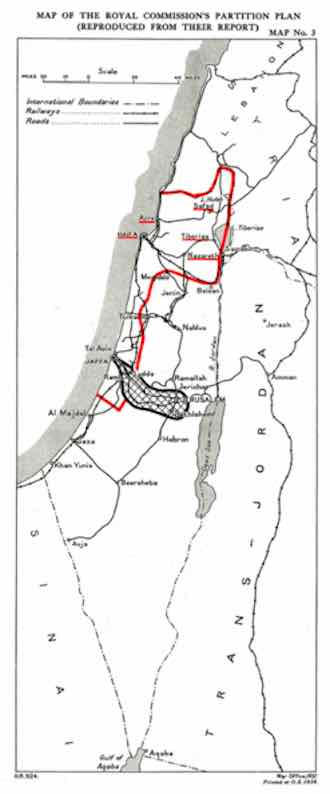
The Peel Commission’s “two-state solution” is shown on this map:

The Arabs rejected partition and the creation of any Jewish State. The Jews accepted the principle of partition - but not the borders designated on the map.

Boris Johnson has advanced the resolution of the Arab-Jewish conflict by highlighting that:
1. the only viable “two-state solution” is the partition proposed by the Peel Commission with newly-negotiated borders agreed between Jordan and Israel

2. Jordan remains the Arab key to resolving the Arab-Jewish conflict - which a naive and gullible world continues to ignore.
Trying to create two Arab States and one Jewish State in an area where only one Arab state and one Jewish state is warranted by history, geography and demography has been a diplomatic disaster with horrendous consequences for Arabs and Jews.

Jordan and Israel - the two successor States to the Mandate - currently exercising sovereignty in 95% of former Palestine - need to sit down and resolve Jewish and Arab claims to the remaining 5%.

Britain’s reaffirmation of Peel’s proposed “two-state solution” is long overdue.

The “two-state solution” posited in 1922 and 1937 — Jordan and Israel — still remains the only viable solution to resolve the Arab-Jewish conflict in 2017.

Balfour Declaration Falsehoods Fuel Jew-Hatred and Israel-Bashing


[Published 30 October 2017]


The centenary of the Balfour Declaration issued on 2 November 1917 is being used to unleash a barrage of falsehoods designed to denigrate the Jewish people and delegitimise the Jewish State of Israel.

Among those current egregious falsehoods:
1. Raja Zaatry - an official of the High Follow-up Committee - the Arab community’s leadership body in Israel - has asserted:
“In 1917 less than 10% of the population was Jewish and more than 90% Arab. The British gave to the Jews something that didn’t belong to them,”
The British Government gave nothing to the Jews in 1917 other than its “declaration of sympathy with Jewish Zionist aspirations” expressed in the Balfour Declaration. Palestine in 1917 still remained under Turkey’s rule as part of the 400 years old Ottoman Empire.
2. Vincent Fean - British consul general to Jerusalem between 2010 and 2014 - reportedly said the UK should uphold its commitment to helping achieve a two-state solution promised in the Balfour Declaration - if only to prevent radicalization at home - stating
“I firmly believe that this unresolved issue contributes to radicalization in our own country among the Muslim community and if only for that self-interested reason we should think of doing something about it.”

The Balfour Declaration promised no two-state solution.

Islamic State has caused Muslim radicalization in Britain.
3. The Balfour Apology Campaign and the Palestinian Return Centre — protesting the Royal Albert Hall being used to host a Balfour Declaration Centenary event on 7 November - have urged the public to sign a letter containing the following statement:
“The 1917 Balfour Declaration directly caused the 1948 Arab-Israeli War where Israel ethnically cleansed 750,000 Palestinians and then established a state in Palestine.”

The 1948 Arab-Israeli War was directly caused by six Arab armies from Egypt, Syria, Transjordan, Lebanon, Saudi Arabia and Iraq invading Palestine in total violation of international law. No invasion — no war.
4. University of Manchester academic Nick Thoburn grabbed some media space by reportedly saying he was dismayed that the University had allowed a Balfour Declaration commemoration event to take place on its campus - adding for good measure:
“Lord Balfour (declared), chillingly, that Zionism was ‘of far profounder import than the desire and prejudices of the 700,000 Arabs who now inhabit that ancient land'"

Chillingly - our news-grabbing academic selectively misquoted what Lord Balfour actually said:
“The Four Great Powers are committed to Zionism. And Zionism, be it right or wrong, good or bad, is rooted in age-long traditions, in present needs, in future hopes, of far profounder import than the desires and prejudices of the 700,000 Arabs who now inhabit that ancient land”

Nick appears to have been engaging in deliberate spin.

Nick should be looking for another job outside academia if this is the standard of his intellectual expertise.
5. Ambassador Jonathan Allen - UK deputy permanent representative to the UN told the Security Council on 17 October:
“And let us remember, there are two halves of Balfour, the second half of which has not been fulfilled. There is therefore unfinished business.”

Ambassador Allen was spouting pure unadulterated fiction. There are no two halves of the Balfour Declaration.

There is however “unfinished business”: allocating sovereignty in the last remaining 5% of Palestine between Jordan and Israel — the two successor States in Palestine — as was first envisaged by Article 25 of the 1922 League of Nations Mandate for Palestine.

The sooner this business is concluded — the sooner the Arab-Jewish conflict can be resolved.
It surely is time to end 100 years of relentlessly hounding 15 million Jews world-wide and falsely and misleadingly lambasting their tiny Jewish State.

Balfour Declaration Centenary Shames Arab and UN Deniers


[Published 23 October 2017]


The continuing Arab refusal — aided and abetted by the United Nations - to recognise the international legitimacy of the Balfour Declaration 100 years after it was first issued on 2 November 1917 - remain the greatest obstacles to resolving the Jewish-Arab conflict.

The current Arab culprits are the Arab League, the PLO and Hamas who unconditionally reject the binding international legal validity of the Balfour Declaration. However their efforts to nullify the Balfour Declaration would have been undermined long ago had the United Nations not lent its support by propagating a fictitious narrative of the Jewish-Arab conflict.

United Nations involvement has occurred through the “Division for Palestinian Rights of the United Nations Secretariat for, and under the guidance of, the Committee on the Exercise of the Inalienable Rights of the Palestinian People” which has published “The Origins and Evolution of the Palestine Problem 1917-1988” containing numerous false and misleading facts on the Jewish-Arab conflict which remain uncorrected.

The Balfour Declaration — when issued - was merely a “declaration of sympathy with Jewish Zionist aspirations” having no binding legal effect - since “Palestine” was still then part of Turkey’s Ottoman Empire and had been so for the previous 400 years.

The Balfour Declaration first gained international endorsement following Turkey’s defeat in World War 1 when the Treaty of Sevres - concluding a truce with Turkey - was signed on 10 August 1920 by:
1. The British Empire, France, Italy and Japan (“The Principal Allied Powers”)

2. Armenia, Belgium, Greece, the Hedjaz, Poland, Portugal, Roumania, the Serb-Croat-Slovene State and Czechoslovakia (constituting with the Principal Allied Powers “the Allied Powers”) and

3. Turkey
Article 95 of the Treaty provided for:
“the administration of Palestine, within such boundaries as may be determined by the Principal Allied Powers, to a Mandatory to be selected by the said Powers. The Mandatory will be responsible for putting into effect the declaration originally made on November 2, 1917, by the British Government, and adopted by the other Allied Powers, in favour of the establishment in Palestine of a national home for the Jewish people, it being clearly understood that nothing shall be done which may prejudice the civil and religious rights of existing non-Jewish communities in Palestine, or the rights and political status enjoyed by Jews in any other country.”

This acceptance of the Balfour Declaration by the Allied Powers was subsequently embraced by all 51 member countries of the League of Nations on 24 July 1922 - when the terms of the Balfour Declaration were incorporated in the preamble to the League of Nations Mandate for Palestine.

Those 51 countries were:
Albania, Argentina, Australia, Austria, Belgium, Bolivia, Brazil, British India, Bulgaria, Canada, Chile, Colombia, Costa Rica, Cuba, Czechoslovakia, Denmark, El Salvador, Estonia, Finland, France, Greece, Guatemala, Haiti, Honduras, Italy, Japan, Kingdom of Serbs, Croats, and Slovenes, Latvia, Liberia, Lithuania, Luxembourg, Netherlands, New Zealand, Nicaragua, Norway, Panama, Paraguay, Persia, Peru, Poland, Portugal, Republic of China, Romania, Siam, Spain, Sweden, Switzerland, Union of South Africa, United Kingdom, Uruguay, and Venezuela
Article 25 of the Mandate was subsequently invoked on 23 September 1922 to restrict the Jewish National Home to just 22% of the territory encompassed by the Mandate - whilst the remaining 78% eventually became an Arabs-only, Jew-free State in 1946 - now called Jordan.

The Jews reluctantly accepted these decisions — but the Arabs never have. The Arabs (with the exception of Jordan and Egypt) still claim 100% of former Palestine by refusing to recognise the Jewish State.

Peace cannot occur until the UN demands Arab recognition of the Balfour Declaration. The UN’s continuing refusal to do so is truly shameful.