Mandate for Palestine - July 24, 1922

Mandate for Palestine - July 24, 1922
Jordan is 77% of former Palestine - Israel, the West Bank (Judea and Samaria) and Gaza comprise 23%.
Showing posts with label Britain. Show all posts

Monday, April 12, 2021

Jordan reaches 100 as its ruling Hashemite dynasty implodes


Jordan continues to be the stumbling block to ending the 100 years old conflict between Jews and Arabs as it celebrates its founding 100 years ago on April 11, 1921 - whilst simultaneously 100 years of unbroken rule by the Hashemite dynasty has been publicly imploding.

Initially called the Emirate of Transjordan - the Hashemites - hailing from the Hejaz - now called Saudi Arabia – were anointed as Transjordan’s future rulers by Britain at the 1921 Cairo Conference as part of the machinations between Britain and France in the carve up of the territory of the defeated Ottoman Empire in World War I.

99.99% of Ottoman-liberated territory was designated for Arab self-determination under the French Mandate for Syria and Lebanon and the British Mandate for Mesopotamia - whilst the remaining 0.01% was to be set aside for the reconstitution of the Jewish National Home in the area today called Israel, Jordan, Gaza and Judea and Samaria (West Bank) pursuant to the British Mandate for Palestine.

Two and a half of the twelve tribes of Israel had settled in Transjordan: Gad, Reuben and half the tribe of Manasseh:


Transjordan – 78% of the territory comprised in the Mandate - was however completely excluded as the site for any part of the future Jewish National Home - when Article 25 was inserted in the Mandate document unanimously endorsed by the League of Nations on July 24, 1922.

Transjordan’s exclusion from future Jewish settlement came after the exchange of the following telegrams between Britain’s State Secretary for the Colonies Winston Churchill and British Colonial Administrator John Schuckburgh in March 1921:


The coup de grĂ¢ce was duly delivered by the Council of the League of Nations on September 16, 1922:


With impeccable Anglo-French doublespeak – the Jews were thus denied any right to reconstitute their National Home in any part of the Mandate territory east of the Jordan River. However – Jewish settlement anywhere west of the Jordan River – including Gaza and Judea and Samaria (West Bank) – has been preserved until today under Article 6 of the Mandate for Palestine and Article 80 of the United Nations Charter.

Former American President Jimmy Carter summed up Jordan’s founding in Time Magazine on October 11, 1982:
“[Jordan’s King] Hussein is personally courageous but an extremely timid man in political matters. That timidity derives almost inevitably from the inherent weakness of Jordan. As a nation it is a contrivance, arbitrarily devised by a few strokes of the pen”
Transjordan remained part of the Mandate for Palestine until Britain granted it independence on 25 May 1946 when it was renamed “The Hashemite Kingdom of Transjordan”. A further name change to Jordan only came in 1950 after Transjordan had conquered Judea and Samaria and East Jerusalem in 1948 – expelling all the Jews living there and uniting those areas with Transjordan to form a single territorial unit until their loss to Israel in the 1967 Six Day War.

Israel and Jordan signed a peace treaty in 1994 which remains in force today despite many events that could have derailed it.

The two-state solution first contemplated in 1922 for Palestine:
  • one for the Jews within 22% of the Mandate territory
  • one for the Arabs exclusively in the remaining 78%
still remains the only realistic and politically-achievable basis for any two-state solution in 2021.

Subdividing Judea and Samaria (West Bank) and Gaza – 5% of the Mandate territory where sovereignty still remains unallocated – between Israel and Jordan – the two successor States to the Mandate for Palestine exercising sovereignty in the other 95% – remains the key to ending the Arab-Jewish conflict.

After 100 years - Jordan’s ruling Hashemite dynasty finally needs to end its timidity.


Author’s note: The cartoon — commissioned exclusively for this article — is by Yaakov Kirschen aka “Dry Bones”- one of Israel’s foremost political and social commentators — whose cartoons have graced the columns of Israeli and international media publications for decades.

Sunday, July 12, 2020

Britain shamefully betrays the Jewish People again


[Published 13 July 2020]


Britain — the architect of the San Remo Resolution and Treaty of Sevres in 1920 that led to the League of Nations Mandate for Palestine in 1922 — has yet again shamefully betrayed the Jewish People by warning Israel not to extend its sovereignty into Judea and Samaria.

Britain’s Prime Minister Boris Johnson has told Israeli Prime Minister Benjamin Netanyahu that any such action would be in violation of international law - which Netanyahu disputes — despite the Mandate vesting in the Jewish People the right to “close settlement” in Judea and Samaria for the purposes of reconstituting the biblical Jewish National Home in what had been the heartland of the Jewish People 3,000 years ago.

Britain had betrayed the Jewish People in 1950 after all the Jews living in Judea and Samaria had been ethnically cleansed by the invading Arab army of Transjordan in 1948. Britain — supported only by Pakistan and Iraq — recognized Transjordan’s illegal annexation of Judea and Samaria, the renaming of the newly merged entity as “Jordan” whilst “Judea and Samaria” was renamed “West Bank”.

Johnson told Netanyahu:
"I am immensely proud of the UK’s contribution to the birth of Israel with the 1917 Balfour Declaration. But it will remain unfinished business until there is a solution which provides justice and lasting peace for both Israelis and Palestinians.

The only way it can be achieved is for both sides to return to the negotiating table. That must be our goal. Annexation would only take us further away from it."
Peace for both “Israelis” and “Palestinians”? Neither existed until 1948 and 1964. There were only “Arabs” and “Jews” in 1917. The Arab residents of Palestine then comprised part of “the existing non-Jewish communities”.

Johnson seems apparently unaware that the “Palestinians” :
  • were defined for the first time in recorded history by article 6 of the 1964 PLO Charter
  • did not claim “regional sovereignty in the West Bank in the Hashemite Kingdom of Jordan”or “on the Gaza Strip” under article 24
  • were Jordanian citizens between 1954 and 1988.
Johnson’s warning to Israel is the complete antithesis of what he wrote on October 29, 2017 as Foreign Minister — ahead of the Balfour Declaration centenary on November 2nd:
“I have no doubt that the only viable solution to the conflict resembles the one first set down on paper by another Briton, Lord Peel, in the report of the Royal Commission on Palestine in 1937, and that is the vision of two states for two peoples.”
The Royal Commission was authorised by Royal Warrant dated August 7, 1936 which did not mention the “Palestinians” - only naming two parties — the “Arabs” and the “Jews” — not three - as disputants.

The Peel Commission after a lengthy and detailed Inquiry concluded that:
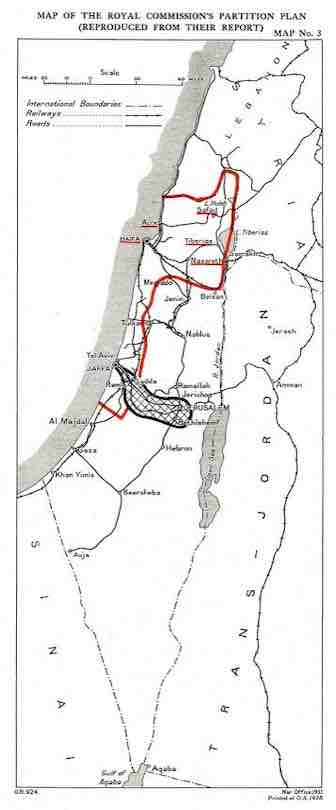
“two sovereign independent States would be established - the one an Arab State, consisting of Trans-Jordan united with that part of Palestine which lies to the east and south of a frontier such as we suggest in [the map] below; the other a Jewish State consisting of that part of Palestine which lies to the north and west of that frontier.”
The Arabs rejected this decision. The Jews disputed the boundaries.

Trans-Jordan in 1937 then comprised the remaining 78% of the Mandate territory closed by Britain to Jewish settlement under Article 25.

Jewish settlement in Judea and Samaria however was to be facilitated and encouraged under article 6.

The PLO’s outright refusal to negotiate with Israel on President Trump’s Peace Plan strengthens Netanyahu’s decision to restore Jewish sovereignty in 30% of Judea and Samaria after 3000 years.

Johnson’s hypocritical posturing should reinforce - not weaken — Netanyahu’s resolve.


Sunday, June 28, 2020

Jewish People reclaiming sovereignty in biblical heartland after 3000 years


[Published 29 June 2020]


The United Nations is disgracefully trying to prevent a miracle happening 100 years after the world first gave its historic imprimatur to an impossible dream becoming a possible reality: 
The restoration of Jewish sovereignty in 1697km² of the Jewish People’s biblical heartland in Judea and Samaria (West Bank)
The defeat of the 400 years-old Ottoman Empire in World War I revived the Jewish People’s 3000 years-old dream of regaining nationhood in their ancient homeland—which had extended across both banks of the River Jordan where the twelve tribes of Israel had finally settled 40 years after their exodus from Egypt.

The San Remo Resolution signed by Great Britain, France, Japan and Italy on April 25, 1920 promised the Jews real hope.

The Treaty of Sevres involving the international community quickly followed on August 10, 1920.

The British Empire, France, Italy and Japan (“Principal Allied Powers”) were joined by Armenia, Belgium, Greece, the Hedjaz, Poland, Portugal, Romania, The Serb-Croat Slovene State and Czechoslovakia (“Allied Powers”) in this peace treaty signed with Turkey.

Signatories for the British Empire were representatives for:
His Majesty the King of the United Kingdom of Great Britain and Ireland
The Dominion of Canada
The Commonwealth of Australia
The Dominion of New Zealand
The Union of South Africa
India
Article 95 provided that Palestine — within such boundaries as might be determined by the Principal Allied Powers — be administered by a Mandatory to be selected by them. The Mandatory was to be responsible for putting into effect the Balfour Declaration made on November 2, 1917 by the British Government — and adopted by the Allied Powers — in favour of the establishment in Palestine of a national home for the Jewish people — it being clearly understood that nothing would be done which might prejudice the civil and religious rights of existing non-Jewish communities in Palestine — or the rights and political status enjoyed by Jews in any other country.

The League of Nations 51 member states unanimously appointed Britain as Mandatory and approved the terms of the Mandate for Palestine on July 24, 1922.

Intervening political events in Syria between 1920 and 1922 involving France and Britain saw the Mandate’s provisions deny the Jewish People the right to reconstitute the Jewish National Home on the East Bank of the Jordan River where two and a half of the twelve tribes had settled after reaching the Promised Land.

Judea and Samaria was reserved however for the Jews under the Mandate — that right being preserved under article 80 of the 1945 United Nations Charter notwithstanding the demise of the League of Nations in 1946.

After Britain handed its Mandate back to the United Nations in 1948 — every Jew living in Judea and Samaria was driven out by the invading army of Transjordan which itself comprised 77% of the Mandate territory and had achieved independence in 1946.

Judea and Samaria was unified with Transjordan to become “The West Bank in the Hashemite Kingdom of Jordan” from 1950 to 1967 — recognized only by Great Britain, Iraq and Pakistan. Jordanian citizenship was extended to all its Arab citizens from 1954 to 1988.

Jordan’s loss of Judea and Samaria to Israel in the 1967 Six Day War saw some 450,000 Jews returning to reclaim their patrimony over the next 53 years — but the international community’s seal of approval soon changed to outright condemnation. President Trump’s 2020 Peace Plan has confirmed those vested legal rights acquired 1920-1922 by the Jewish People in Judea and Samaria.

An amazing miracle is about to occur on July 1st without any parallel in world history.


Sunday, April 26, 2020

Jordan must not socially distance from Judea and Samaria's Arabs


[Published 27 April 2020]


Formation of a National Unity Government in Israel has focused attention on the future of Judea and Samaria — 4% of the territory of the Mandate for Palestine — in which sovereignty still remains unallocated between Jews and Arabs.

President Trump’s Peace Plan published on January 28, 2020 has been endorsed by Israel.

Trump’s Plan proposes that Israeli sovereignty be extended into parts of Judea and Samaria – with the balance reserved to create a second Arab state in former Palestine – in addition to Jordan – for the first time in recorded history.

The PLO, Arab League and the international community have rejected Trump’s proposals.

However US Secretary of State Mike Pompeo has given the greenlight to Israel proceeding with extending Israeli sovereignty in about 30% of Judea and Samaria now the new Israeli Government of National Unity is finalised.

Blue and White leader Benny Gantz has agreed that Prime Minister Benjamin Netanyahu can seek Parliament’s approval for Israeli sovereignty to be extended into about 30% of Judea and Samaria after July 1st. in accordance with the decisions of a joint US-Israel mapping committee.

Israel’s entitlement to do so is grounded in the legal rights vested by the international community in the Jewish People pursuant to:
1. The San Remo Resolution dated April 25, 1920

2. Article 95 Treaty of Sevres dated August 10, 1920,

3. Article 6 Mandate for Palestine dated July 24, 1922,

4. Article 16 Treaty of Lausanne dated July 24, 1923

5.Article 80 United Nations Charter 1945
These commitments have been previously breached by:
1. The Council of the League of Nations approving article 25 being inserted in the Mandate for Palestine - allowing Britain to postpone or withhold the Jewish National Home being reconstituted in Transjordan - 77% of the territory of the Mandate for Palestine

2. Britain unilaterally granting independence to Transjordan on May 25, 1946 contrary to article 5 of the Mandate for Palestine

3. Britain handing back its Mandate to the United Nations — uncompleted — on May 15th 1948 — leaving the Jews to defend themselves against six invading Arab armies from neighbouring States.
The European Union has now hypocritically chosen to strongly oppose Israel extending sovereignty into Judea and Samaria after July 1st.

EU High Representative for Foreign Affairs Josep Borrell released the following statement:
”…the EU’s position on the status of the territories occupied by Israel in 1967 remains unchanged. The EU does not recognize Israeli sovereignty over the occupied West Bank. The EU reiterates that any annexation would constitute a serious violation of international law.”
Borrell is way off the mark:
1. Not “sovereignty over the occupied West Bank” — but “sovereignty over 30% of Judea and Samaria — land designated for reconstitution of the Jewish National Home under internationally-negotiated agreements”

2. Not “annexation” — but “the restoration of sovereignty lost 3000 years ago by the Jewish people in its biblical heartland”

3. Not “a serious violation of international law”: Israeli sovereignty is being applied in accordance with international agreements that the international community is obligated to uphold.
Trump should focus on Jordan — having occupied and ruled Judea and Samaria between 1948 and 1967 — to replace the PLO in negotiations with Israel on Trump’s additional Arab State proposal.

The PLO — only founded in 1964 - expressly stipulated under article 24 of its Charter that it did:
“not exercise any territorial sovereignty over the West Bank in the Hashemite Kingdom of Jordan,”
The PLO reversed its position in 1968 after Israel gained control in the 1967 Six Day War.

Judea and Samaria’s Arab residents were Jordanian citizens between 1954 and 1988. Socially distancing from them now is the last thing Jordan should be doing.

Author’s note: The cartoon—commissioned exclusively for this article—is by Yaakov Kirschen aka “Dry Bones”- one of Israel’s foremost political and social commentators—whose cartoons have graced the columns of Israeli and international media publications for decades. His cartoons can be viewed at Drybonesblog

Thursday, September 13, 2018

PLO-Hamas anti-England, anti-Israel hatred politicises FIFA World Cup.


[Published 11 July 2018]


Hatred against Britain and Israel surfaced in Gaza as England progressed its way through the World Cup to meet Sweden in the quarter finals.

One Gaza fan was outspoken:
“Of course I will support Sweden.

I can’t imagine a Palestinian supporting England, which created the Balfour Declaration, or not supporting the country that stood before the world and recognized our state."

The 1917 Balfour Declaration has never been forgotten or forgiven by the Palestine Liberation Organisation (PLO) and Hamas — both of whom consider the Declaration to be null and void — spending decades in spruiking this false message to their respective constituencies — fomenting Arab hatred against the Jews since the Declaration first called for the establishment in Palestine of a national home for the Jewish people.

The fuming Gaza fan was expressing his resentment by barracking for Sweden — even though Sweden was one of the 51 countries that transformed the Balfour Declaration into binding international law by unanimously incorporating it in the League of Nations Mandate for Palestine in 1922.

Our anguished fan was blissfully unaware of these facts having obviously not studied the 100 years old Arab-Jewish conflict. Anti-England prejudice was enough to back his decision to go for Sweden.

True — Sweden had purged itself of its 1922 decision when officially recognizing the State of Palestine in October 2014 - making it the first major European Union member state to back the PLO’s statehood bid.

However in atoning for its 1922 sin - Sweden’s recognition of the “State of Palestine” was a fiction that failed to meet the requirements demanded in international law by Article 1 of the 1933 Montevideo Convention which states:
“The state as a person of international law should possess the following qualifications:
(i) A permanent population
(ii) defined territory
(iii) Government
(iv) Capacity to enter into relations with the other states"

FIFA’s admission of the Palestinian Football Federation as a member of FIFA in 1988 had also contravened Article 10.1 of FIFA’s then governing articles:
“Any Association which is responsible for organising and supervising football in its country may become a Member of FIFA. In this context, the expression “country” shall refer to an independent state recognised by the international Community.”
FIFA started living in its own dream world 26 years before Sweden joined it.

Who will replace Sweden as Britain’s nemesis was summed up by another fan:
“Anyone supporting England is supporting Israel itself. These teams represent their countries and governments and will raise their flags in the stands. How can I support the country that allowed the Jewish state on our land?”
The Gazan fans are in for a shock and a reality check when they begin choosing one of the three remaining teams — France, Belgium or Croatia - to topple the evil Brits.

France, Belgium and Croatia just happen to have all voted in favour of the Mandate for Palestine incorporating the Balfour Declaration.

The semi-finals, final and third-place playoff will be agony for Gazan viewers as one of these last four countries holds up the trophy on the winner’s podium come finals day - the others the three minor places - with their flags filling Gaza’s TV screens.

The moral is clear — international law cannot be turned on and off as circumstances dictate — because one day the perpetrator will become entrapped in the hopeless position that the Arab States, the PLO and Hamas now find themselves.

Throwing out binding international law — the Balfour Declaration and the Mandate for Palestine — and falsely creating fake international law — “the State of Palestine” — goes to the heart of why the Arab-Jewish conflict still remains unresolved in 2018.

Wednesday, February 28, 2018

Palestine - Abbas Abandons Peace Negotiations With Israel


[Published 18 August 2016]


Mahmoud Abbas’s decision to prosecute Britain for publishing the 1917 Balfour Declaration amounts to an outright rejection of the right of the Jewish people to have their own State in former Palestine - the major stumbling block to peacefully resolving the Jewish-Arab conflict for the last 100 years.

Abbas effectively abandoned further peace negotiations with Israel when his Foreign Minister Riad al-Maliki announced Abbas’s decision during an Arab League meeting in the Mauritanian capital of Nouakchott on 25 July:
“We are working to open up an international criminal case for the crime which they [Britain] committed against our nation — from the days of the British Mandate all the way to the massacre which was carried out against us from 1948 onwards ...

... With the commemoration of 100 years since this historic massacre, and following the continuity of this tragedy, we request that the Secretary General of the Arab League assist us in prosecuting the British government for publishing the Balfour Declaration which caused this catastrophe against the Palestinian people.”

The Palestine Liberation Organisation (PLO) — from its founding in 1964 — had labelled the Balfour Declaration a “fraud” - revising this position in 1968 by claiming it was “deemed null and void.”

Such unsubstantiated assertions of British fraud and illegality are supposedly now to be legally challenged — but can Abbas be taken seriously?

Abbas has not similarly threatened France - although France’s Secretary General For Foreign Affairs - Jules Cambon — informed Nahum Sokolow on 4 June 1917 — 5 months before the Balfour Declaration:
“You were good enough to present the project to which you are devoting your efforts, which has for its object the development of Jewish colonization in Palestine. You consider that, circumstances permitting, and the independence of the Holy Places being safeguarded on the other hand, it would be a deed of justice and of reparation to assist, by the protection of the Allied Powers, in the renaissance of the Jewish nationality in that Land from which the people of Israel were exiled so many centuries ago.

The French Government, which entered this present war to defend a people wrongfully attacked, and which continues the struggle to assure the victory of right over might, can but feel sympathy for your cause, the triumph of which is bound up with that of the Allies.

I am happy to give you herewith such assurance.”

Abbas is not proposing to sue all 51 member States of the League of Nations who unanimously adopted and incorporated the Balfour Declaration in the Mandate for Palestine — when calling for the “reconstitution of the Jewish National Home in Palestine”.

Threatened legal action against Britain only will probably never eventuate — let alone have any chance of success.

Abbas’s latest grandstanding ploy comes as he desperately tries to recover lost political ground to Hamas by reinforcing his own Jew-hating credentials.

The Nouakchott Declaration has however served to focus attention on thirty years of long-overlooked international political decisions taken between 1917 and 1947 which resulted in:
1. 99.99% of the Ottoman Empire lands conquered by Britain and France in World War 1 being set aside for Arab self-determination whilst only 0.01% - Palestine — was set aside for Jewish self-determination

2. 78% of Palestine being closed in 1922 to Jewish settlement and development of the Jewish National Home — such territory subsequently becoming an independent sovereign Jew-free Arab State in 1946 — today called Jordan.
Burying Arab heads in the sand by refusing to accept these decisions remains an exercise in futility.

When Arab minds acknowledge these historic and legal realities - the peaceful resolution of the century-old conflict between Arabs and Jews becomes certainly attainable.

Saturday, January 27, 2018

Britain backs Jordan and Israel to end the Arab-Jewish conflict


[Published 7 November 2017]


Britain’s Foreign Secretary Boris Johnson has acknowledged that Jordan and Israel represent the only viable “two state solution” that can end the Arab-Jewish conflict.

Writing in the Daily Telegraph on 29 October — ahead of the centenary of the Balfour Declaration on 2 November — the Foreign Secretary stated:
“I have no doubt that the only viable solution to the conflict resembles the one first set down on paper by another Briton, Lord Peel, in the report of the Royal Commission on Palestine in 1937, and that is the vision of two states for two peoples.”

The Royal Commission had been authorised by Royal Warrant dated 7 August 1936:
”... to enquire into the manner in which the Mandate for Palestine is being implemented in relation to Our obligations as Mandatory towards the Arabs and the Jews respectively; and to ascertain whether, upon a proper construction of the terms of the Mandate, either the Arabs or the Jews have any legitimate grievances upon account of the way in which the Mandate has been, or is being implemented;”

Significantly the Royal Warrant did not mention or identify the “Palestinians” as being a party to the dispute. There were only two parties— the “Arabs” and the “Jews” — not three.

The “two-state solution” - one Jewish, one Arab — first envisioned in article 25 of the 1922 Mandate for Palestine (Mandate) — had restricted Jewish rights to reconstitute the Jewish National Home in just 22% of the territory covered by the Mandate. The Jews had accepted that proposal but the Arabs had rejected it.

The Peel Commission after a lengthy and detailed Inquiry confirmed that the “two-state solution” contemplated by the Mandate — one Jewish, one Arab —remained the only solution to end the grievances between Arabs and Jews — concluding that:
“two sovereign independent States would be established - the one an Arab State, consisting of Trans-Jordan united with that part of Palestine which lies to the east and south of a frontier such as we suggest in Section 3 below; the other a Jewish State consisting of that part of Palestine which lies to the north and west of that frontier.”

Transjordan — renamed Jordan in 1950 - comprised the remaining 78% of the territory contained in the Mandate for Palestine closed to Jewish settlement under the Mandate. Britain still retained full responsibility for Transjordan as Mandatory Power until Transjordan was finally granted independence by Britain in 1946.

The Peel Commission’s “two-state solution” is shown on this map:

The Arabs rejected partition and the creation of any Jewish State. The Jews accepted the principle of partition - but not the borders designated on the map.

Boris Johnson has advanced the resolution of the Arab-Jewish conflict by highlighting that:
1. the only viable “two-state solution” is the partition proposed by the Peel Commission with newly-negotiated borders agreed between Jordan and Israel

2. Jordan remains the Arab key to resolving the Arab-Jewish conflict - which a naive and gullible world continues to ignore.
Trying to create two Arab States and one Jewish State in an area where only one Arab state and one Jewish state is warranted by history, geography and demography has been a diplomatic disaster with horrendous consequences for Arabs and Jews.

Jordan and Israel - the two successor States to the Mandate - currently exercising sovereignty in 95% of former Palestine - need to sit down and resolve Jewish and Arab claims to the remaining 5%.

Britain’s reaffirmation of Peel’s proposed “two-state solution” is long overdue.

The “two-state solution” posited in 1922 and 1937 — Jordan and Israel — still remains the only viable solution to resolve the Arab-Jewish conflict in 2017.

Saturday, March 18, 2017

Palestine: Britain rebuffs Abbas call to apologise for Balfour Declaration


[Published 22 December 2016]


Palestine Liberation Organisation (PLO) Chairman Mahmoud Abbas’s demand that Britain apologise for the Balfour Declaration has been rebuffed by British Prime Minister Theresa May.

Addressing the Conservative Friends of Israel (CFI) on 12 December — May responded:
”... we are entering the centenary year of the Balfour Declaration.

On the 2nd of November 1917, the then Foreign Secretary — a Conservative Foreign Secretary — Arthur James Balfour wrote:

“His Majesty’s Government view with favour the establishment in Palestine of a national home for the Jewish people, and will use their best endeavours to facilitate the achievement of this object, it being clearly understood that nothing shall be done which may prejudice the civil and religious rights of existing non-Jewish communities in Palestine, or the rights and political status enjoyed by Jews in any other country.”

It is one of the most important letters in history.

It demonstrates Britain’s vital role in creating a homeland for the Jewish people.

And it is an anniversary we will be marking with pride.”

The Balfour Declaration became established international law after being incorporated into the Mandate for Palestine on 24 July 1922 - all 51 Member States of the League of Nations unanimously agreeing that:
“recognition has thereby been given to the historical connection of the Jewish people with Palestine and to the grounds for reconstituting their national home in that country;”

The Mandate further affirmed that Britain would be responsible for:
“placing the country under such political, administrative and economic conditions as will secure the establishment of the Jewish national home, as laid down in the preamble, and the development of self-governing institutions, and also for safeguarding the civil and religious rights of all the inhabitants of Palestine, irrespective of race and religion.”

The use of the terms
1. “existing non-Jewish communities in Palestine” in the Balfour Declaration and

2. “all the inhabitants of Palestine” in the Mandate document rather than the term “Palestinians”
clearly refutes the existence of any identifiable “Palestinian people” in Palestine in 1917 or 1922.

However fake news stories repetitively dealing with the “stateless Palestinians” may have influenced Ms May into also telling the CFI meeting:
“Of course, people are correct when they say that securing the rights of Palestinians and Palestinian statehood have not yet been achieved.”

The Prime Minister has ignored the following pertinent facts:
1. The term “Palestinians” was not defined until 1964 when article 6 of the PLO Charter stipulated:
“The Palestinians are those Arab citizens who were living normally in Palestine up to 1947, whether they remained or were expelled. Every child who was born to a Palestinian parent after this date whether in Palestine or outside is a Palestinian.”

2. The “Palestinian people” was declared to be an integral part of the Arab Nation under Article 1 of the revised 1968 PLO Charter — not a separate and distinct people.

3. The rights of the Arab citizens of Palestine were secured in 1922 by articles 2 and 25 of the Mandate.

4. On 13 September 1922 - a Note communicated to the League of Nations by the Secretary General contained a Memorandum by the British Representative limiting the site designated for the Jewish National Home to just 22% of the mandate territory.

5. The other 78% was designated for the Arab citizens of Palestine — where Statehood was finally declared on 25 May 1946 when the area was renamed the “Hashemite Kingdom of Transjordan”. Another name change to “Jordan” in 1950 followed Transjordan’s illegal occupation of Judea and Samaria in 1948.
A second Arab State in former Palestine — in addition to Jordan - remains a fatuous and unrealistically attainable goal.

Monday, November 23, 2015

Palestine - A Stone's Throw Away From Syria


[Published 14 March 2014]


It boggles the imagination that Australia’s national broadcaster the Australian Broadcasting Corporation (ABC) could have been involved in a joint investigation between its premier Public Affairs show - “Four Corners” - and one of Australia’s leading newspapers – The Australian – in producing a 45 minute television documentary – “Stone Cold Justice” - examining the treatment of Palestinian children in Israel’s military court system.

ABC News announced that:
“Children are being intimidated and forced into false confessions by Israeli soldiers in the West Bank, according to allegations to be broadcast tonight on the ABC’s Four Corners program.

A joint investigation between Four Corners and The Australian newspaper has examined the treatment of Palestinian children in Israel’s military court system. Four Corners looks at claims the Israeli army is arresting hundreds of Palestinian children during night raids for alleged crimes, such as throwing stones at Israeli soldiers and settlers.

Israel’s security services have also been accused by lawyers and youth workers of using Palestinian children to gather intelligence.”

The news item went on to reveal that:
“700 Palestinian children [are] detained each year by the Israeli army…”

Any allegations concerning the mistreatment or abuse of children should be vigorously questioned and exposed - but the allocation of substantial resources by the Australian taxpayer funded ABC to investigate allegations that relate to 700 children a year in the West Bank must be seriously questioned.

There are certainly far more serious abuses being suffered by children – most notably in Syria for the last three years – that deserve detailed investigation by national broadcasters like the ABC.

The impotency of the United Nations and its “humanitarian” agencies in allowing inhumane outcomes for children resulting from member states either backing the Assad regime or those seeking to overthrow it – has been starkly revealed in a report - “Under Siege -The devastating impact on children of three years of conflict in Syria” - issued by UNICEF this week.

The Report reveals that:
1. Since March 2013, the number of children affected by the crisis in Syria has more than doubled from 2.3 million to more than 5.5 million.

2. The number of children displaced inside Syria has more than tripled from 920,000 to almost 3 million.

3. The number of child refugees has more than quadrupled from 260,000 to more than 1.2 million. Of these children, 425,000 are under the age of five

4. One in 10 children – over 1.2 million – have fled the country to become refugees in neighbouring countries. And these numbers are rising every day. By the end of January 2014, 37,498 Syrian children had been born as refugees.

5.As of January 2014, more than 10,000 children have lost their lives to Syria’s violence reflecting a blatant disregard for civilian lives by all sides to the conflict. Most have reportedly died in the last 24 months - and there is evidence that children are being directly targeted.

6. Boys as young as 12 have been recruited to support the fighting, some in actual combat, others to work as informers, guards, or arms smugglers

7.According to a recent UN report, children as young as 11 are being detained with adults. In some cases, they are being subjected to torture and sexual abuse to humiliate them, force confessions, or pressure relatives to surrender

8. According to UN field estimates- one in ten refugee children is thought to be working – whether as cheap labour on farms, in cafes and car repair shops or as beggars on city streets.

9.Malnutrition and dangerous vitamin and mineral deficiencies – so-called “hidden hunger” - have been slowly undermining children’s ability to develop and thrive over the last three years.

10. Since the confirmation of a polio outbreak in the governorate of Deir Ezzour in October 2013, 25 cases of the disease have been confirmed in the north and east of the country. Despite a massive immunization programme since - polio remains a threat, especially to an estimated 323,000 children under the age of five in areas under siege or that are hard-to-reach
Australia currently occupies a seat on the United Nations Security Council –positioning it to take a lead role in demanding that an armed UN force be sent to Syria to implement an imposed cease fire to end this mayhem and slaughter – if the warring parties do not agree on a cease fire within a specified time frame.

If Australia’s national broadcaster has been moved to investigate the abuse of 700 children in the West Bank – surely it should be similarly motivated to produce a series of 45 minute documentaries interviewing UNICEF officials and those on the front line in Syria named in UNICEF’s report detailing the abuses being visited on 5.5 million children.

Indeed all national broadcasters – especially in those democratic countries forming part of the “The Friends of Syria Core Group of countries – the ‘London 11’” - the United States, Britain, France, Germany, Italy and Turkey – should be actively demanding a cease fire to end the suffering of these innocent children.

The other members of the London 11 - Egypt, Jordan, Qatar, Saudi Arabia and the United Arab Emirates must be prepared to join such an international force to end this genocidal assault on Arab children.

Russia, Iran and Hezbollah need to accept such a cease fire immediately.

The world must intervene without further delay.

Syria is only a stone’s throw away from the West Bank – not on another planet.

Monday, October 12, 2015

Syria - London Eleven Need Help From Heaven


[Published 22 September 2013]


Only divine intervention now seems likely to justify continuing support for the anti- Assad forces in Syria by the group known as the London 11 - United States, Britain, France, Germany, Italy, Turkey, Egypt, Jordan, Qatar, Saudi Arabia and the United Arab Emirates.

An unnamed Pentagon official has made this very clear in a Sunday Times article on 15 September headlined “Who’s calling the shots”:
“What everyone’s missing here is that the US has effectively chosen to back Assad,” a Pentagon official said. “There won’t be airstrikes in the foreseeable future and the administration has made clear that any help for the moderate opposition will be, to use Secretary Kerry’s words, unbelievably small. The facts on the ground are that Assad — who is still being armed by Russia — is winning.”

The Syrian opposition is clearly teetering on the ropes - indicating the failure of the London 11 strategy announced on 22 June:
“Doha, Qatar (CNN)—Foreign ministers from 11 countries meeting here cited the presence of foreign fighters in the country and the alleged use of chemical weapons by Damascus in agreeing Saturday to increase arms shipments to the rebels.

In a statement, the ministers representing the “London 11,” an offshoot of the “Friends of Syria,” said they would “provide urgently all the necessary materiel and equipment to the opposition on the ground, each country in its own way in order to enable them to counter brutal attacks by the regime and its allies and protect the Syrian people.”

The weapons are to be funneled through the opposition Free Syrian Army’s Supreme Military Council (SMC).

The alleged use of chemical weapons, which President Bashar al-Assad has denied, and the involvement of Hezbollah and Iran left the participants no choice:
“but to provide greater assistance of one kind or another, each nation making its own decision as to what it is comfortable doing, but all of them committing to do more to help the Syrian opposition,” U.S. Secretary of State John Kerry told reporters.”

Exacerbating Syria’s agony is the growing number of foreigners fighting alongside the Free Syrian Army - undoubtedly causing great concern among the London 11 as disclosed in this disturbing report in The Telegraph on 15 September:
“Opposition forces battling Bashar al-Assad’s regime in Syria now number around 100,000 fighters, but after more than two years of fighting they are fragmented into as many as 1,000 bands.

The new study by IHS Jane’s, a defence consultancy, estimates there are around 10,000 jihadists - who would include foreign fighters - fighting for powerful factions linked to al-Qaeda.

Another 30,000 to 35,000 are hardline Islamists who share much of the outlook of the jihadists, but are focused purely on the Syrian war rather than a wider international struggle.

There are also at least a further 30,000 moderates belonging to groups that have an Islamic character, meaning only a small minority of the rebels are linked to secular or purely nationalist groups…

...Fears that the rebellion against the Assad regime is being increasingly dominated by extremists has fuelled concerns in the West over supplying weaponry that will fall into hostile hands. These fears contributed to unease in the US and elsewhere over military intervention in Syria”

Certainly the western nations among the London 11 would have been appalled at the following remarks appearing in the Sunday Times article by a resident in the largely Christian town of Maaloula - following the entry of anti- Assad forces:
“These people are not after Bashar [al-Assad]. Their main aim and goal is to establish an Islamic caliphate. We have been living for 40 years as Christians under Assad. Now they place a gun to our head and say we have to convert to Islam.”

Another distraught resident declared:
“They broke into homes, stole things. They broke crosses and destroyed holy books. They fired at homes, ransacked, looted and destroyed anything with Christian symbols”

Moral imperatives might certainly have motivated the London 11 to initially take sides in the Syrian civil war.

However with this war claiming over 100000 deaths and seven million displaced Syrian civilians during the past 30 months - the time for the London 11 to call it a day must surely be approaching.

As the USA, Britain and France haggle with Russia in a vain attempt to procure face-saving terms for a United Nations Security Council Resolution to destroy all chemical weapons in Syria - the prospect of a ceasefire enabling their collection continues to evaporate given the disparate forces now fighting against Assad.

Intervention in Syria by the London 11 has been disastrous - as the increasing human casualties make so starkly clear.

The Pentagon official’s assessment declaring Assad the emerging winner is being increasingly confirmed with each passing day.

This conclusion may be unpalatable to the London 11 - and the group must shoulder some responsibility for the catastrophic humanitarian outcome.

A ceasefire between Assad and the SMC accompanied by an offer of safe passage and political asylum for SMC fighters and their families to the London 11 countries - would isolate the foreign jihadists - forcing them to exit Syria or die fighting Assad’s forces.

Assad would see off his armed opponents - Russia would see its pro-Assad stance justified - and the London 11 would have acted honourably to save those it supported.

These attainable goals - backed by Russia and America - represent a heaven-sent opportunity to end Syria’s hell and destroy its chemical weapons.

Friday, June 19, 2015

Palestine - Two Opportunities Better Missed


[Published 3 May 2012]


Israel’s former Foreign Minister - the late Abba Eban - is remembered for his many wise and pithy comments - of which the following is probably the most memorable:
“The Arabs never miss an opportunity to miss an opportunity”

The Arabs have been unyielding in their refusal to recognize a Jewish state in its biblical and ancestral homeland throughout the history of the 130 years conflict between Jews and Arabs in former Palestine.

The idea that such a Jewish state should be allowed to exist on just 0.01% of the former Ottoman Empire captured by Britain and France in the First World War - has been an ongoing anathema for the 22 Arab states who received the remaining 99.99% for Arab self-determination.

Opportunities to create another Arab state - and so end the conflict - were afforded by the Peel Commission in 1937, the United Nations in 1947, between 1948-1967 and in 2001 and 2008.

All such opportunities were missed by the Arabs.

Now the opportunity to conclude a peace treaty with Israel under the Oslo Accords and the Bush Roadmap has also gone begging - following the rush by the Palestinian Arabs to unilaterally seek to achieve statehood by joining the United Nations and when that failed - UNESCO.

Ironically - these are two opportunities that should have been avoided like the plague.

The attempt to join the United Nations was a failure - after the 15 members of the Committee on the Admission of New Members could not agree on whether Palestine’s application to join the UN complied with the two following fundamental requirements in Article 4 of the UN Charter:1.
1. Was Palestine a state?

2. If so, was it peace loving?

The Committee took their work seriously - as the following two paragraphs in their Report indicates:
“It was stated that the criteria set out in Article 4 of the Charter were the only factors that could be taken into consideration in the Committee’s deliberations. In support of this position, reference was made to the Advisory Opinion of 28 May 1948 of the International Court of Justice (ICJ), on the Conditions of Admission of a State to Membership in the United Nations (Article 4 of the Charter).

It was also asserted that the Committee’s work, whatever its outcome, should be mindful of the broader political context. The view was expressed that a negotiated solution remained the only option for a long-term sustainable peace and that final status issues had to be resolved through negotiations. Support was expressed for a two-State solution based on pre-1967 borders, resulting from political negotiations, leading to an independent State of Palestine with East Jerusalem as its capital. It was stressed that the granting of Palestine’s right to self-determination and recognition must not be seen as contrary to Israel’s inalienable right to exist.”

The legal issues inherent in deciding whether Palestine was a “State” were also canvassed by the committee as the following paragraphs in their Report indicates:
“On the criterion of statehood, reference was made to the 1933 Montevideo Convention on the Rights and Duties of States, which declares that a State as a person of international law should possess a permanent population, a defined territory, a government and the capacity to enter into relations with other States.

With regard to the requirements of a permanent population and a defined territory, the view was expressed that Palestine fulfilled these criteria. It was stressed that the lack of precisely settled borders was not an obstacle to statehood.

Questions were raised, however, regarding Palestine’s control over its territory, in light of the fact that Hamas was the de facto authority in the Gaza Strip. It was affirmed that the Israeli occupation was a factor preventing the Palestinian government from exercising full control over its territory. However, the view was expressed that occupation by a foreign power did not imply that the sovereignty of an occupied territory was to be transferred to the occupying power.”

Given the diversity and range of views expressed - it is no wonder that the Committee was unable to attest to Palestine’s current status qualifying it to meet the Charter’s requirements for membership.

Undeterred at the outcome - Palestine ran off to UNESCO hoping to get a better result there in its quest for statehood.

The application to join UNESCO was treated very differently to the UN application.

There was no vetting Committee to look at and first decide whether Palestine was a state - again a necessary prerequisite to entitle it to apply for membership under Article II paragraph 2 of UNESCO’s Constitution.

Whilst there was no requirement in the UNESCO Constitution that Palestine be “peace - loving” - there was a provision that stipulated a two-thirds majority vote of the members was required. There appears to have been no consideration whether that meant members “present and voting” or whether it required two thirds of the 194 members to vote in favour.

The 58 members of the Executive Board simply voted to recommend to the Members that Palestine be admitted as a member of UNESCO - without apparently considering any of the issues that had so perplexed the Security Council’s Committee. This recommendation then went to a meeting of the 194 members - when 107 of those present and attending voted in favour. 129 were required - if a two-thirds majority of the 194 members was necessary.

This foray into UNESCO has turned out disastrously for Palestine, UNESCO and the scores of millions of people worldwide reliant on UNESCO - as events since that decision on 31 October 2011 have shown.

The idea that the two-state solution should be achieved by a negotiated solution has gone out the door. 194 countries have now recognized that Palestine is a state and that the Palestinian Arabs are no longer homeless. No more negotiations are required to create a state for the Palestinian Arabs.

If the state of Palestine now wants to make demands on Israel - a new negotiating process will first have to be agreed on between Israel and Palestine.

The Oslo Accords and the Roadmap have become extant - and Israel is now free to make decisions without regard to their provisions.

Palestine can only blame itself for the position it now finds itself in. The 194 nations that made the decision to admit Palestine as a member state of UNESCO - where the UN Security Council for good legal reasons feared to tread - are equally culpable .

All of these countries have forfeited the right to talk of international law as the final determinant in this long running conflict or any other conflicts - following their willingness to breach international law when it suits them.

The law of the jungle has taken over from the rule of law.

If these 194 countries ever come to their senses - the following further words of wisdom from Abba Eban will prove to be prescient:
“History teaches us that men and nations behave wisely once they have exhausted all other alternatives.”
Such wise behaviour will only emerge when international law - not political opportunism - is applied to settle the Arab - Jewish conflict.

Monday, March 9, 2015

Palestine - UNESCO Rebuffs, PLO Huffs And Puffs


[Published 2 November 2011]


The PLO application seeking admission of Palestine to the UN has been dealt a serious blow - after 86 of its 193 members failed to support a mirror application for Palestine to join UNESCO.

The poor UNESCO majority vote recorded in favor is even more remarkable when one excludes the 56 Islamic member States - whose vote to recognize Palestine’s admission to UNESCO was always assured. Only 51 of UNESCO’s remaining 137 members were prepared to publicly out themselves in support of the PLO application.

Any of the four following reasons could be possible explanations for this rebuff to the PLO and could signal a similar disastrous outcome when the UN deals with the Palestine issue later this month:
1. Member States were concerned that any favorable UNESCO decision would be in breach of Article II (2) of UNESCO’s constitution- which only provides for States to be admitted to full membership.
2. Palestine does not possess the attributes for statehood required in customary international law and codified in article 1 of the Montevideo Convention 1933.
3. Palestine could have chosen an easier and less controversial option by applying for associate membership of UNESCO as a territory which was not responsible for the conduct of its international affairs under Article II (3). Such an application - however - would have been an admission that Palestine was not a state - dooming the UN application to almost certain defeat.
4. The UNESCO vote came just days after PLO Chairman - Mahmoud Abbas - sought to appease the UN by admitting that the Arab refusal to accept the 1947 UN Partition Plan was a “mistake“.

Non-supporters of Palestine’s admission to UNESCO would have had serious reservations after hearing Abbas’s untruthful and misleading remarks to Israel’s Channel 2 on 28 October:
“At the time, 1947, there was [General Assembly] Resolution 181, the partition plan for Palestine and Israel. Israel existed. Palestine diminished.”

Arafat was clearly misrepresenting the situation in 1947 since:
(i) The partition plan was not for Palestine and Israel. It was for partition into a Jewish State and an Arab State
(ii) Israel did not exist in 1947.

Abbas however had every reason for stressing that Palestine had been diminished by 1947 - since 78% of Palestine had been granted independence by Britain in 1946 when it was permanently placed under Hashemite control and re-named the Hashemite Kingdom of Transjordan.

Britain’s action was in flagrant violation of article 5 of the Mandate for Palestine - which required Britain to see that no Palestine territory should be ceded or leased to or in any way placed under the control of, the Government of any foreign Power.

The PLO has never accepted Britain’s decision.

Article 2 of the PLO Charter still insists that Israel, the West Bank, Gaza and Jordan is one separate and indivisible territorial unit that must be liberated.

Not content with reminding those listening that the PLO still coveted all of this area - Abbas then attempted to ameliorate its intransigent stance in rejecting the 1947 partition plan by stating:
“It was our mistake. It was an Arab mistake as a whole. But do they punish us for this mistake for 64 years?”

This statement must have sent shudders through the UNESCO waverers.

Abbas was being totally untruthful in failing to acknowledge that the Arabs had from 1948 to 1967 to correct their 1947 mistake - after six Arab armies had invaded a “diminished Palestine” and Jordan had ended up occupying the West Bank and East Jerusalem whilst Egypt had occupied Gaza and all the Jews then living in those areas had been driven out.

Blaming Israel for 19 years of Arab failure to do anything to create Palestinian statehood could explain why many states did not support the push to recognize a fictitious Palestine now.

Abbas had already blotted his copybook when he told Dream 2 TV on 23 October:
“First of all, let me make something clear about the story of the ‘Jewish state.’ They started talking to me about the ‘Jewish state’ only two years ago, discussing it with me at every opportunity, every forum I went to – Jewish or non-Jewish – asking: ‘What do you think about the “Jewish state”?’ I’ve said it before, and I’ll say it again: I will never recognize the Jewishness of the state, or a ‘Jewish state.’

This clear repudiation of the 1947 UN Partition Plan calling for a Jewish state indicated a resolute refusal to ever live in peace with its Jewish neighbour - making the possibility of the two state solution an impossible dream to accomplish.

Such a display of unadulterated racism and hatred could have also weighed heavily on the minds of many UN member states as they failed to support Palestine‘s admission to UNESCO.

The preamble to the UNESCO Constitution requires the Governments of the State Parties to declare on behalf of their people:
“That since wars begin in the minds of men, it is in the minds of men that the defences of peace must be constructed;
That ignorance of each other’s ways and lives has been a common cause, throughout the history of mankind, of that suspicion and mistrust between the peoples of the world through which their differences have all too often broken into war; “

Believing Palestine could ever respect and honor these lofty principles after Abbas’s remarkable statements during the few days prior to the UNESCO vote could have been the final nail in the coffin for so many states voicing their displeasure and failing to support Palestine’s admission to UNESCO.

The fact that the PLO still was refusing to enter into direct negotiations with Israel to peacefully resolve the creation of a Palestinian State- preferring instead to take unilateral action at UNESCO and the UN - could be another explanation for the poor vote recorded in UNESCO.

Whatever happens from here on in at the UN - the UNESCO vote shows that the UN vote will not be the cakewalk predicted by the PLO.

The PLO can huff and puff - but a large number of the UN members have made it clear they are not prepared to be blown down in the process.

Sunday, November 30, 2014

Palestine - An Arab West Bank Is A Lost Cause


[Published 10 June 2011]


The 44th Anniversary of the Six Day War occurred this week on 5 June 1967.

It is therefore opportune to recall some of the significant events that led to Jordan’s loss of the West Bank in that War ending 19 years of uninterrupted occupation - and to understand why all of the West Bank - or its equivalent area - will never again return to Arab control.

I am indebted to the Six Day War Comprehensive Timeline for much of the material that follows. This website should be required reading for all who wish to understand why international pressure to return all of the West Bank to the Arabs must fail.

Jordan’s path down the road to its disastrous loss of the West Bank began on 30 May 1967 - 6 days before the start of the Six Day War. This was the fatal day that Jordan signed a five year mutual defence treaty with Egypt, thereby joining the military alliance already in place between Egypt and Syria. Jordanian forces were given to the command of an Egyptian General.

Jordan’s King Hussein had been caught up in the Arab euphoria and vitriol emanating from Egypt’s President Nasser who had declared on 28 May 1967:
“We will not accept any…coexistence with Israel.…Today the issue is not the establishment of peace between the Arab states and Israel….The war with Israel is in effect since 1948”.

Such was the mood of Jordan’s population that Jordan’s Army Commander-in-Chief General Sharif Zaid Ben Shaker warned in a press conference that :
“If Jordan does not join the war a civil war will erupt in Jordan”.

The West Bank had been unified with Transjordan in 1950 and the country renamed Jordan after unanimous ratification by a Parliament comprised equally of representatives from the West Bank and Transjordan. No demand was made in the next 17 years for the creation of a separate Palestinian Arab State - even though all the Jews living there had been driven out by six invading Arab armies in 1948.

On 31 May 1967 President Aref of Iraq declared:
“The existence of Israel is an error which must be rectified. This is our opportunity to wipe out the ignominy which has been with us since 1948. Our goal is clear - to wipe Israel off the map”

Al Akhbar - Cairo’s daily newspaper correctly summed up Jordan’s involvement on the same day:
“Under the terms of the military agreement signed with Jordan, Jordanian artillery, coordinated with the forces of Egypt and Syria, is in a position to cut Israel in two at Qalqilya, where Israeli territory between the Jordan armistice line and the Mediterranean Sea is only 12 kilometres wide”.

What was true in 1967 remains as valid in 2011. Israel’s vulnerable waistline of only 12 kilometers would return again with all of the West Bank under Arab control.

On 5 June Israel made its pre-emptive strike against Egypt. That same morning, Israel sent a message to Jordan’s leader King Hussein via the US State Department, the UN and the British Foreign Office, saying that, despite the outbreak of war, it would not attack the West Bank if Jordan maintained quiet on that front.

Jordan ignored Israel’s appeal to avoid conflict and launched immediate multiple attacks on Israel:
1. civilian suburbs of Tel-Aviv were shelled by artillery;
2. Israel’s largest military airfield, Ramat David, was shelled;
3. Jordanian warplanes attacked the central Israeli towns of Netanya and Kfar Sava;
4. thousands of mortar shells rained down on West Jerusalem hitting civilian locations indiscriminately, including the Hadassah Hospital and the Mount Zion Church;
5. Israel’s parliament building (the Knesset) and the Prime Minister’s office, each in Israeli-controlled West Jerusalem, were targeted;
6. 20 Israelis died in these attacks; 1000 were wounded. 900 buildings in West Jerusalem were damaged.

All this happened before Israel reacted militarily against Jordan, or moved at all into the West Bank.

The Security Council unanimously passed Resolution 242 on 22 November 1967 recognizing that secure and recognized boundaries needed to be drawn between Israel and its neighbours to ensure the Arabs would not be tempted to again try and cut Israel in two in the future as the first step in any attempt to wipe Israel off the map.

Egypt and Jordan eventually came to realise the folly of their action. Both entered into peace treaties with Israel in 1979 and 1994 respectively. Syria refused to join them. But the current upheaval in Egypt, Jordan and Syria now put the continued operation of these two treaties at real risk.

Jordan withdrew all its claims to the West Bank and East Jerusalem in 1988. The Palestinian Authority (PA) was created in 1993 as a result of the Oslo Accords - stepping into the void left by Jordan.

The PA has since then sought to undo the 1950 reunification and substitute the creation of a Palestinian Arab State in all of the West Bank, East Jerusalem and Gaza for the first time in recorded history

The PA is now threatening to approach the United Nations in September to achieve this outcome. The UN’S abject surrender to an Egyptian diktat was the catalyst that led to the Six Day War.

UN Secretary General U Thant had of his own volition agreed to Nasser’s demand that the United Nations Emergency Force be withdrawn on 18 May 1967 - just seven hours after Egyptian ambassador Kony had informed U Thant:
“Egypt has decided to terminate the presence of the United Nations Emergency Force from the territory of the United Arab Republic and Gaza Strip. Therefore I request that the necessary steps be taken for the withdrawal of the Force as soon as possible.”

Britain made its position very clear when its Foreign Secretary George Brown stated:
“UNEF was established with the full concurrence of the United Nations…any decision to withdraw the force should be taken in the United Nations after full consultation with all the countries involved – it should not be taken as the result of some unilateral decision.”

It is unthinkable and immoral that Jordan’s heinous conduct should be rewarded by the United Nations now ignoring Security Council Resolution 242 and returning Israel to the vulnerable 1967 armistice lines.

That the UN might seek to do so in clear contravention of its own resolution and international law - specifically the Montevideo Convention 1933 - would certainly not surprise. Treachery knows no bounds when it comes to double standards by the UN in dealing with Israel.

Jordan paid a high price for joining in an alliance with Egypt and Syria - the loss of the West Bank and East Jerusalem.

Those pre-June 1967 halcyon days are not going to return in 2011 - either for Jordan or the PA.

Monday, February 8, 2010

Palestine, Cocktail Parties and Prejudice

[Published August 2008]

“The cocktail party is easily the worst invention since castor oil” -
Elsa Maxwell

If you happen to be Jewish and live in the West Bank then you have certainly blown your chances of ever being invited to a cocktail party again at the British Ambassador’s residence in Israel.

The presence of three prominent West Bank Jewish residents there to celebrate Queen Elizabeth’s birthday in June so incensed Conservative MP Crispin Blunt that he was moved to raise the matter in Parliament and write to British Foreign Office Minister Kim Howells on July 25 stating that the invitation to “settler leaders” gave the impression of a “weakening in the government’s long held position that settlements were illegal and an obstacle to peace.” (Jerusalem Post, August 5).

Mr Blunt is not just your ordinary Opposition backbencher. He also happens to be the Chairman of the pro-Arab Conservative Middle East Council in the House of Commons and Co-Chairman of the Council for British and Arab Understanding (CAABU) with Colin Breed MP and John Austin MP.

Mr Howells sought to justify issuing the invitations to join in the Queen’s birthday bash - whilst at the same time expressing his contrition - by telling Mr Blunt on 31 July:
“Our Embassy in Tel Aviv’s contacts with the settler community have been with the goal of setting out the British Government’s view on this issue, and to seek to convince them that settlements are a significant obstacle to peace. But you are right that their presence at this event was not helpful and the Embassy is reviewing its procedures to ensure that it does not happen in the future.”

This incredible response will surely require the Ambassador in future to exclude Israel’s President, its Prime Minister and any Cabinet Minister – indeed any Jew living anywhere in Israel - from sharing a gin and tonic and cucumber sandwiches with the Ambassador - since Israel’s policy on the right of Jews to live in the West Bank totally rejects the British government’s stated policy.

Israel’s Ministry of Foreign Affairs web site succinctly describes Israel’s policy as follows:
“Repeated charges regarding the illegality of Israeli settlements must therefore be regarded as politically motivated, without foundation in international law.

Politically, the West Bank and Gaza Strip is best regarded as territory over which there are competing claims which should be resolved in peace process negotiations. Israel has valid claims to title in this territory based not only on its historic and religious connection to the land, and its recognized security needs, but also on the fact that the territory was not under the sovereignty of any state and came under Israeli control in a war of self-defense, imposed upon Israel. At the same time, Israel recognizes that the Palestinians also entertain legitimate claims to the area. Indeed, the very fact that the parties have agreed to conduct negotiations on settlements indicated that they envisage a compromise on this issue.”

The West Bank and Gaza comprise about 6% of the total area of former Palestine previously administered by the British from 1920 to 1948 under League of Nations Mandate. It comprises the only territory of former Palestine in which sovereignty has not yet been allocated to any State or group. It can be best fairly described as “no man’s land” or “disputed land” in international law.

Sovereignty in 77% of former Palestine - today called Jordan - was exclusively granted by the British to the Arabs in 1946 in contravention of Article 5 of the Mandate.

Israel secured sovereignty over another 17% after fighting a war against six invading Arab states in 1948 following the Arabs refusal to accept a United Nations compromise that would have seen the remaining 23% divided into one Jewish and a second Arab state. Egypt occupied Gaza whilst Jordan occupied the West Bank for 19 years - until both were captured by Israel in the Six Day War in 1967.

Only Britain supported Jordan’s attempt to claim sovereignty in the West Bank between 1948 - 1967. Britain never described the West Bank as “occupied Palestinian territories” during all those 19 years - but uses that term today with increasing stridency and utter political hypocrisy.

Jews living in the West Bank and Gaza were uprooted in 1948 and their settlements razed. They began to return there after 1967 and the current Jewish population living in the West Bank numbers about 450000 people. All 8000 Jews living in Gaza were evacuated in 2005.

Jews had been given the right to “close settlement” in the West Bank and Gaza, “including State lands and waste lands not required for public purposes” under Article 6 of the Mandate. It was on these lands and land purchased from Arab owners that the Jewish towns and villages in the West Bank and Gaza had been founded before 1948 and were subsequently to be re-established after 1967.

The right of Jews to live in the West Bank and Gaza survived the termination of the Mandate in 1948 pursuant to Article 80 of the United Nations Charter, which is still applicable today.

The British lost the plot from the day they assumed control of Palestine in 1920. Their attitude today shows they have learnt nothing from many of the problems they created during – and after – they abandoned the Mandate in 1948.

The British are entitled to maintain their own political point of view – but to exclude anyone disagreeing with that policy from attending their cocktail parties because it might indicate a weakening in Britain’s political stance is rather churlish and indicative of an arrogance that hopefully had disappeared from the persona of this bastion of democracy and free speech.

It will be interesting to see if British Ambassadors around the world are instructed to similarly strike off their guest lists anyone (even other countries’ diplomatic representatives) whose policies differs from Her Majesty’s Government for fear that their presence would show weakness in promoting Britain’s political views.

Perhaps slipping some castor oil into their guests’ martinis might help purge political views that don’t coincide with those of their convivial British hosts.

Somehow I think the British directive will stop at Israel and the Jews - and hopefully it will be reversed immediately after a quite drink between Israel and Britain’s respective Foreign Ministers.

Otherwise you might find that diplomatic postings in the British Foreign Service will not be so eagerly sought after if Ambassadors are going to end up having only themselves to drink with and talk to.