Mandate for Palestine - July 24, 1922

Mandate for Palestine - July 24, 1922
Jordan is 77% of former Palestine - Israel, the West Bank (Judea and Samaria) and Gaza comprise 23%.
Showing posts with label Treaty of Sevres. Show all posts

Tuesday, November 30, 2021

Israel swallows UN, EU and Arab propaganda on Judea and Samaria

  •  


United Nations (UN), European Union (EU) and Arab propaganda has perverted the history of the Arab-Jewish conflict. Their heinous conduct enables them to falsely claim that Jews have no legal right to live in Judea and Samaria (West Bank).  Israel’s Ministry of Foreign Affairs (MFA) has seemingly swallowed parts of their disingenuous narrative hook line and sinker. 

Achieving this triumvirate’s sinister agenda has been amazingly simple: Start with the year 1967 —instead of 1920 — when talking about resolving a conflict that has in fact been raging for more than 100 years.

Doing so has seen the UN, EU and Arab propagandists:

  • Term the conflict: The “Israel-Arab conflict” or the “Israeli-Palestinian conflict” —instead of what it has always been — the “Jewish-Arab conflict”
  • Ignore that Arabs living in Palestine in 1922 were only regarded as part of the “existing non-Jewish communities” — that “Israelis” and “Palestinians” did not then exist.
  • Paper over that the San Remo Conference and Treaty of Sevres in 1920 decided that: 

(i) Arab self-determination was to occur in 99.99% of the territory captured from the Ottoman Empire in World War 1 — including those territories designated under the Mandate for Syria and Lebanon and the Mandate for Mesopotamia (now Iraq) 

(ii) Jewish self-determination was to occur in the remaining 0.01% — “Palestine” — under the Mandate for Palestine (Mandate) — unanimously adopted by all 51 member states of the League of Nations in 1922 

  • Avoid any consideration or discussion that under the Mandate:

(i) The territory of Palestine encompassed what is today called Jordan (78%), Israel (17%), and the West Bank and Gaza (5%) 

(ii) Jews were prevented from reconstituting the Jewish National Home in Jordan under article 25 of the Mandate – but “close settlement by Jews” in Judea and Samaria was to be encouraged under article 6 and that the right of Jews to do so was expressly reserved under article 80 of the UN Charter notwithstanding the subsequent demise of the League of Nations in 1946.

(iii) Self-determination for the Palestinian Arabs was achieved in 78% of Palestine in 1946 when Jordan (then called Transjordan) was granted its independence by Great Britain.

  • Not condemn the ethnic cleansing of every Jew living in Judea and Samaria and East Jerusalem between 1948 and 1967.  

  • Use the 1950 Arab-coined name “West Bank” to replace the 3000 years old UN-recognised name “Judea and Samaria”  

  • Cover up that the “Palestinians” were not identified or defined until 1964 under article 6 of the PLO Charter and that they made no claim to regional sovereignty under article 24 to “the West Bank of the Hashemite Kingdom of Jordan” or “on the Gaza Strip”

  • Disregard that Transjordan was unified with Judea and Samaria between 1950 and 1967 to form a single Palestinian Arab state — renamed Jordan — and that all its residents were Jordanian citizens.

Falsely claiming Jews have no legal right to live in Judea and Samaria reeks of Jew-hatred.

Israel’s MFA website has given some of this revisionist rewrite of history unwarranted credibility: 

“Israel’s territory according to the agreed 1949 Armistice Demarcation Line encompassed about 78% of the Mandate area, while the other parts, namely the West Bank and the Gaza Strip, were occupied by Jordan and Egypt respectively.”

Israel’s territory only encompassed about 17% — not 78% — of the Mandate Area. The remaining 83% comprised Jordan (78%) - and Judea and Samaria (West Bank) and the Gaza Strip (5%). 

Using the stand-alone term “West Bank” expunges recognition of that territory’s Jewish identity as “Judea and Samaria” — part of the Jewish People’s ancient biblical and historic homeland. 

Words count. 

Israel’s Foreign Ministry needs to correct these monumental gaffes. 

Author’s note: The cartoon — commissioned exclusively for this article — is by Yaakov Kirschen aka “Dry Bones”- one of Israel’s foremost political and social commentators — whose cartoons have graced the columns of Israeli and international media publications for decades.

Sunday, November 7, 2021

UN and EU semantic war in Judea and Samaria backfires


Many travel agents, tour operators and airlines seem to have been unwittingly caught up in the Arab-Jewish conflict – as the case of Australia’s national airline – Qantas – has exposed.

Websites like Reservations.com (image below), Champion Traveler and Zen Hotels have also been using the term “State of Palestine” to identify the location of holiday destinations in Judea and Samaria.


Qantas is currently conducting an investigation:


Other travel websites use the term “Palestinian Territories” to pinpoint the location of holiday spots in Judea and Samaria. 

The United Nations (UN) and European Union (EU) have been using the term “occupied Palestinian Territories” for the last 20 years to define the territories known as Judea and Samaria (West Bank), East Jerusalem and Gaza (“Territories”). 

These Territories should be re-labelled the “Disputed Territories” as explained in 2002 by Dore Gold — former Permanent Representative of Israel to the UN (1997 -1999):

“... the use of “occupied Palestinian territories” denies any Israeli claim to the land: had the more neutral language of “disputed territories” been used, then the Palestinians and Israel would be on an even playing field with equal rights. Additionally, by presenting Israel as a “foreign occupier,” advocates of the Palestinian cause can delegitimize the Jewish historical attachment to Israel. This has become a focal point of Palestinian diplomatic efforts since the failed 2000 Camp David Summit, but particularly since the UN Durban Conference in 2001. Indeed, at Durban, the delegitimization campaign against Israel exploited the language of “occupation” in order to invoke the memories of Nazi-occupied Europe during the Second World War and link them to Israeli practices in the West Bank and Gaza Strip.”

The right of the Jewish People to reconstitute the Jewish National Home in these Territories – part of their ancient and biblical homeland 3000 years ago - was specifically granted by the: 

  • San Remo Conference and the Treaty of Sevres in 1920 
  • League of Nations Mandate for Palestine in 1922
  • Article 80 of the 1945 UN Charter has preserved this Jewish entitlement until today. 

Travel tour operators cannot escape identifying ancient Jewish sites in Judea and Samaria – even as they use this false and misleading UN and EU language designed to bury their existence:

Tripadvisor describes Kalia Kibbutz as being: “Adjacent to the Caves of Qumran Kalia 90666 Palestinian Territories”


The Dead Sea Scrolls were initially discovered in the Caves of Qumran in 1947. The Scrolls comprise more than 800 documents written on animal skin and papyrus that shed light on the histories of Judaism and Christianity. Among the texts are parts of every book of the Hebrew Bible — the Old Testament —except the book of Esther. The Scrolls also contain the earliest version of the Ten Commandments. Most were written between 200 B.C. and the period prior to the failed Jewish revolt to gain political and religious independence from Rome that lasted from A.D. 66 to 70.

Tripadvisor fails to disclose that Kalia Kibbutz was established in the 1930’s but was destroyed by Transjordan in 1948 when it invaded and conquered Western Palestine. Residents of Kalia and nearby Kibbutz Beit HaArava – established in 1939 - fled by boat on 20 May 1948.The area remained unpopulated save for a Jordanian military camp until lost by Jordan to Israel in the 1967 Six Day War. Kalia was re-established and resettled by Jews in 1972 - Beit HaArava similarly in 1996.

The UN and EU use of language denying Jews have any proprietary rights in Judea and Samaria is pointedly racist.

UN engagement in such reprehensible conduct in blatant violation of its own Charter explains why the UN has failed to end the 100 years old Arab-Jewish conflict. 

Author’s note: The cartoon — commissioned exclusively for this article — is by Yaakov Kirschen aka “Dry Bones”- one of Israel’s foremost political and social commentators — whose cartoons have graced the columns of Israeli and international media publications for decades.


Saturday, August 7, 2021

Jordan is the Palestinian State: Hussein and Abdullah differ


It is rare for CNN host Fareed Zakaria to issue an apology – but he did so after interviewing Jordan’s King Abdullah II last week.

Zakaria had wrongly attributed the following comments to prominent Israeli diplomat Dore Gold when questioning the King:
“Jordan needs to start thinking of itself as the Palestinian state. In other words, there is a two-state solution, the Palestinian state is Jordan.”

Abdullah’s response to Zakaria was dismissive:
“Jordan is Jordan. We have a mixed society from different ethnic and religious backgrounds… it is our country. The Palestinians do not want to be in Jordan; they want their lands, they want their football team, they want their flag to fly above their houses.”

Jordan – then called Transjordan - was founded on 77% of the territory comprised in the 1922 League of Nations Mandate for Palestine - following the San Remo Conference and Treaty of Sevres in 1920 and the 1921 Cairo Conference.

The planned reconstitution of the Jewish National Home in Transjordan was postponed or withheld under article 25 of the Mandate with the result that no Jews live there today – the population being entirely Arab.


Transjordan achieved independence in 1946 – changing its name to Jordan in 1950 after unifying its territory with Judea and Samaria (West Bank) and East Jerusalem conquered by Transjordan in the 1948 Arab-Israeli War. Only Great Britain and Pakistan recognised Transjordan’s decision.

Zakaria’s apology to Gold was unqualified:
“On last week’s show, I asked King Abdullah about the concept that there would be no stand-alone Palestine state in the future that but instead his nation, Jordan, would become the de-facto Palestine state. I said the idea had been recently mentioned by long time Israeli diplomat, Dore Gold. I was wrong. Many have talked about that concept, but not ambassador Gold. I apologize for that error.”

One Arab leader who talked about “that concept” was King Abdullah’s father – the late King Hussein - who in 1972:

• lauded his grandfather King Abdullah 1’s legacy: 
“On 24 April 1950, the new Jordanian National Assembly - with its two chambers, deputies and senators - representing the two Banks held an historic meeting which marked the first real step in modern Arab history towards Arab unity, which the revolution has advocated since its inception. The meeting announced the unity and merger of the two Banks in a single independent Arab State, a parliamentary monarchy known as the Hashemite Kingdom of Jordan.” 
 
• pointed out the memorable period that followed during King Hussein’s reign:
“The primary fact that the unity of the two Banks represented day after day has been that the people in both Banks are one and not two peoples. This fact was manifested for the first time in the reunion of the sons of the East Bank with their emigrant brothers, the sons of the Palestine areas occupied in 1948. It was manifested when the former shared with the latter food and shelter and the sweetness and bitterness of life. This fact became more salient and took deeper roots with every step the State took.

The unity of blood and destiny reached its greatest significance in 1967 when the sons of the two Banks stood together on the West Bank as they have been doing for twenty years and jointly sacrificed their blood on its pure soil. But the struggle was too great for them and its conditions and complexities were too much for their valour. The catastrophe occurred and what happened did happen.”

Abdullah’s repudiation of his ancestors’ reunification of the two Banks of the Jordan River and their Arab populations within one State marks the lowest point in Jordan’s 100 years-old history.


Author’s note: The cartoon — commissioned exclusively for this article — is by Yaakov Kirschen aka “Dry Bones”- one of Israel’s foremost political and social commentators — whose cartoons have graced the columns of Israeli and international media publications for decades.

Sunday, July 12, 2020

Britain shamefully betrays the Jewish People again


[Published 13 July 2020]


Britain — the architect of the San Remo Resolution and Treaty of Sevres in 1920 that led to the League of Nations Mandate for Palestine in 1922 — has yet again shamefully betrayed the Jewish People by warning Israel not to extend its sovereignty into Judea and Samaria.

Britain’s Prime Minister Boris Johnson has told Israeli Prime Minister Benjamin Netanyahu that any such action would be in violation of international law - which Netanyahu disputes — despite the Mandate vesting in the Jewish People the right to “close settlement” in Judea and Samaria for the purposes of reconstituting the biblical Jewish National Home in what had been the heartland of the Jewish People 3,000 years ago.

Britain had betrayed the Jewish People in 1950 after all the Jews living in Judea and Samaria had been ethnically cleansed by the invading Arab army of Transjordan in 1948. Britain — supported only by Pakistan and Iraq — recognized Transjordan’s illegal annexation of Judea and Samaria, the renaming of the newly merged entity as “Jordan” whilst “Judea and Samaria” was renamed “West Bank”.

Johnson told Netanyahu:
"I am immensely proud of the UK’s contribution to the birth of Israel with the 1917 Balfour Declaration. But it will remain unfinished business until there is a solution which provides justice and lasting peace for both Israelis and Palestinians.

The only way it can be achieved is for both sides to return to the negotiating table. That must be our goal. Annexation would only take us further away from it."
Peace for both “Israelis” and “Palestinians”? Neither existed until 1948 and 1964. There were only “Arabs” and “Jews” in 1917. The Arab residents of Palestine then comprised part of “the existing non-Jewish communities”.

Johnson seems apparently unaware that the “Palestinians” :
  • were defined for the first time in recorded history by article 6 of the 1964 PLO Charter
  • did not claim “regional sovereignty in the West Bank in the Hashemite Kingdom of Jordan”or “on the Gaza Strip” under article 24
  • were Jordanian citizens between 1954 and 1988.
Johnson’s warning to Israel is the complete antithesis of what he wrote on October 29, 2017 as Foreign Minister — ahead of the Balfour Declaration centenary on November 2nd:
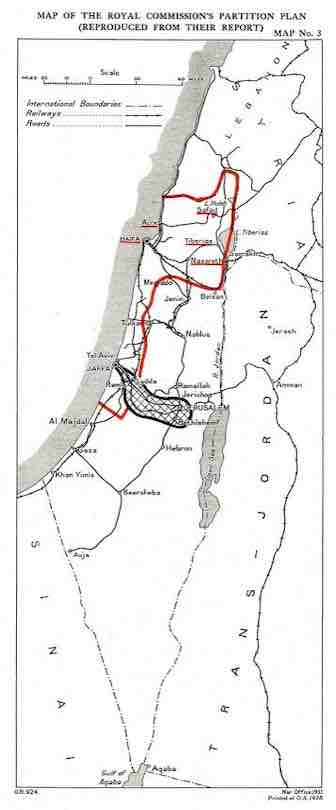
“I have no doubt that the only viable solution to the conflict resembles the one first set down on paper by another Briton, Lord Peel, in the report of the Royal Commission on Palestine in 1937, and that is the vision of two states for two peoples.”
The Royal Commission was authorised by Royal Warrant dated August 7, 1936 which did not mention the “Palestinians” - only naming two parties — the “Arabs” and the “Jews” — not three - as disputants.

The Peel Commission after a lengthy and detailed Inquiry concluded that:
“two sovereign independent States would be established - the one an Arab State, consisting of Trans-Jordan united with that part of Palestine which lies to the east and south of a frontier such as we suggest in [the map] below; the other a Jewish State consisting of that part of Palestine which lies to the north and west of that frontier.”
The Arabs rejected this decision. The Jews disputed the boundaries.

Trans-Jordan in 1937 then comprised the remaining 78% of the Mandate territory closed by Britain to Jewish settlement under Article 25.

Jewish settlement in Judea and Samaria however was to be facilitated and encouraged under article 6.

The PLO’s outright refusal to negotiate with Israel on President Trump’s Peace Plan strengthens Netanyahu’s decision to restore Jewish sovereignty in 30% of Judea and Samaria after 3000 years.

Johnson’s hypocritical posturing should reinforce - not weaken — Netanyahu’s resolve.


Monday, April 13, 2020

PLO continues to denigrate Trump peace plan and ignore elections


[Published 13 April 2020]


The Palestine Liberation Organisation (PLO) has cranked up its propaganda machine to continue denigrating President Trump’s deal of the century - as a joint US-Israel Mapping Committee is finalising those areas in Judea and Samaria on Trump’s map where Jewish sovereignty can be restored after 3,000 years.

The PLO rejected Trump’s plan on the day it was published – 28 January 2020 — even though it provided for the creation of a second Arab State in former Palestine — in addition to Jordan — for the first time in recorded history.

WAFA — the Palestinian news and information agency — has attacked Trump’s move to start implementing his plan in an article headlined:“PLO official warns of Israeli plan to annex parts of West Bank” — which headline itself is false and misleading for the following reasons:

1. It is not an Israeli plan but Trump’s plan being applied by Israel in tandem with Trump

2. Trump’s plan does not involve annexation by Israel - rather the restoration of Jewish sovereignty after 3000 years in the Jewish people’s ancient and biblical heartland in areas authorised by the San Remo Conference and Treaty of Sevres in 1920, the League of Nations Mandate for Palestine in 1922 and the United Nations Charter.

3. “West Bank” was only coined in 1950 to replace the 3000 years old geographic place name “Judea and Samaria” — after all the Jews living there had been ethnically cleansed by Transjordan during the 1948 War of Independence - and Judea & Samaria was unified with Transjordan to form a new territorial entity— renamed Jordan.
Wafa’s report references a statement by Ahmad Majdalani — Member of the PLO Executive Committee and Minister of Social Affairs:
“Uncovered reports that Washington and Tel Aviv are about to agree on the maps of annexation [of parts of the West Bank] — at a time the world is preoccupied with the war on coronavirus — falls within the framework of the US plan to implement the “deal of the century”
Note:
1. No uncovered reports are produced

2. Repetition of the false and misleading terms "annexation" and "West Bank"

3.The world might be preoccupied with the war on coronavirus but Governments —i ncluding the US and Israeli Governments — have not stopped governing and making decisions, and to suggest they should is arrant nonsense
Wafa asserts:
“The PLO official stressed that the US-Israeli plan undermines the basic principles of the Palestinian-Israeli peace process and the resolutions of the international community, calling on the latter to compel Israel to abide by these resolutions.”
No mention that:
1. Negotiations between Israel and the PLO spanning various periods between 1993 and 2014 have failed to produce any resolution

2. negotiations have not been held since 2014
Majdalani concludes:
“This plan, drawn with maps by the teams of the Israeli occupation and the Trump administration, is the actual implementation of the “deal of the century”, which means an end to the two-state solution.”
False:
1. Israel’s occupies 60% and the PLO 40% of Judea and Samaria pursuant to the 1993 Oslo Accords

2. The “two-state” solution is very much alive under Trump’s Plan. It just doesn’t meet the PLO’s non-negotiable demand for the last 53 years claiming a state in 100% of Judea and Samaria.
The PLO has not called any general election since 2006.

Holding elections now would allow 95% of Judea and Samaria’s Arab population currently living under the PLO’s tyrannical and oppressive governance in Areas “A” and “B” to have their say on Trump’s two-state proposal and the PLO’s continuing rule over them.

The deathly-silent international community needs to stop fawning over the PLO and demand such long-overdue elections take place.

Author’s note: The cartoon, commissioned exclusively for this article, is by Yaakov Kirschen aka “Dry Bones” — one of Israel’s foremost political and social commentators — whose cartoons have graced the columns of Israeli and international media publications for decades. His cartoons can be viewed at Drybonesblog

Saturday, July 6, 2019

Trump recognizes Israel claims in West Bank and East Jerusalem


[Published 12 June 2019]


US Ambassador to Israel — David Friedman — has set a cat among the pigeons with his claim that:
“Under certain circumstances I think Israel has the right to retain some, but unlikely all, of the West Bank.”
Friedman clearly was speaking for the Trump administration — not just himself personally — when he continued:
“We really don’t have a view until we understand how much, on what terms, why does it make sense, why is it good for Israel, why is it good for the region, why does it not create more problems than it solves. These are all things that we’d want to understand, and I don’t want to prejudge.”
Friedman accused the Obama administration — which in the last month of Obama’s Presidency - allowed passage of a United Nations resolution in December 2016 condemning Israeli settlements as a “flagrant violation” of international law, of giving credence to Palestinian Arab arguments “that the entire West Bank and East Jerusalem belong to them.”

Friedman asserted:
“Certainly Israel’s entitled to retain some portion of it”
Friedman was spot on.

The right of the Jewish people to reconstitute the Jewish National Home in at least some parts of the West Bank and East Jerusalem was recognised by:
1. the 1920 San Remo Conference

2. the 1920 Treaty of Sevres,

3. articles 6 and 25 of the 1922 League of Nations Mandate for Palestine (Mandate) and

4. article 80 of the 1945 United Nations Charter
Friedman’s criticism of the United Nations attempt to subvert the Jewish peoples’ legal rights created under the Mandate and preserved under the United Nations own Charter to “close settlement by Jews on the land including State lands and waste land not required for public purposes” located in the West Bank and East Jerusalem — was justified and long overdue.

Friedman postulated:
“The absolute last thing the world needs is a failed Palestinian state between Israel and Jordan.”
He could have also added that:
1. Jordan is a Palestinian Arab state that has occupied 78% of the land comprised in the Mandate for Palestine since 1922

2. Redrawing the international boundary between Jordan and Israel in direct negotiations between those two states as successor States to the Mandate could see parts of the West Bank and East Jerusalem incorporated within each of these two existing states thereby eliminating any danger a failed third state would pose to their security and existence.
Interestingly — Friedman indicated that Trump’s long awaited “deal of the century” might not even be released if Trump believed it would do more harm than good.

Friedman reportedly said the United States would coordinate closely with Jordan — which could face unrest among its large Palestinian population over a plan perceived as overly favourable to Israel.
“We don’t want to make things worse. Our goal is not to show how smart we are at the expense of people’s safety.”
Trump has seemingly anointed Jordan to replace the rejectionist Palestine Liberation Organization as Israel’s negotiating partner on the future of the West Bank and East Jerusalem.

It now appears that Trump’s proposals will not see the light of day unless Trump receives an unqualified assurance from Jordan that it is willing to negotiate with Israel before the plan’s details are released.

Recognising Israel has claims in the West Bank and East Jerusalem sends a clear signal to Jordan and the rest of the Arab World that time is not on their side. The opportunity to yet again miss another opportunity to make peace looms large.

Trump has targeted the West Bank and East Jerusalem — as he already has in West Jerusalem and the Golan Heights — with amazing prescience.

Author’s note:The cartoon — commissioned exclusively for this article — is by Yaakov Kirschen aka “Dry Bones” - one of Israel’s foremost political and social commentators — whose cartoons have graced the columns of Israeli and international media publications for decades. His cartoons can be viewed atDrybonesblog

Monday, May 16, 2016

Palestine - 1922 Two-State Solution Key To Resolving Arab-Jewish Conflict


[Published 22 October 2015]


United Nations Secretary-General Ban-Ki moon has jetted into Jerusalem on a fool’s errand - with tensions continuing to escalate between Arabs and Jews as their conflict spanning almost 100 years remains unresolved.

The Secretary-General observed:
“Beyond the immediate tensions, what is missing is the resolve to restore a political horizon for talks, and a political process that delivers real results and hope… We must, for the future of our children, turn back from this dangerous abyss, safeguard the two-state solution and lead people back onto the road towards peace,”

Safeguarding this “two-state solution” – code words for creating a second Arab State in Mandatory Palestine in addition to Jordan – is a lost cause. Restoring talks on this failed political process after twenty years of fruitless negotiations is meaningless United Nations babble speak.

The Secretary-General needs to focus on the “two-state solution” actually existing in 2015 – Israel and Jordan – the two successor States to the 1922 Mandate for Palestine – which eventually emerged after:
1. the 1920 Arab riots and

2. the political machinations of France and Great Britain between 1920 and 1922.
The riots were intended to pressure decisions affecting the fate of Palestine, Lebanon, Syria and Mesopotamia (Iraq) at the San Remo Conference starting on 19 April 1920 - following the liberation of those territories from 400 years of Ottoman Empire rule in World War 1.

The Arabs opposed a Jewish homeland in Palestine – and went on a murderous rampage to express their rage. 5 Jews and 4 Arabs were killed and hundreds wounded between 4 April and 7 April 1920.

However,the riots had little impact on the decisions taken at San Remo and the subsequent signing of the Treaty of Sevres.

The resulting Mandate for Palestine – adopted unanimously by all 51 member States of the League of Nations on 24 July 1922:
1. Gave recognition to the historical connection of the Jewish people with Palestine and to the grounds for reconstituting their national home in that country

2. Empowered Great Britain as the Mandatory Power to be responsible for placing the country under such political, administrative and economic conditions as would secure the establishment of the Jewish national home whilst safeguarding the civil and religious rights of existing non-Jewish communities in Palestine and the rights and political status enjoyed by Jews in any other country.
The Mandate, however, contained Article 25 – a provision used to deny the Jews the right to reconstitute the Jewish National Home in Transjordan - 78% of the territory of Mandatory Palestine.

The inclusion of Article 25 followed French pressure on the British to stop Abdullah – the second son of the Sharif and Emir of Mecca Hussein bin Ali – leaving Transjordan whilst en route to Damascus with an armed force of 400 Arabs to help his brother Feisal resist French attempts to remove him from power in Syria.

Britain obliged by appointing Abdullah Emir of Transjordan on 11 April 1921. This Emirate became the independent Jew-free Hashemite Kingdom of Transjordan in 1946 – today’s Jordan.

Achieving these British and French objectives closed the door firmly on any right to reconstitute the Jewish National Home in Transjordan - confining that right within the remaining 22% of Mandatory Palestine – today’s Israel, the West Bank (Judea and Samaria) and Gaza.

Redrawing the current boundaries of that fateful 1922 decision - taking into consideration today’s changed circumstances on the ground - remains the key to ending the Arab-Jewish conflict.

Pencils and rubbers wielded by Israeli and Jordanian negotiators can end the indiscriminate murder and maiming of Jews by Arab gun-toters, knife-stabbers, stone-throwers and car-rammers - and the inevitable Jewish response.

Saturday, October 17, 2015

Palestine - Bandar Candour Can Help End Arab-Jewish Conflict


[Published 27 October 2013]


Saudi Arabia’s intelligence chief - Prince Bandar bin Sultan - made a secret visit to Jordan this week - according to a report in Ammon News dated 25 October - reportedly meeting with Jordanian officials to discuss recent developments in the region - especially the Syrian file.

It would be inconceivable that they did not also discuss the Palestinian file - where any prospect of achieving a “two-state solution” for the first time ever in recorded history involving the creation of a second Arab state in former Palestine - in addition to Jordan - seems destined to certain failure after twenty years of fruitless negotiations trying to procure such an outcome.

Bandar’s visit to Jordan came hard on the heels of a conference held in Israel - where Israel’s lead negotiator in current secret two-state negotiations with the PLO - Tzipi Livni - is reported by the Jerusalem Post to have made the following remarks:
“Livni said she supported an ideological debate on the Israeli-Palestinian conflict. But what really bothers her, she said, is that the opponents of a two-state solution have failed to put forward a legitimate alternative that is consistent with Jewish values and that would allow Israel to continue its relations with the international community.

She warned that failure to finalize an agreement with the Palestinians puts Israel at risk of having an unfavorable solution imposed upon it.

There are only two options facing Israel, she said, a one -state solution or a two-state solution, and only a two-state solution ensures a Jewish and democratic state. She noted that the goal of the nine months negotiating process begun almost three months ago is a final-status agreement to end all claims by both sides.”

Livni is wrong - and Bandar would be the first to castigate her for her unpardonable error.

There are three possible one-state solutions that would ensure a Jewish and democratic state - which involve merging the West Bank and Gaza:
1. Entirely with Jordan or
2. Dividing between Israel and Jordan or
3. Dividing between Israel, Jordan and Egypt

Twenty-three years ago in an Open Letter published in the Washington Times on 30 September 1990 - Bandar - then Saudi Arabia’s Ambassador in America - had publicly criticised Jordan’s King Hussein for his failure to create a Palestinian Arab State in the West Bank between 1948-1967.

Bandar made the following three very pertinent comments:
“Your Majesty, you claimed to defend the Palestinian people`s right to self-determination and a state of their own. And I support you in that. But you were responsible for the Palestinian homeland on the West Bank from 1948 to 1967. Why in all that period did you not give them their rights and statehood?

You are a very intelligent man, Your Majesty. And you have a fine memory. You say the Kuwait-Iraqi border is disputed and based on a historical record created by the colonial British. Your Majesty, you should be the last one to say that. Not only all your borders, but your whole country was created by the same colonial British.

Tell us, Your Majesty, what you have done to safeguard the Al-Aqsa Mosque and the Church of the Holy Sepulchre that you lost to the Israelis in 1967, almost a quarter of a century ago?"

Bandar was right in sheeting home the blame on Jordan - but he also failed to acknowledge that the Arab League shared a major part of the responsibility for failing to have achieved that “two-state solution” during 1948-1967 - when not one Jew lived in Gaza, the West Bank and East Jerusalem after they had all been permanently driven from their homes by six invading Arab-League members’ armies in 1948,

Bandar correctly identified that the conflict did not begin in 1948 - but started with the “colonial British” - who in 1922 planted the seeds enabling the ultimate creation of the Hashemite Kingdom of Transjordan in 1946 - thus denying the Jews the right to reconstitute the Jewish National Home in 76.9% of the territory originally intended for that purpose by the San Remo Conference as confirmed in the Treaty of Sevres in 1920.

Former US President Jimmy Carter neatly summed up this British decision in Time on 11 October 1982:
“As a nation it (Jordan) is a contrivance, arbitrarily devised by a few strokes of the pen”

With the two-state solution now in tatters - Jordan must resolutely face up to the responsibility incumbent on it to end the Arab-Jewish conflict by negotiating with Israel to achieve the most realistic one-state solution presently attainable - dividing the West Bank between Israel and Jordan.

Jordan’s opportunity to belatedly rectify the errors committed by it between 1948-1967 would have almost certainly been aired in the secret discussions this week in Jordan with Bandar.

Jordan’s King Abdullah would be well aware of the words of his father - the late King Hussein - who stated in his Autobiography - Uneasy Lies The Head:
“Palestine and Transjordan were both under British Mandate, but as my grandfather pointed out in his memoirs, they were hardly separate countries. Trans-Jordan being to the east of the river Jordan, it formed in a sense, the interior of Palestine”

The idea that Saudi Arabia could actually be encouraging Jordan to help end - if not finally terminate - the Arab-Jewish conflict within the context of secret discussions - is fascinating to contemplate.

The PLO has undeniably botched its chances.

Sunday, August 2, 2015

Palestine - Obama Chooses Zionism Over Rejectionism


[Published 8 April 2013]


Veteran Israeli peace activist and former Knesset member Uri Avnery points out in his latest article “Obama’s Empathy Deficit in Palestine” that there are two completely divergent Jewish and Arab narratives driving each other’s current claims to the territory once called Palestine.
“Our conflict is tragic, more than most. One of its tragedies is that neither side can be entirely blamed. There is not one narrative, but two. Each side is convinced of the absolute justice of its cause. Each side nurses its overwhelming sense of victimhood.”

Avnery is very upset that President Obama had apparently chosen to empathise with the Jewish narrative during his recent visit to Jerusalem, Ramallah and Amman.
“The trouble with Obama is that he has completely, entirely, totally embraced one narrative, while being almost completely oblivious to the other. Every word he uttered in Israel gave testimony to his deeply-rooted Zionist convictions. Not just the words he said, but the tone, the body language, all bore the marks of honesty. Evidently, he had internalized the Zionist version of every single detail of the conflict.”

The reasons Avnery attributes for Obama empathising with Israel are shallow and misconceived.
“It was really amazing. He must have studied us thoroughly. He knew our strengths and our weaknesses, our paranoias and our idiosyncrasies, our historical memories and dreams about the future.

And no wonder. He is surrounded by Zionist Jews. They are his closest advisors, his friends and his experts on the Middle East. Even from mere contact with them, he obviously absorbed much of our sensitivities.

As far as I know, there is not a single Arab, not to mention Palestinian, in the White House and its surroundings.”

This shabby explanation indicates little understanding of the multitude of advice that is received by any President from a variety of sources and the need for the President to ultimately sort the wheat from the chaff.

Avnery’s outburst regrettably leaves his readers in the dark by failing to actually quote President Obama’s carefully crafted remarks:
“For the Jewish people, the journey to the promise of the State of Israel wound through countless generations. It involved centuries of suffering and exile, prejudice, pogroms and even genocide. Through it all, the Jewish people sustained their unique identity and traditions, as well as a longing to return home. And while Jews achieved extraordinary success in many parts of the world, the dream of true freedom finally found its full expression in the Zionist idea – to be a free people in your homeland.”

It is indeed this Zionist idea that has been rejected both by Avnery personally and by the Palestinian Arabs in their narrative.

The Palestinian Arab narrative ignores Obama’s sweep of history - starting its narrative from 1948 by characterising the conflict as the “Israeli - Palestinian conflict”- thus allowing such narrative to completely ignore a host of critical events that occurred between 1917-1947.

This rejectionism is clearly evident in article 20 of the 1968 PLO Charter:
"Article 20: The Balfour Declaration, the Palestine Mandate, and everything that has been based on them, are deemed null and void. Claims of historical or religious ties of Jews with Palestine are incompatible with the facts of history and the conception of what constitutes statehood. Judaism, being a religion, is not an independent nationality. Nor do Jews constitute a single nation with an identity of their own; they are citizens of the states to which they belong.”

The Palestinian Arab narrative conveniently ignores the fact that the two-state solution was first suggested in 1922 and actually proposed and rejected by the Palestinian Arabs in 1937, 1938 and 1947.

The Palestinian Arab narrative has no memory or remorse for the Arab riots in 1920 and 1929 that targeted and slaughtered Jews or the 1936-1939 Arab revolt which wrought similar havoc on Jews living in Palestine during those turbulent years.

Starting from 1948 the Arab narrative can avoid confronting the reality that Winston Churchill told a delegation of Palestinian Arabs leaders in 1921 urging him to halt Jewish immigration to Palestine:
“It is manifestly right that the Jews,who are scattered all over the world,should have a national centre and a National Home,where some of them may be reunited. and where else could that be but in the land of Palestine, with which for more than three thousand years they have been intimately and profoundly associated?”

The flawed Arab narrative also avoids accepting responsibility for the Arab pressure put on Great Britain to severely curtail Jewish immigration to Palestine between 1939 and 1945 - resulting in hundreds of thousands of Jews perishing at the hands of the Nazis when their lives might have been spared had Great Britain ignored such inhumane Arab demands.

The Arab narrative has always rejected - and will continue to reject - the will of the international community expressed in the 1920 San Remo Conference and the Treaty of Sevres, the 1922 Mandate for Palestine and article 80 of the 1945 United Nations Charter.

Avnery’s dismay at President Obama’s adoption of the “Zionist idea” is explained on Avnery’s own website:
“After some years of sporadic political activity, in 1946 Avnery founded the Eretz Yisrael Hatzira (“Young Palestine”) movement, also known as the “Bamaavak (Struggle) group” from the name of its publication, which he edited. This group provoked an unprecedented uproar because of its contention that the Jewish community in Palestine constituted a “new Hebrew nation” within the Jewish people, and that this nation belongs to Asia and is a natural ally of the Arab national movements.”

From Avnery’s viewpoint the Jewish community in Palestine in 1945 had no biblical or historical connection with Palestine - or any right to reconstitute the Jewish National Home in Palestine - despite the League of Nations imprimatur to do so.

Avnery’s rejection of the Zionist idea identified with the viewpoint of the Arab population of Palestine in 1945 - whose opposition to Jews immigrating to Palestine had been violently resisted ever since the Allied Powers decided in 1920 that Arab self- determination should occur in 99.99% of the liberated Ottoman Empire - whilst Jewish self-determination should take place in Palestine - the remaining 0.01%.

President Obama has indeed empathised with the Jewish narrative - which dates the “Jewish - Arab conflict” as having begun in 1880 - not 1948.

Until both narratives at the very least commence from an agreed starting date - one can confidently predict that any talk of peacefully resolving the ongoing and unresolved conflict is a complete waste of time.

Hopefully President Obama has taken the first step to ram this message home.

Monday, October 7, 2013

Israel - Negotiating With Naysayers Needs Nous


[Published 19 July 2010]


Egypt has been the latest venue for attempts to kick start direct negotiations between Israel and the Palestinian Authority.

Israel’s Prime Minister Benjamin Netanyahu, Palestinian Authority Chairman Mahmoud Abbas and President Obama’s special envoy George Mitchell jetted into Cairo over the weekend for more talks with Egyptian President Hosni Mubarak and a clutch of other lesser dignitaries from the Arab League designed to revive what has become increasingly seen as irrelevant and a complete waste of time - creating a new Arab state between Israel and Jordan.

Abbas continues to reject the idea of such a state being created in 93.5% of the West Bank with an additional area equivalent to the remaining 6.5% being carved out of Israel’s sovereign territory.

Abbas has rejected that offer since it was made to him by former Israeli Prime Minister Ehud Olmert in December 2008. Given that Israel has changed its Prime Minister since then - the chances of this offer even being open now can only be tested if Abbas publicly indicates his willingness to accept such an offer. That is not going to happen.

The Arabs have always found it impossible to say “Yes” when it comes to any offers of compromise.

The Arabs have seen their personal hopes and aspirations in former Palestine in constant decline as a result of their refusal to accept:

(i) The division of 99.999% of the Ottoman Empire to the Arabs and 0.001% to the Jews as determined in 1920 at the San Remo Conference and by the Treaty of Sevres

(ii) The binding legal effect of the 1922 League of Nations Mandate for Palestine

(iii) The partition recommendations for Palestine made by the Peel Commission in 1937

(iv) The 1947 United Nations Partition Resolution

(v) Recognition of Israel as the sovereign independent state of the Jewish people following its establishment in 1948

(vi) The opportunity to create an independent Arab state in the West Bank and East Jerusalem following its occupation by Jordan between 1948-1967 and in Gaza following its occupation by Egypt during that same period

(vii) Any negotiations with Israel after the Six Day War in 1967 until 1993

(viii) The offers made by Israel at Camp David in 2000 and 2001 and in 2008 under the Annapolis negotiating process


Conversely however their stocks in terms of international political support continue to rise the more their intransigence in seeking a solution to the Arab-Jewish conflict continues to harden.

The only possible solution that now presents itself as remotely achievable in the face of such obstinacy is the division of sovereignty of the West Bank between Jordan and Israel in direct face to face negotiations.

That solution too has been rejected by Jordan whose decision has been accepted internationally without demur and without any attempt to have it reconsider its position.

Obviously such Arab naysaying brings its rewards as Israel is pressured to make even more concessions whilst the Arabs sit back and continue to hold out for more.

Naysaying has now even affected the thinking of former Israeli Minister of Defence and Ambassador to Washington Moshe Arens who recently wrote:

“The Jordanian option has on occasion been raised as a promising approach. After all, most of Jordan’s population is Palestinian. For 19 years, Judea and Samaria were part of Jordan, its population Jordanian citizens, and the geographic juxtaposition between Israel and Jordan should make delineating the border between the two countries in an agreement considerably easier than reaching a deal on a border between Israel and a Palestinian state that might be established in the area. There is only one problem - the Jordanians won’t hear of it. They don’t want to overload their security apparatus, which has been functioning quite effectively, by including another 1.5 million Palestinians within their borders.”


Strangely no such complaints of overloading Jordan’s security apparatus were made when those same Palestinians were Jordanian citizens between 1948-1967. But Jordan’s continuing refusal to become involved in the West Bank based on this specious argument is sufficient reason enough for Arens to give up on the Jordanian option he has long advocated and seek other unrealistic alternatives.

It seems all right for Israel to be pressured to take “risks for peace” - but not Jordan.

Israel now needs to start some naysaying itself by declaring that it will not enter into further negotiations with the Palestinian Authority unless direct negotiations without conditions are resumed within 30 days.

Israel should make it clear that at the expiration of those 30 days it will call on King Abdullah to come and sit at the negotiating table with Israel to enable the two successor states to the Mandate for Palestine to complete some long outstanding and unfinished business - establishing for the first time ever an unconditional internationally recognized boundary between their respective states which has remained undetermined since the Israel-Jordan Armistice Agreement signed in 1949.

The Armistice Agreement clearly states:

“It is also recognised that no provision of this Agreement shall in any way prejudice the rights, claims and positions of either Party hereto in the ultimate peaceful settlement of the Palestine question, the provisions of this Agreement being dictated exclusively by military considerations.” [Article II (2)]

“The Armistice Demarcation Lines defined in articles V and VI of this Agreement are agreed upon by the Parties without prejudice to future territorial settlements or boundary lines or to claims of either Party relating thereto.[Article VI (9)]”


The demarcation of the internationally recognized boundary that eventually took place between Jordan and Israel under the Israel-Jordan Peace Treaty 1994 contains the following proviso:

“The boundary, as set out in Annex I (a), is the permanent, secure and recognised international boundary between Israel and Jordan, without prejudice to the status of any territories that came under Israeli military government control in 1967” [Article 3(2)]


Determining the status of those territories has been impossible to achieve with the Palestinian Authority for the last 17 years. It has been an exercise fraught with frustration caused by the intransigence of the Palestinian Authority. The time has come to determine the status of those territories with Jordan if the Palestinian Authority does not return to the negotiating table within the next thirty days.

Israel should say “no” to anything else - and continue saying “no“ until its demands are met - either by the Palestinian Authority or Jordan.

Naysaying is a tactic that has rewarded the Arabs. It is time for Israel to take a leaf out of their book and end the current farcical situation.

Sunday, April 17, 2011

Obama Won't Become Israel's Embalmer

[Published April 2010]

Speculation is rife that a far-reaching shift is taking place in how the United States views the Jewish-Arab conflict - and how aggressively America might push for a peace agreement between Israel and the Palestinian Authority.

Whilst nothing concrete has yet emerged to confirm such speculation - there is plenty of evidence available to suggest that President Obama will not be attempting to publicly impose any settlement on Israel that would not have first been approved of by Israel before its release.

America’s special relationship with and commitment to the future of the Jewish people extends over 90 years and was first made by United States President Woodrow Wilson on 3 March 1919 when he declared:
“I am persuaded that the Allied Nations, with the fullest consent of our own Government and people, are agreed that in Palestine shall be laid the foundation of a Jewish Commonwealth”

The reconstitution of the Jewish National Home in Palestine subsequently became accepted at the San Remo Conference on 25 April 1920, was confirmed by Article 95 of the Treaty of Sevres on 10 August 1920 and adopted by the unanimous approval of the League of Nations in the Mandate for Palestine on 24 July 1922.

America was not a member of the League of Nations but on 30 June 1922 a joint resolution of both Houses of Congress of the United States unanimously endorsed the Mandate.

On September 21, 1922 President Harding signed the joint declaration of approval to establish a Jewish homeland in Palestine.

Two days later a Memorandum was presented to the League of Nations by the British Government denying the Jews the right to establish their national home in 77% of Mandatory Palestine - today called Jordan.

This left the remaining 23% of Palestine west of the Jordan River - today called Israel, the West Bank and Gaza - as the only remaining location available for fulfilling the Mandate’s Jewish National Home objective

The Mandate was clear in stating that:
1.The Jewish National Home was to be established in Palestine whilst safeguarding the civil and religious - (but not any political) - rights of “the existing non-Jewish communities in Palestine” irrespective of race and religion.

2.Jewish immigration and close settlement on the land, including state lands and waste lands not required for public purposes was to be encouraged.

The demise of the League of Nations in 1945 did not mean an end to these rights vested in the Jewish people. They were preserved by the introduction of Article 80 - known as “the Palestine Clause” - in the United Nations Charter. America took a leading role in the drafting and inclusion of Article 80.

At midnight on May 14, 1948, the Provisional Government of Israel proclaimed a new State of Israel. 11 minutes later the United States, in the person of President Truman, recognized the provisional Jewish government as de facto authority of the Jewish state (de jure recognition was extended on January 31, 1949).

On 15 May 1948 six Arab armies invaded Palestine.

At the conclusion of hostilities Egypt had occupied Gaza and Jordan had occupied the West Bank. Both continued to do so until Israel assumed control of both areas on 10 June 1967 following the conclusion of the Six Day War.

America led the drafting of Security Council Resolution 242 - passed on 22 November 1967 - which did not require Israel to return to the armistice lines existing since 1949 - but only to secure and recognized boundaries.

The conditional acceptance by Israel of President Bush’s Roadmap issued on 30 April 2003 led to Israel proposing a unilateral withdrawal from Gaza - but only after it had received the following written assurances from President Bush on 14 April 2004:
•The United States would do its utmost to prevent any attempt by anyone to impose any other plan.

•The United States reiterated its steadfast commitment to Israel’s security, including secure, defensible borders, and to preserve and strengthen Israel’s capability to deter and defend itself, by itself, against any threat or possible combination of threats.

•The United States understood that after Israel withdrew from Gaza and/or parts of the West Bank, and pending agreements on other arrangements, existing arrangements regarding control of airspace, territorial waters, and land passages of the West Bank and Gaza would continue.

•The United States was strongly committed to Israel’s security and well-being as a Jewish state.

•It seemed clear that an agreed, just, fair and realistic framework for a solution to the Palestinian refugee issue as part of any final status agreement would need to be found through the establishment of a Palestinian state, and the settling of Palestinian refugees there, rather than in Israel.

•As part of a final peace settlement, Israel must have secure and recognized borders, which should emerge from negotiations between the parties in accordance with UNSC Resolutions 242 and 338. In light of new realities on the ground, including already existing major Israeli populations centers, it was unrealistic to expect that the outcome of final status negotiations would be a full and complete return to the armistice lines of 1949, and all previous efforts to negotiate a two-state solution had reached the same conclusion. It was realistic to expect that any final status agreement would only be achieved on the basis of mutually agreed changes that reflect these realities.

The importance of these American commitments to Israel was stressed in a speech given in the Knesset by Prime Minister Sharon on 22 April 2004 when he stated:
“The political support we received during my visit to the United States is an unprecedented accomplishment for Israel. Since the establishment of the State, we have not received such vast and staunch political support, as was expressed in the President’s letter.”

President Bush’s letter of commitment to Israel was subsequently approved by the US Senate and House of Representatives on 23 June and 24 June 2004.

On 11 April 2005 President Bush again confirmed these American commitments to Prime Minister Sharon in Crawford - Texas.

At the Annapolis Conference convened on 27 November 2007, Israel made its future negotiating stance clear when Israel’s then Prime Minister - Ehud Olmert - said in the presence of President Bush:
” The negotiations will be based on previous agreements between us, UN Security Council Resolutions 242 and 338, the Roadmap and the April 14th 2004 letter of President Bush to the Prime Minister of Israel.”

For President Obama to unilaterally seek to impose a settlement contrary to these American commitments extending over 90 years would be a complete abnegation of America’s credibility in the international arena. America would be exposed as a nation whose commitments are not worth the paper they are written on. America’s proud record of standing by and honoring the commitments it makes would be shattered forever.

Israel’s enemies are unceasing in their determination to end the Jewish State’s existence. President Obama is not going to oblige them and become Israel’s embalmer by breaching any of America’s solemn commitments made to the Jewish people.

Reuters Reprehensible Report Requires Retraction

[Published March 2010]

Reuters - considered the world’s top news source - has allowed its credibility to be seriously damaged with the publication of its “Timeline: Path to new Israel-Palestinian talks” on 7 March 2010.

Its cursory - almost totally dismissive - omission of Jewish claims to reconstitute the Jewish National Home in Palestine - are made blatantly clear at the beginning of its Timeline which states:
“Here are key dates on the path to this point:
1897 - European Jews in Zionist movement declare goal of creating a Jewish state in Ottoman Turkish-ruled Palestine.

1917 - British forces take Palestine from collapsing Ottoman empire in World War One. British Foreign Secretary Arthur Balfour declares support for Jewish “national home” there.

1945 - Revelation of Nazi Holocaust and new Jewish migration to Palestine bolster Western support for creating Jewish state.

1948 - Britain quits and great powers recognize Israel as U.N. partition plan dissolves in war that leaves Jewish state on 78 percent of land and half of Palestine’s Arabs as refugees.”

1967 - In what it calls pre-emptive strikes on Arab states, Israeli forces seize rest of British-mandate Palestine, taking West Bank and East Jerusalem from Jordan and Gaza Strip from Egypt. Israel captures Golan Heights from Syria.

1988 - After a year of Intifada (uprising), exiled PLO leader Yasser Arafat, widely acknowledged as speaking for Palestinians, renounces “terrorism” and accepts Israel’s right to exist.

Omitted from this hastily concocted version are the following crucial - and critical - dates:
1920: Treaty of Sevres entrusts the administration of Palestine to a Mandatory for putting into effect the establishment in Palestine of a national home for the Jewish people.

1922: Britain appointed Mandatory for Palestine by unanimous vote of the League of Nations. 78% of Mandate Palestine excluded from inclusion in the future Jewish National Home in area known as Transjordan which is exclusively reserved for Arab homeland.

1937: Peel Commission recommends division of Palestine into two States - one Jewish, one Arab . Arabs reject recommendation.

1939: Britain severely limits Jewish emigration to Palestine in breach of Mandate for duration of World War Two.

1945: League of Nations wound up and United Nations created. Article 80 inserted in United Nations Charter preserves Jewish rights to establish Jewish National Home in Palestine.

1946: Britain grants Transjordan independence in 78% of Mandate Palestine.

1947: United Nations votes to divide remaining 22% of Mandate Palestine into two states - one Jewish, one Arab. Arabs reject recommendation. Fighting breaks out between Jews and Arabs.

1948: Reuters omits to mention that

•six Arab armies invaded Palestine
•Egypt occupied Gaza and Transordan occupied the West Bank and East Jerusalem
•The Palestinian National Conference decides to place the West Bank under the sovereignty of Transjordan and
•Erroneously states that Israel ended up with 78% - not 17% - of the land

1949: Transjordan changes its name to Jordan

1950: The West Bank and Jordan are unified into one country by the Jordanian Parliament comprising equal number of West Bank and Jordanian representatives

1967: Reuters omits to mention Security Council Resolution 242 requiring Israel to only withdraw to secure and recognized boundaries.

1988: Jordan cedes any claims to the West Bank


This perversion of the history of Palestine is either induced by ignorance or a deliberate suppression of critical information that goes to the heart of the debate currently raging at the moment.

Inclusion of the above dates in Reuters Timeline would substantiate Jewish claims to be entitled to sovereignty in all or part of the West Bank and East Jerusalem and to build settlements there based on the League of Nations Mandate for Palestine and article 80 of the United Nations Charter - rights grounded in international law.

Their absence from the Timeline needs to be explained or justified by Reuters if it is to regain any credibility in its reporting in the Middle East.

This Timeline has now been distributed throughout Reuters extensive network and can be viewed on its American, British and Indian websites and has been published and reproduced by other web sites and news services.

It has also been distributed on Reuters AlertNet site which proudly claims:
“AlertNet attracts upwards of ten million users a year, has a network of 400 contributing humanitarian organizations and its weekly email digest is received by more than 26,000 readers

It was started in 1997 by Reuters Foundation - an educational and humanitarian trust - to place Reuters’ core skills of speed, accuracy and freedom from bias at the service of the humanitarian community.”


Any claim to Reuters possessing these core skills is exposed as a sham and continues the gross media bias that continues to bury Jewish claims in international law to the West Bank and Gaza and to settle there to reconstitute the Jewish National Home.

Reuters continues the practice of the United Nations which similarly omitted any mention of many of these critical dates when seeking an advisory opinion of the International Court of Justice in 2004 on the legality of the construction of the security barrier on and over the 1967 armistice lines.

Judge Elaraby - gave this warning to his fellow 14 judges sitting on that case:
“,,, the international legal status of the Palestinian Territory merits more comprehensive treatment”.

Judge Elaraby identified the need for such a review saying:
“A historical survey is relevant to the question posed by the General Assembly, for it serves as the background to understanding the legal status of the Palestinian Territory on the one hand and underlines the special and continuing responsibility of the General Assembly on the other. This may appear as academic, without relevance to the present events. The present is however determined by the accumulation of past events and no reasonable and fair concern for the future can possibly disregard a firm grasp of past events. In particular, when on one or more than one occasion, the rule of law was consistently sidestepped.”

Judge Elaraby continued:
“The point of departure, or one can say in legal jargon, the critical date, is the League of Nations Mandate which was entrusted to Great Britain”

The bias of the United Nations against Israel in omitting to refer to the Mandate when approaching the International Court is par for the course.

Reuters omission to similarly inform its millions of readers now places it on a similar pedestal following the publication of its grossly inaccurate and misleading Timeline.

The best thing Reuters can do is immediately withdraw its Timeline. I would hope it has the integrity and honesty to do so with an appropriate - and prominent - apology for its publication in the first place.

Saturday, April 16, 2011

Palestine - Mediterranean Union Misses Making Its Mark

[Published February 2010]

An International Meeting in support of Israeli- Palestinian Peace was organized by the Parliamentary Assembly of the Mediterranean Union and the Committee on the Exercise of the Inalienable Rights of the Palestinian People [CEIRPP] of the United Nations in Malta on 12 and 13 February 2010.

The Union now includes all 27 member states of the European Union, along with 16 partners across the Southern Mediterranean and the Middle East.

The meeting turned out to be the usual talkfest in flogging a dead horse - the creation of a 22nd Arab State between Jordan, Israel and Egypt - also known as “the two-state solution“. This solution has been unsuccessfully pursued for the last 16 years and there is no possible chance that such a resolution will be achieved at any time in the future.

The two-state solution could have been availed of in 1937,1947, between 1948-1967, in 2000/2001 and 2008 but was rejected on each occasion by the Arabs. It will continue to be rejected by the Arabs who are not prepared to tolerate Israel gaining sovereignty in any part of the West Bank.

Despite the hopelessness of ever reaching the two-state solution - those present in Malta still concluded in their final communique :
“The Organizers appreciated that the participants had stated their firm commitment to ending Israeli occupation which started on 4 June 1967 in order to achieve a permanent two-State solution in which Israel and Palestine would live side by side in peace and security within mutually recognized borders. …

The Organizers support the firm stance by the international community not to recognize any changes to the pre-1967 borders including with regard to occupied Jerusalem, other than those agreed by the parties.”

These statements go to the heart of explaining why the two-state solution can never be achieved for the following reasons:
•Israel’s occupation of the West Bank as a consequence of the Six Day War in 1967 is conveniently forgotten

•The use of the term “borders” is clearly wrong. There were in 1967 - and still are in 2010 - only armistice lines - a legacy of the Arab League‘s refusal to recognize Israel and settle the final boundaries between Israel, Jordan and Egypt following the conclusion of hostilities in 1948.

•No recognition is given to Security Council resolution 242 which does not require Israel to withdraw from the entire West Bank but only to withdraw to secure and recognized boundaries

•The statement ignores the Palestinan Authority’s continuing refusal to surrender its claim to even one square metre of the West Bank to Israel.

•America has recognized that a change to the 1967 armistice lines is necessary given the changed circumstances on the ground where 500000 Jews now live in the West Bank and East Jerusalem. The notion that these Jews can be forcibly evicted from their homes is racist and offensive.

•No account has been taken of the League of Nations Mandate for Palestine which provides that the West Bank and East Jerusalem were to form part of the area within which the Jewish National Home was to be reconstituted and that such right has been preserved by Article 80 of the United Nations Charter.

No doubt the tone and language of the final communique was inevitable given the involvement of the CEIRPP, whose participation ensured that no attention would be paid to Arab intransigence and lost opportunities over 62 years - which has been largely responsible for any progress in finalizing the two-state solution.

What was particularly interesting was the frequent reference to the importance, observance and respect for the rule of international law in resolving the conflict to achieve the two-state solution. Such a reference appears on six separate occasions in the communique.

Yet the Mandate for Palestine and article 80 of the United Nations Charter didn’t rate a mention in Malta.

Strangely enough these critical documents were also omitted from inclusion by the United Nations Secretary General in the brief submitted to the World Court when seeking the advisory opinion of the Court on the legality of the construction of Israel’s security barrier in the West Bank.

One wonders whether any of these august bodies will eventually take the time to read the Mandate and article 80 and fully understand what was determined by the League of Nations in 1922 following the Treaty of Sevres in 1920.

This is not ancient history but has been kept alive and is relevant today by virtue of Article 80.

Whilst the United Nations and its member States flagrantly breach the terms of the UN Charter pursuing a course of conduct that is completely devoid of compliance with and acknowledgment of international law, any hope of a peaceful resolution of the conflict between Jews and Arabs relating to the territory once called “Palestine” will be impossible.

The reference by the Malta Meeting to the West Bank as “occupied Palestinian land” rather than “territory disputed between Jew and Arabs” further indicates an Arab bias that needs to be eradicated if the Mediterranean Union wishes to play any future role in resolving the conflict.

A hint of things to come was apparent in the following terms of the final communique:
“They [the participants] expressed their hope that the ten-month freeze of settlement expansion declared by the Israeli Government would be comprehensive, extended to East Jerusalem and retained indefinitely. “

Israel will no doubt be subjected to intense pressure to comply with this demand - irrespective of whether the Palestinian Authority resumes negotiations within the ten months time frame or not.

Rather than exploring new ideas to end the conflict, the Malta Meeting trotted out the old and familiar phrases that have formed the vocabulary of Middle East diplomacy for decades.

In doing do the Mediterranean Union has shown itself unable to break free from the failures of the past and embrace new and innovative ideas - such as the return of Jordan to the West Bank - which might offer some hope to resolving what President Obama has described as “an intractable problem”.

Saturday, November 27, 2010

West Bank - Jews Worldwide Have Legal Rights

[Published January 2010]

Catherine Ashton - High Representative of the Union for Foreign Affairs and Security Policy/Vice-President of the European Commission - was merely parroting European Union policy when she told the European Parliament in Strasbourg on 30 December 2009:
"East Jerusalem is occupied territory, together with the rest of the West Bank.”

It was justification enough however for Israel’s Deputy Foreign Minister Danny Ayalon to pen an article in the Wall Street Journal on 30 December 2009 pointing out that Israel considers these territories to be “disputed territories” rather than “occupied territories” - the nomenclature adopted by the United Nations General Assembly and the International Court of Justice.

Mr Ayalon stated the reasons for Israel‘s position as follows:
“That’s because the land now known as the West Bank cannot be considered "occupied" in the legal sense of the word as it had not attained recognized sovereignty before Israel’s conquest. Contrary to some beliefs there has never been a Palestinian state, and no other nation has ever established Jerusalem as its capital despite it being under Islamic control for hundreds of years.”

Mr Ayalon criticised the perception that:
“... Israel is occupying stolen land and that the Palestinians are the only party with national, legal and historic rights to it. Not only is this morally and factually incorrect, but the more this narrative is being accepted,the less likely the Palestinians feel the need to come to the negotiating table.”

Mr Ayalon was affirming that the West Bank was at present “no man’s land” in which no recognized State - including Israel - had yet attained sovereignty.

The current claimants - Israel on behalf of the Jewish people and the Palestinian Authority (PA) on behalf of the Palestinian Arabs - are yet to finally negotiate on and conclude the allocation of sovereignty between them based on their competing claims.

It was therefore particularly pleasing that Ms Ashton stated:
“ Negotiations should be based on international law and respect previous agreements.”

This should be seen as a welcome statement from the European Union since the international law dealing with the legal status of the West Bank and Jewish rights to claim sovereignty there has been consistently and studiously - perhaps even deliberately - overlooked since Israel‘s capture of the West Bank from Jordan in the 1967 Six Day War.

The International Court of Justice (ICJ) is a prime example of such oversight.

In its 2004 advisory opinion on the legality of the security barrier constructed by Israel - the ICJ omitted to even mention - let alone consider - the international law applicable to the entitlement of the Jewish people to reconstitute the Jewish National Home in the West Bank by close settlement on West Bank land - including State lands and waste lands not required for public purposes.

These rights were vested in the Jewish people pursuant to Articles 94 and 95 of the 1920 Treaty of Sevres, the League of Nations Mandate for Palestine 1920 and Article 80 of the United Nations Charter.

The failure of the ICJ to consider these Jewish rights is exacerbated by the fact that one of the Judges who heard the security barrier case - Judge Elaraby - gave this warning to his fellow 14 judges sitting on that case:
"... the international legal status of the Palestinian Territory merits more comprehensive treatment" .

Judge Elaraby identified the need for such a review saying:
"A historical survey is relevant to the question posed by the General Assembly, for it serves as the background to understanding the legal status of the Palestinian Territory on the one hand and underlines the special and continuing responsibility of the General Assembly on the other. This may appear as academic, without relevance to the present events. The present is however determined by the accumulation of past events and no reasonable and fair concern for the future can possibly disregard a firm grasp of past events. In particular, when on one or more than one occasion, the rule of law was consistently sidestepped."

The failure of the ICJ to consider the legal status of the West Bank was therefore inexplicable.

Judge Elaraby continued:
"The point of departure, or one can say in legal jargon, the critical date,is the League of Nations Mandate which was entrusted to Great Britain"

True the Arab League has never accepted the Mandate in which inalienable Jewish rights to closely settle the West Bank were created. But they were created by the unanimous vote of the then members of the League of Nations, still do exist for the benefit of the Jewish people today and are entitled to be taken into consideration in negotiations on the future sovereignty of the West Bank.

The Jerusalem Post reported on 25 September 2008 that there were 13.3 million people around the world who define themselves as Jewish and who do not belong to any other faith according to a survey conducted by Prof.Sergio Della Pergola from the Jewish People Policy Planning Institute and the Harman Institute of Contemporary Jewry at the Hebrew University.

5.55 million Jews live in Israel and 7.75 million live outside Israel, meaning 58.7 percent of World Jewry now resides outside the Jewish state.

The reconstitution of the Jewish National Home in the West Bank is as much a concern for a large number of those Jews living outside Israel as those who live within Israel - if not for themselves going to live there then for their children and future generations who might want to do so.

Ms Ashton is therefore to be commended on drawing attention to the need to base any resumed negotiations on international law.

Ms Ashton further stated:
“The EU will continue to support and work closely with the US via the Quartet [America, Russia, EU and the United Nations - author]. The Quartet needs reinvigoration. The current stalemate in the peace process demands it. The Quartet can provide the careful yet dynamic mediation that is required.”

The first steps in that invigoration should involve the Quartet gaining a full understanding of:
1. The current legal status of the West Bank and
2. Jewish rights to claim sovereignty in the West Bank under international law.

Ms Ashton said she will be travelling to the region shortly adding:
“ My main objective will be to meet the main actors and see first hand how the EU can be a force for change. I think we all share the overall and overriding priority of a resumption of Israeli-Palestinian negotiations. Not negotiations for negotiations sake but negotiations to achieve a peace deal and turn the page. We cannot, and nor, I doubt can the region tolerate another round of fruitless negotiations. Negotiations have taken place on and off for several years starting with the Oslo Declaration of Principles signed in September 1993.”

Negotiations to achieve that peace deal can only realistically take place within the context of the European Union recognizing Jewish rights to sovereignty in the West Bank and comprehending the current legal status of the West Bank.

Otherwise her visit to the region will end up in total failure like the hundreds - if not thousands - of earlier attempts at peace making by well intended but totally misinformed envoys.

Saturday, February 20, 2010

Palestine And Obama - Ego Trip Or Meaningful Journey?

[Published December 2008]

Hillary Clinton’s appointment as Secretary of State will afford many future opportunities to compare her performance with her predecessor Condoleezza Rice in bringing finality to the allocation of sovereignty in the West Bank and Gaza - where no internationally recognised sovereign ruler has reigned supreme since Britain left in haste in 1948 with its lion’s tail firmly planted between its legs.

To be fair to Ms Rice her failure to resolve the status of the West Bank and Gaza was due to the flawed objectives of President Bush’s 2003 Roadmap - popularly termed the “two state solution”.

President Bush misguidedly envisioned the Palestinian Arabs accepting a democratic, contiguous, viable - - and 22nd Arab Moslem - state in the major part of the West Bank and Gaza between Jordan, Egypt and Israel - living in peace and harmony alongside an expanded Jewish State whose boundaries would incorporate a substantial majority of the 200000 Jews then living in the West Bank and Gaza.

President Bush also believed the Arabs would abandon their 70 years old demand for millions of Arabs to be granted permission to emigrate to Israel - opting instead to engage in the business of nation building in their own newly created state in the West Bank and Gaza.

Not only he genuinely believed this laudable and idealistic goal was achievable. The President was able to convince the European Union, Russia and the United Nations to join him in negotiating such an outcome.

He - and they - have been proved sorely wrong on all counts.

Ms Rice became the most frequent - and frustrated - foreign emissary to the region since the Roadmap’s formulation yet failed to achieve even the slightest change in the Arabs’ negotiating stance - first formulated in 1967 - which totally rejected the President’s vision and its desired result.

Israel had been prepared to make concessions in settling its claims in the West Bank and Gaza in accordance with the rights accruing to the Jewish people under Article 80 of the United Nations Charter. However in the face of entrenched Arab opposition to recognising any Jewish claims of any sort whatsoever in the West Bank and Gaza those concessions were always bound to be rejected.

President Bush’s belief that he could solve the Arab - Jewish conflict has come crashing to the ground joining the failed attempts of President Carter and President Clinton - who also thought they too had the power prestige and standing to do exactly the same.

Now President-elect Obama stands ready to follow their footsteps. He needs to be very careful in believing he has the answers to finally end the Arab -Jewish conflict where distinguished former Presidents - and even the League of Nations and United Nations before them - have failed so abysmally.

Unverified reports that President-elect Obama intends to pursue the two-state solution or perhaps even embrace the 2002 Arab League Peace Initiative will inevitably land him in the same cavernous potholes that President Bush - and those who resolutely accompanied him - encountered in their six year trip to nowhere.

The Arab League Initiative is a sugar coated pill that merely repeats the 40 years old Arab demands that have caused the Roadmap to be taken off the best seller list. Put to the Jewish people as a “take it or leave it” proposal the Initiative will be rejected - as no major political party in Israel could possibly embrace its terms unconditionally and hope to gain Government when the next elections are held in February 2009.

Peace between Jews and Arabs will not be achieved in one trip. There will need to be frequent garage stops to refuel the vehicle and even a few oil and grease changes. It is a very long journey that will require patient and very careful navigation around all kinds of obstacles and pot holes.

The overly-ambitious objective of totally solving the conflict should now give way to genuine attempts to manage and moderate the conflict - rather than bring it to a triumphant and permanent end - since Jews and Arabs remain as far apart as they were when the division of Palestine was first proposed between them by the Peel Commission in 1937.

President-elect Obama needs to prepare for his journey armed with the Congressional Resolution dated 21 September 1922 (42 Stat. 1012 PART 1, 1922) signed by the 29th President Warren G. Harding which stated:
“Resolved by the Senate and House of Representatives of the United States of America in Congress assembled THAT the United States of America favours the establishment in Palestine of a national home for the Jewish people, it being clearly understood that nothing shall be done which may prejudice the civil and religious rights of Christian and all other non-Jewish communities in Palestine, and that the holy places and religious buildings and sites in Palestine shall be adequately protected.”

The President-elect should unequivocally affirm his support for this resolution and its clear intent.

He needs to understand where the territorial boundaries of “Palestine” were located in 1922 and what has since happened to the allocation of sovereignty between Arabs and Jews in the length and breadth of that territory.

He has to recognise that the Jews now exercise sovereignty in 17% of Palestine, the Arabs exercise sovereignty in 77% of Palestine and that sovereignty remains unallocated between either Jews or Arabs in the remaining 6% now called the West Bank and Gaza.

He must appreciate that the history of Palestine did not start in 1948, that it was part of the territorial division of the Ottoman Empire after the defeat of Turkey in World War 1 - offering the Arab nation self determination in 99.99% of that liberated land and the Jewish people self determination in just 0.01% of such land.

He must acknowledge the body of international law that exists in relation to Palestine - starting with the Treaty of Sevres in 1920 - which the Arabs now need to finally accept since continuing rejection prevents any possible prospect of a peaceful resolution of the Arab-Jewish conflict.

Armed with this body of information President-elect Obama will understand why the two state solution and the Arab League Initiative never did, never could, and never will succeed. He should be able to conclude that changes in the Arab negotiating stance are necessary since pressing for 100% of your demands can never lead to a concluded agreement with your adversary.

President-elect Obama must carefully plan for the journey that awaits him before he turns the engine on.

Sunday, July 22, 2007

Olmert's Unilateralism Undermines Unity

[Published April 2006]


"Convergence" is the buzzword used by Ehud Olmert and his slick Public Relations team to gift-wrap his policy on Israel's intended unilateral withdrawal from large areas of the West Bank to a defensive line behind the security barrier being presently constructed by Israel.

365,000 Jews today live in the West Bank -- roughly the size of Delaware -- among 2.3 million Arabs.

"Convergence" has already become entrenched in the international lexicon of the Middle East and in the media although no one had heard of the word just two months ago.

Yet the use of this word masks a multi faceted approach to singling out and victimising Jews on a scale not seen since the 1930's and 1940's.

"Convergence" is defined in the Chambers 20th century dictionary to mean, "coming nearer together, tending towards or meeting in one point or value"

"Convergence" as espoused by Mr Olmert will actually result in Jews being alienated from each other -- precisely the opposite of what he is suggesting -- since his policy will have the following consequences:

1. The forced removal of up to 70,000 Jews from their homes and businesses in the West Bank in breach of international humanitarian law embodied in the 1966 International Covenant on Civil and Political Rights, as well as the 1989 United Nations Convention on the Rights of the Child, to both of which treaties Israel is a signatory.

2. The abrogation of the right of present and future generations of Jews anywhere in the world to return and settle in the West Bank for the purpose of reconstituting the Jewish National Home in that area as was specifically conferred on them by the San Remo Conference and the Treaty of Sevres 1920, the League of Nations Mandate for Palestine 1922 and article 80 of the United Nations Charter.

How such outcomes can possibly be described as bringing people nearer together remains unexplained by Mr Olmert.

"Convergence" is in fact a repackaged version of Ariel Sharon's policy of "Disengagement" or "Evacuation" carried out last year in the Gaza Strip where 8000 Jews and the international Jewish community saw their legal and humanitarian rights trampled on in exactly the same manner.

Far from bringing Jews nearer together such "Disengagement" has created areas of resentment and frustration as well as breakdowns in family and societal relationships that are ongoing and serious.

The failure of the Israeli Government to meet its obligations to those it forcibly removed and whose livelihoods it destroyed could well lead to continuing tragedies on an unprecedented scale.

Ariel Sharon promised the Israeli public and the international Jewish community that no further "painful concessions" of this kind would be undertaken at least until a peace agreement was reached with Israel's neighbours in accordance with the Road Map compiled by the Quartet -- the US, Russia, the European Union and the United Nations.

His Deputy Ehud Olmert has repudiated this assurance and now claims to have received a mandate to introduce more of the same medicine under the supposed guise of bringing Jews closer together within more defensible lines.

In fact, such policy will serve to further exacerbate the frictions and divisions in Israeli society caused by the Gaza withdrawal at a time when unity is needed more than ever to face the enemies that surround Israel.

Mr. Olmert's "Convergence" policy will have a harder time getting off the ground in the West Bank than Mr.Sharon 's "Disengagement" policy from Gaza for the following reasons:

1. 70,000 people will be affected this time, not 8000, and they will be fully aware of the manner in which those 8000 people in Gaza were left to fend for themselves.

2. Another 295,000 people living within a 30 minutes drive of those being tossed out of their homes and businesses will see this as the thin edge of the wedge. Failure by them to protest and prevent such "convergence" could well see them next in the firing line to be removed. Gaza was not in their backyard, but the areas to be vacated in the West Bank certainly are. They should not rely on their living inside the security barrier to guarantee they will not also be forcibly removed at some later date.

3. Those Jews allowed to remain in the West Bank will be subjected to ever increasing terror attacks as the recently elected Hamas Government and other Arab terrorist militias quickly move in to take control of and operate from the areas vacated by Jews.

4. Any Government promises of no such further unilateral withdrawals being undertaken will not be believed and with good reason.

Mr Olmert needs to stop and think long and hard before embarking on an expedition that threatens to destroy what little unity still exists in Israel.

He needs to ponder on the effect his policy will have on the strong and supportive relationship Israel enjoys with Jewish communities throughout the world who will have no say in his unilateral abandonment of their rights and those of future generations to live in the vacated areas of the West Bank -- the biblical heartland of the Jewish people

Mr Olmert can still unilaterally separate from the Arab residents living in the West Bank by withdrawing to defensible lines that will incorporate the overwhelming majority of those 70000 Jews without the necessity of moving them. This will allow Israel to retain those areas until a final peace treaty is achieved.

Sugarcoating a policy that can have catastrophic effects for the Jewish people with the imprimatur of "convergence" is doublespeak of the worst possible kind.