Mandate for Palestine - July 24, 1922

Mandate for Palestine - July 24, 1922
Jordan is 77% of former Palestine - Israel, the West Bank (Judea and Samaria) and Gaza comprise 23%.
Showing posts with label Friedman. Show all posts

Sunday, February 12, 2023

New two-state solution: Israel & Hashemite Kingdom of Palestine


Indications that a new-two state solution - Israel and the Hashemite Kingdom of Palestine - continues to progress towards its successful implementation - were in evidence again this past week.

The demise of the two-state solution dominating the political discourse for the last 30 years - creating a new Palestinian Arab State between Israel and Jordan - was summed up beautifully by veteran New York Times Opinion Columnist Thomas Friedman last December:

“A week of reporting from Israel and the West Bank has left me feeling that the prospect for a two-state solution has all but vanished. But no one wants to formally declare it dead and buried - because categorically ruling it out would have enormous ramifications. So, diplomats, politicians and liberal Jewish organizations pretend that it still has a faint heartbeat. I do as well. But we all know that the two-state option is not in a hospital. It’s in hospice. Only a miracle cure could save it now.”

Friedman has surprisingly failed to consider a new plan to replace it - published on June 8, 2022 and emanating from Saudi Arabia: Merging Jordan, Gaza and part of Judea and Samaria (West Bank) into one new territorial entity to be called the Hashemite Kingdom of Palestine.

This new entity will be governed by the current Hashemite rulers of Jordan and have its capital in Amman - not Jerusalem.

Friedman’s attitude is very puzzling since it was Friedman who first brought the 1993 two-state solution to the West from Saudi Arabia in an Op Ed article he wrote in the New York Times on February 17, 2002 headlined: "An Intriguing Signal From the Saudi Crown Prince".

Instead Friedman has concluded that the “most likely outcome" of the demise of the 1993 two-state solution will be:

“ a total mess that will leave Israel no longer being a bedrock of stability for the region and for its American ally, but instead, a cauldron of instability and a source of anxiety for the U.S. government.”

The following developments during the past week indicate Friedman has got it completely wrong - as implementation of the Saudi-based 2022 Hashemite Kingdom of Palestine solution - begun on January 24th with Israeli Prime Minister Benjamin Netanyahu’s surprise visit to Jordan’s King Abdullah - continues to take root.

United Nations, international media, analysts and think tanks continue to fail to even acknowledge the existence of the 2022 two state solution:

  • Abdullah and US Vice President Kamala Harris met in the White House but made no mention of their countries joint affirmation of the 1993 two-state solution.
  • Abdullah met with representatives of international and US Jewish organisations in Washington when he again failed to affirm his support for the 1993 two-state solution.
  • Netanyahu discussed with investors during his three-day visit to Paris the possibility of building a network of underground highway systems across Judea and Samaria (West Bank) to enable the maintenance of territorial contiguity for both Israeli settlements and Palestinian Arab towns.

Friedman is in good company - as the United Nations, international media, analysts and think tanks continue to fail to even acknowledge the existence of the 2022 two state solution.

I asked 124596 members of the International Relations (IR) & Affairs Group and 6492 members of the International Relations and Diplomacy Group on Linked In this identical question:

"Have any members of this group published an analysis of the Saudi-based Hashemite Kingdom of Palestine solution published on 8 June 2022?"

Their total silence has been deafening.

The High Court of Justice’s refusal to grant Israel’s Government a four month’s extension to formulate a plan to evacuate the illegal Khan al-Ahmar Bedouin encampment Court-ordered to be demolished in the West Bank may be just the catalyst needed to expedite the implementation of the 2022 two-state solution.

Amazing times indeed...


Please join my Facebook Page: “Hashemite Kingdom of Palestine supporters”

Author’s note: The cartoon--commissioned exclusively for this article--is by Yaakov Kirschen aka “Dry Bones”- one of Israel’s foremost political and social commentators--whose cartoons have graced the columns of Israeli and international media publications for decades


Sunday, January 8, 2023

Jordan PLO & Hamas revise Hashemite Kingdom of Palestine Plan


The Saudi-based Hashemite Kingdom of Palestine plan (Saudi Plan) - initially published in Al Arabiya News on 8 June 2022 - has been revised in a later document containing amendments that appear to have been made at the request of and agreed to by Jordan, the Palestine Liberation Organisation (PLO) and Hamas - the three parties most affected if the Saudi Plan is successfully implemented. 

The revised version has not been published in Al Arabiya News or on any other news site. It is written in Arabic - but an English translation - a copy of which is in the writer’s possession - is very informative in clarifying certain parts of the original version which were apparently vague or unacceptable to Jordan, the PLO and Hamas.

The Saudi Plan calls for Jordan, Gaza and part of Judea and Samaria (West Bank) to be merged into one territorial entity to be called the Hashemite Kingdom of Palestine. This plan trashes the creation of an independent Palestinian Arab State between Israel and Jordan - the solution proposed by:

  • The 2002 Arab Peace Initiative, 
  • The United Nations - after adopting Security Council Resolution 2334 in 2016, 
  • The 2020 Trump Peace Plan - and 
  • Jordan and the PLO since the signing of the 1993 Oslo Accords

The major changes to the published version of the Saudi Plan made in the revised version are:

  • The area of Judea and Samaria (West Bank) to be included in the Hashemite Kingdom of Palestine - approximately 70% in the published version - has been reduced to about 30% in the revised version. 

This concession would purportedly weaken Israel’s claim to sovereignty in the Jordan Valley - 87% of which is situated in Area C - currently under Israel’s full administrative and security control.

The possibility that Israel could regain sovereignty in up to 90% of Judea and Samaria (West Bank) for the first time in 3000 years - with Jordan, PLO and Hamas consensus - is a potential game changer.

  • The Hashemite Kingdom of Palestine - will be under Hashemite rule. The original version did not designate who would be its ruler. 
  • Important changes have been made in relation to Jerusalem:

The original version states: 

"The formal relinquishment of any claims to Jerusalem (with an appropriate arrangement for the holy places)" will be "a key bargaining chip in Palestinian hands".

The revised version states:

"The formal renunciation of Jerusalem (while giving the Holy Places special status)" will be a major bargaining chip in the hands of the Palestinians."

Sole Israeli sovereignty in Jerusalem is now promised - if agreement on all other issues can be resolved. 

Under the radar contact already commenced between Israel and Saudi Arabia will certainly focus on implementing the revised version - not the published version. 

I reached out to the author of both the original and revised versions - Ali Shihabi - asking him to explain why his original published plan was substantially revised and not published. 

I offered to publish his reasons verbatim in an article which I would submit to him to approve before publication. Shihabi has not replied to my request. 

Shihabi might be more forthcoming if contacted by any of the following - who have not even acknowledged the existence of the Saudi Plan since its original publication:

  • Joe Biden, 
  • UN Secretary-General Antonio Guterres, 
  • New York Times Op Ed writer Thomas Friedman 
  • Any reporter with Shihabi’s cell phone number.
  • Private think tanks, 
  • Israeli Non-Government Organisations, 
  • Investigative journalists 

The failure of Jordan, the PLO or Hamas to reject the Saudi Plan since its initial publication seven months ago is explained by their agreement to the changes made in the revised version.


Please join my Facebook Page: "Hashemite Kingdom of Palestine supporters"

Author’s note: The cartoon--commissioned exclusively for this article--is by Yaakov Kirschen aka "Dry Bones"--one of Israel’s foremost political and social commentators--whose cartoons have graced the columns of Israeli and international media publications for decades.


Monday, December 5, 2022

NYT needs to end silence on Hashemite Kingdom of Palestine


The visit to Hebron this week by New York Times (NYT) columnist Thomas Friedman and Kathleen Kingsbury, The New York Times' Opinion Editor could see the NYT finally breaking its silence on the Hashemite Kingdom of Palestine proposal published in the Saudi Arabian government-controlled Al Arabiya News on June 8, 2022. 

This new plan is certainly newsworthy: The merger of Jordan, Gaza and part of Judea and Samaria (West Bank) into one territorial entity to be named The Hashemite Kingdom of Palestine - to be governed by the Hashemite dynasty that has ruled Jordan for the last 100 years and will have its capital located in Amman – not Jerusalem (Saudi Plan).

The NYT is not on its own.  

The international media has almost universally ignored the Saudi Plan – which supersedes the 2002 Arab Peace Initiative – originally formulated by Thomas Friedman himself - as his NYT op-ed dated 17 February 2002 reveals:
"Earlier this month, I wrote a column suggesting that the 22 members of the Arab League, at their summit in Beirut on March 27 and 28, make a simple, clear-cut proposal to Israel to break the Israeli-Palestinian impasse: In return for a total withdrawal by Israel to the June 4, 1967, lines, and the establishment of a Palestinian state, the 22 members of the Arab League would offer Israel full diplomatic relations, normalized trade and security guarantees. Full withdrawal, in accord with U.N. Resolution 242, for full peace between Israel and the entire Arab world. Why not?"
Friedman was surprised when he dared mention his idea to Saudi Arabia's Crown Prince and de facto ruler – Abdullah bin Abdul Aziz Al Saud - at a dinner a few days later
"After I laid out this idea, the crown prince looked at me with mock astonishment and said, ''Have you broken into my desk?'' ''No,'' I said, wondering what he was talking about... ''... I have drafted a speech along those lines. My thinking was to deliver it before the Arab summit and try to mobilize the entire Arab world behind it. The speech is written, and it is in my desk.  
Friedman then proffered this advice to the Crown Prince:
"I suggested to the crown Prince that if he felt so strongly about this idea, even in draft form, why not put it on the record--only then would anyone take it seriously. He said he would think about it. The next day his office called, reviewed the crown prince's quotations and said, Go ahead, put them on the record. So here they are."
Thus was born the Friedman-inspired 2002 Arab Peace Initiative - which has gone nowhere in the last 20 years. 

The 2022 Saudi Plan - authored by Ali Shihabi - a close confidant of Saudi Arabia's current Crown Prince and de facto ruler  – Mohammed Bin Salman (MBS) –shreds Friedman's 2002 idea – offering in its place a drastically different solution to end the 100 years-old Jewish-Arab conflict - if negotiations to implement it are successfully completed.

Yet Friedman has not written one word about Shihabi's proposal in the six months since its publication--despite my personal request to him to do so. Sour grapes perhaps?  

However why has the NYT not informed its readers of this Saudi Plan - that also offers Israel sole sovereignty in Jerusalem and in part of Judea and Samaria (West Bank)? If that's not front page news--what is? 

Could a well-resourced NYT investigative journalist with Saudi contacts find out whether a plan similar to Shihabi's is in MBS's desk or ask MBS directly whether he endorses Shihabi's plan? 

Thomas Friedman and Kathleen Kingsbury – some answers and an op-ed please. 

Author's note: The cartoon--commissioned exclusively for this article--is by Yaakov Kirschen aka "Dry Bones"--one of Israel's foremost political and social commentators--whose cartoons have graced the columns of Israeli and international media publications for decades.

Monday, January 25, 2021

Biden declares Trump two-state solution dead and buried


An apparent attempt by the outgoing US Ambassador to Israel — David Friedman — to preserve the two-state solution proposed in former President Trump’s Vision for Peace (Vision) — lasted about two hours— before being shredded in the garbage bin of history by the newly-elected President Biden.

This is the only conclusion one can reasonably draw after a second U.S. Ambassador to Israel page — in French — headed U.S. Ambassador to Israel, the West Bank and Gaza—was published on Twitter at about the same time as President Biden’s swearing in ceremony was beginning (See images following).


Republican Senator Rick Scott of Florida blamed the new Biden administration for the Embassy’s second Twitter page:
“The Biden Admin title change for the @USAmbIsrael shows the Democrats’ hostility to Israel”

 Other comments similarly blamed the Biden administration.

These criticisms seem misplaced — given the timing of the second page’s appearance on Twitter.

The second page was not a forgery — as a spokesman for the American embassy told The Times of Israel:
“This is not a policy change or indication of future policy change.”
The spokesman was simultaneously confirming that Trump’s two-state solution was still America’s policy objective in the West Bank and Gaza:
  • A Palestinian Arab State in Gaza and about 70% of the West Bank—plus an area currently within Israel’s sovereign borders and 
  • Israeli sovereignty being extended in the remaining 30% of the West Bank
That Friedman — not the incoming Biden administration — authorised this second Embassy Twitter page — is further supported by the fact that Friedman posted his final Tweet — as Ambassador — on both Embassy pages:
“Signing off now, moving to @DavidM_Friedman. Thank you President Trump for the honor of a lifetime. Thank you @MikePence,@MikePompeo,@SteveMnuchin1,Jared Kushner,@AviBerkow45,@Robertcobrienand @LighstoneA…”
The Jewish Chronicle also reported:
“In a further comment, the US Embassy said: “It was an inadvertent edit, and not reflective of a policy change.”
An “inadvertent edit” it certainly was not.

Someone in the Embassy had created the second Embassy page — pre-Biden — and someone in the new 2 hours-old Biden administration had apparently directed the Embassy — after Friedman had left— to de-activate that page. Representing Trump’s two-state solution as American current policy going forward under the Biden administration had come to a crushing halt.

A Washington Post article in August 2020 summed up Biden and the Democrats position on Trump’s two-state solution:
“The Democrats, led by presidential candidate Joe Biden, are determined to change course should they come to power. There are open discussions within the caucus about conditioning the billions in aid given to Israel on the basis of its actions. Biden and virtually every Democrat in Congress were vocal in their opposition to Israeli Prime Minister Benjamin Netanyahu’s now-stalled plans to start annexing parts of the West Bank.”
Any attempt by Israel to extend its sovereignty unilaterally into any part of the West Bank — incorrectly termed “annexation” — will assuredly be opposed by President Biden.

Trump’s Vision acknowledged the historic and biblical right of the Jewish people to reconstitute the Jewish National Home in the West Bank — recognized and legally authorized by the 1922 League of Nations Mandate for Palestine — and preserved under article 80 of the United Nations Charter.

A jointly-appointed US-Israel Mapping Committee — headed by Friedman — had failed — after 11 months — to produce a detailed subdivision of the West Bank embracing the conceptual two-state solution proposed by Trump — before Friedman’s retirement as Ambassador.

Closing the Embassy’s second Twitter page signals such a map will never be released under President Biden’s administration.

Biden has effectively declared Trump’s two-state solution dead and buried.


Author’s note: The cartoon—commissioned exclusively by the author —is by Yaakov Kirschen aka “Dry Bones”- one of Israel’s foremost political and social commentators – whose cartoons have graced the columns of Israeli and international media publications for decades. His cartoons can be viewed at Drybonesblog

Saturday, January 16, 2021

Trump’s indecision is sinking his own two-state solution


President Trump’s failure to release a detailed plan showing the specific borders of a Palestinian Arab State incorporating Gaza and about 70% of Judea and Samaria (West Bank) - before he leaves office at midday on January 20, 2021—will sink the only two-state solution that has any possibility of being implemented in direct negotiations between Israel and the Palestine Liberation Organization (PLO).

President-elect Biden seems set to support the failed two-state solution propagated by the United Nations for the last 25 years — which is unacceptable to Israel.

When releasing his comprehensive plan “Peace to Prosperity — A Vision to Improve the Lives of the Palestinian and Israeli People” (“Peace Plan”) on January 28, 2020—Trump pointed out:

“For the first time in this conflict, President Trump has reached an understanding with Israel regarding a map setting forth borders for a two-state solution.
This Vision proposes a realistic two-state solution, offering a viable path to Palestinian statehood.
Israel has now agreed to terms for a future Palestinian State.”
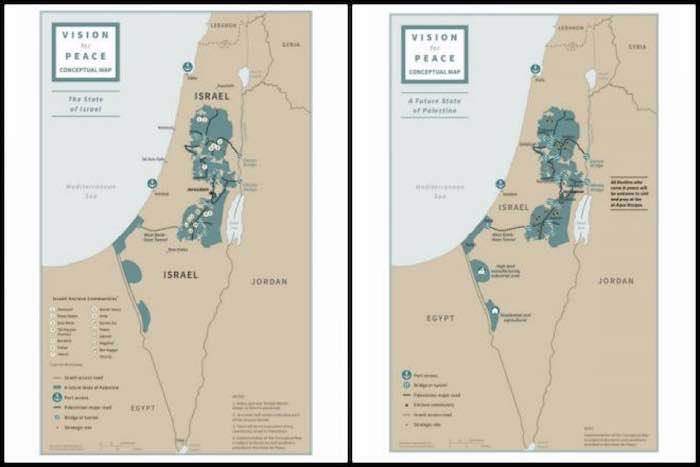
Trump’s Peace Plan — unlike any other Presidential solution previously offered by his predecessors —was accompanied by the following conceptual plans showing his proposed two-state solution.

The final borders were to be determined in direct negotiations between Israel and the PLO.


At a joint press conference with Israeli Prime Minister Netanyahu on January 28, 2020—Trump announced:
“We will form a joint committee with Israel to convert the conceptual map into a more detailed and calibrated rendering so that [Israeli] recognition can be immediately achieved.

We will also work to create a contiguous territory within the future Palestinian State for when the conditions for statehood are met, including the firm rejection of terrorism.”
Trump’s Peace Plan was rejected by PLO Chairman Mahmoud Abbas on February 5, 2020:
“They told me Trump wants to send me the deal of the century to read, I said I would not,” Abbas told the meeting of Arab League foreign ministers.

“Trump asked that I speak to him over the phone, so I said ‘no’, and that he wants to send me a letter, so I refused to receive it.”
On February 9, 2020 - US Ambassador to Israel—David Friedman—affirmed:
“The process [preparing a detailed map—ed] will not last very long, but we want to go through a process… We’re going to go through a mapping process to convert a map which is drawn of more than a million to one into something which really shows on the ground how the territory will be put together.

It’s not unduly difficult, but it’s also not simple, because there are a lot of judgment calls. We don’t want to do this piecemeal …

We want to do it once, holistically, in totality, and get it done right. We just want to get it done right. That’s not too much to ask. And that was the president’s message when he spoke about it the first time.”
On February 15, 2020 - the three US members of a joint US-Israel committee to join Israel’s three nominees in translating Trump’s conceptual plans into two defined territorial entities were announced (Mapping Committee).

Eleven months later the Mapping Committee’s map remains under tight wraps. No reasons have been given for the Committee’s failure to publish.

Failing to release the Committee’s detailed map before January 20 will see Trump’s two-state solution sink into political oblivion — leaving no defined borders for future Israel-PLO negotiations — should they ever be resumed.

President Trump’s opportunity to finally end the 100 years-old unresolved Jewish-Arab conflict will then have become just a footnote in history — joining the failed attempts of his Presidential predecessors.


Author’s note: The cartoon—commissioned exclusively by the author —is by Yaakov Kirschen aka “Dry Bones”- one of Israel’s foremost political and social commentators – whose cartoons have graced the columns of Israeli and international media publications for decades. His cartoons can be viewed at Drybonesblog


Thursday, November 19, 2020

PLO could soon be negotiating with Israel on Trump peace plan

 [Published 20 November 2020]


The Palestine Liberation Organisation (PLO) could soon be negotiating with Israel on President Trump’s peace plan — after suddenly announcing on November 17th that it would resume its relationship with Israel as existed before May 19th.

PLO head—Mahmoud Abbas—had broken off all contacts with Israel since May — when declaring:
“The Palestine Liberation Organization and the State of Palestine are absolved, as of today, of all the agreements and understandings with the American and Israeli governments and of all the obligations based on these understandings and agreements, including the security ones. The Israeli occupation authority, as of today, has to shoulder all responsibilities and obligations in front of the international community as an occupying power over the territory of the occupied state of Palestine.”
Abbas’s decision came after Israeli Prime Minister Benjamin Netanyahu had told the Israeli Knesset just a few days earlier:
“It’s time to apply the Israeli law and write another glorious chapter in the history of Zionism. These territories [Judea and Samaria (West Bank)—ed.] are where the Jewish nation was born and grew”
President Trump’s Middle East plan — released in January — had endorsed Israeli sovereignty on 30 percent of Judea and Samaria in a departure from long-standing U.S. policy.

America’s Ambassador to Israel — David Friedman — had made clear on 6 May that Israel could not act unilaterally without negotiating with the PLO:
“The expectation is that the prime minister will agree to negotiate, and if the Palestinians show up, he will negotiate in good faith based on this plan.”
Friedman however warned:
“If the Palestinians refuse to show up, I’m not sure what else the prime minister can do. But I think there ought to be an unequivocal communication to the Palestinians that they are invited to negotiate in good faith on the president’s vision.”
Netanyahu gave that commitment on June 29:
“I encourage the Palestinians not to lose another opportunity, not to waste another century trying to destroy Israel. They should embrace Trump’s vision. They should sit down and negotiate in good faith. They should be prepared to negotiate a historic compromise that can bring peace to Israelis and Palestinians alike.

Israel is prepared for such negotiations. I am prepared for such a negotiation. And I’m sure that many Arab states in our region are hoping we enter such negotiations with the Palestinians.”
Alternate Israeli Prime Minister Benny Gantz also urged Abbas to reconsider his refusal to negotiate:
“and not miss another opportunity for positive change, for peace and for prosperity.”
Netanyahu added that the Trump Peace Plan:
“is anchored in a foundation of truth” and “makes clear that the Jewish people have a valid, legal, historic and moral claim to Judea and Samaria, and it supports Israel’s sovereignty over the Jewish communities there.”
Abbas has remained unmoved by these urgings — until now.

Instead — Abbas has witnessed the United Arab Emirates, Bahrain and Sudan normalize their relations with Israel — with Israel holding off any action to unilaterally extend Israeli sovereignty in Judea and Samaria.

Abbas has also seen Trump fighting against the odds to become America’s next President.

If Abbas was ever to secure Gaza and 70% of Judea and Samaria offered by Trump for a demilitarized Palestinian Arab State — he had to act now — and he has.

60 days are left for the commencement and finalisation of negotiations between Israel and the PLO.

Should negotiations not occur or fail — an independent Palestinian Arab state — promised between Jordan and Israel for the first time in recorded history — will end up in the graveyard of failed Middle East diplomatic initiatives.


Author’s note: The cartoon—commissioned exclusively for this article—is by Yaakov Kirschen aka “Dry Bones”—one of Israel’s foremost political and social commentators—whose cartoons have graced the columns of Israeli and international media publications for decades. His cartoons can be viewed at Drybonesblog.


Thursday, November 12, 2020

Trump-Netanyahu Mapping Committee needs to deliver the map

 [Published 13 November 2020]


The threatened political demise of President Trump should provide the impetus for the joint Trump-Netanyahu Mapping Committee to publish its map delineating the areas of Judea and Samaria (West Bank) to which Israeli sovereignty can be expanded under Trump’s Peace Plan released last January (Plan).

Trump made this intention clear when releasing his Plan:
“We will form a joint committee with Israel to convert the conceptual map into a more detailed and calibrated rendering so that recognition can be immediately achieved”
US Ambassador to Israel David Friedman went further:
“The president got up and he made a speech. And he said there will be a committee and the committee will go through a process; the process will not last very long, but we want to go through a process.”
The Committee’s first meeting — held on February 24 — comprised:
  • David Friedman, 
  • Friedman's senior adviser Aryeh Lightstone, and 
  • Scott Leith, director of Israeli and Palestinian affairs in the US National Security Council
  • Israeli Tourism Minister Yariv Levin, 
  • acting Prime Minister’s Office chief Ronen Peretz, and 
  • National Security Adviser Meir Ben Shabbat.
Little has been heard of its progress since.

Trump would be following former Presidents who progressed their peace plans as fast and as far as they could before their four year terms of office ended:
  • President Clinton brought together Israeli and Palestinian negotiators at Camp David as late as December 2000 who failed to reach agreement on Clinton’s proposed two-state solution before he stood down as President on January 20, 2001
  • President George Bush — whose 2002 Road Map and 2007 Annapolis process never came to fruition — attempted to solidify gains made under Annapolis with UNSC Resolution 1850 —approved on December 16, 2008 — before he left office on 20 January 2009.
  • President Barack Obama discarded the Annapolis process for his own peace initiatives, which had come to nought in April 2014 when negotiations were broken off. With no hope of reversing this deadlock - Obama regrettably refused to veto UNSC Resolution 2334 on December 23, 2016 as he was preparing to leave the White House on January 20, 2017 — which proposed a two-state resolution based on the pre-1967 armistice lines
Trump still has until January 20, 2021 left in his present term to try and bring his Plan to fruition.

Trump — unlike Clinton, Bush and Obama — has been unable to get the Palestine Liberation Organization (PLO) to negotiate with Israel on his Plan.

However Trump can still materially advance his Plan by:
  • releasing the Mapping Committee’s map showing the areas of Judea and Samaria where Israeli sovereignty can be applied and delineating the boundaries of a demilitarized Palestinian Arab State
  • procuring consent to that map by Egypt, Jordan, United Arab Emirates, Bahrein and Sudan who have all normalized their relationships with Israel
  • getting other Arab states to normalize their relationships with Israel and agree to the Mapping Committee’s proposals
  • attempting to get the PLO to negotiate with Israel and
  • giving Israel the green light to apply sovereignty when it considers appropriate
Trump begun his presidency by visiting Saudi Arabia and pledging to bring peace to the Middle East. 

During his Presidency — Trump took significant steps to recognise Israel’s claim to 30% of Judea and Samaria by determining that:
  • Israeli settlements located there were not inconsistent with international law
  • the US would not distinguish between Israel and Judea and Samaria in its future dealings with Israel
Early release of the Mapping Committee’s map will ensure Trump’s momentum for peace continues full speed ahead until at least January 20, 2021 —  and beyond if re-elected for a second term.


Author’s note: The cartoon—commissioned exclusively for this article—is by Yaakov Kirschen aka “Dry Bones”—one of Israel’s foremost political and social commentators—whose cartoons have graced the columns of Israeli and international media publications for decades. His cartoons can be viewed at Drybonesblog.


Wednesday, November 4, 2020

Trump confirms Israel's permanent presence in Judea and Samaria

 [Published 5 November 2020]


President Trump – fighting for re-election in America - has now lifted restrictions on American federal investment in science, research and agriculture projects undertaken in Israeli settlements in Judea and Samaria (West Bank).

Trump’s peace plan provides for Israel to ultimately extend its sovereignty into about 30% of Judea and Samaria where some 460000 Israelis presently live.

Signing the agreement lifting the investment restrictions on 28 October - U.S. Ambassador to Israel David Friedman – said:

“Just as we have seen tremendous regional progress on the Abraham Accords, we are also seeing the tangible benefits of President Trump’s policies for bilateral cooperation with Israel”

The Abraham Accords - brokered by President Trump - signed on 15 September by Israel, United Arab Emirates and Bahrain and expanded on 23 October to include Sudan after Sudan and Israel agreed to normalize relations – states:  
 
“We support science, art, medicine, and commerce to inspire humankind, maximize human potential and bring nations closer together.”

Trump’s initiative is consistent with this noble principle and has not met with any opposition from its Arab signatories.

However a spokesman for PLO Chairman Mahmoud Abbas said lifting of the funding ban represented:
“American participation in the occupation of Palestinian lands”.
The PLO continues to bury its head in the sand as the Arab world’s burgeoning relations with Israel expand. Abbas also runs the risk of missing out on the creation of a demilitarized Palestinian State in Gaza and 70% of Judea and Samaria - as envisioned in Trump’s plan.

The lifted restrictions apply to three U.S. foundations established in the 1970s for joint research projects with Israel in the fields of science, technology and agriculture - the Binational Industrial Research and Development Foundation (BIRD), the Binational Science Foundation (BSF) and the Binational Agricultural Research and Development Foundation (BARD).

The announcement stated:

“The three Foundations are mechanisms for bilateral science, agriculture, and technology cooperation and have provided over $1.4 billion since their inception to support more than 7,300 joint research and commercial projects that have scientifically and economically benefited both countries. Each dollar invested through the BARD Foundation has returned an estimated $12 in value to the U.S. and Israeli economies. Each dollar invested through the BIRD Foundation produces an estimated $5 in revenue from commercially successful projects and an estimated $6 in follow-on investments in startups. BSF has supported 47 Nobel Laureates and has kept scientists in both countries in the lead in innovation in medicine, cybersecurity, high technology, other critical areas of science with both civilian and military applications.”

BIRD, BSF and BARD represent the last remaining agreements between Israel and the US that included geographic restrictions barring them from working with Israelis in settlements established in Judea and Samaria after the 1967 Six Day War.

The statement affirmed:

“These geographic restrictions are no longer consistent with U.S. policy following (i) the Administration’s opposition to the provisions of United Nations Security Council Resolution 2334, (ii) the Administration’s recognition of Jerusalem as Israel’s capital and moving the U.S. Embassy from Tel Aviv to Jerusalem, (iii) the Administration’s recognition of Israel’s sovereignty over the Golan Heights, and (iv) the Administration’s announcement that the U.S. will no longer consider that the establishment of civilian settlements in the West Bank is per se inconsistent with international law.”

Israel’s Prime Minister Benjamin Netanyahu declared:

“The Trump vision ... opens Judea and Samaria to academic, commercial and scientific engagement with the United States. This is an important victory against all those who seek to delegitimise everything Israeli beyond the 1967 lines.”

Trump has at least another ten weeks in the White House to weave some more magic.


Author’s note: The cartoon — commissioned exclusively for this article — is by Yaakov Kirschen aka “Dry Bones”- one of Israel’s foremost political and social commentators — whose cartoons have graced the columns of Israeli and international media publications for decades. His cartoons can be viewed at Drybonesblog.

Wednesday, August 12, 2020

Trump Mapping Committee needs to break its deafening silence


[Published 12 August 2020]


Peace between Jews and Arabs after 100 years of unresolved conflict - promised with President Trump’s release of his deal of the century on 28 January - has stalled - with the continuing failure to produce a map translating Trump’s conceptual plan into an attainable reality.

Trump’s plan (See map below) proposed:
  • Israeli sovereignty in about 30% of Judea and Samaria (West Bank)
  • The remaining 70% plus Gaza providing “a realistic two-state solution that resolves the risk of Palestinian statehood to Israel’s security”
Incredibly Trump announced:
“My vision presents a “win-win” opportunity for both sides, Today, Israel is taking a giant step toward peace. Yesterday, Prime Minister Netanyahu informed me that he is willing to endorse the vision as the basis for direct negotiations—and, I will say, the General [Gantz] also endorsed, and very strongly—with the Palestinians. A historic breakthrough. 
This is the first time Israel has authorized the release of a conceptual map, illustrating the territorial compromises it’s willing to make for the cause of peace. And they’ve gone a long way. This is an unprecedented and highly significant development.”
Trump continued:
“We will form a joint committee with Israel to convert the conceptual map into a more detailed and calibrated rendering so that recognition can be immediately achieved. We will also work to create a contiguous territory within the future Palestinian State for when the conditions for statehood are met, including the firm rejection of terrorism.” [Bolding by author]
This joint committee began its work just two weeks later in February - but since then little has been heard from the current Committee:
  • Israeli representatives - Knesset Speaker Yariv Levin (Likud), National Security Adviser Meir Ben Shabbat, Prime Minister’s Office director Ronen Peretz, and Ambassador to the US Ron Dermer on the Israeli side; and
  • US representatives - Ambassador to Israel David Friedman, his adviser Aryeh Lightstone, and the US National Security Council’s Israel and Palestinian affairs director Scott Leith.
Leith had been unable to join the Committee in Israel because of Covid 19 until he visited Israel in June with Avi Berkowitz, US Special Representative for International Negotiations.

Complications and differences could be holding up the plan’s finalisation such as those detailed in June by Lior Schillat – the director of the Jerusalem Institute of Policy Research:
“When we say mapping, it isn’t just opening up Google Maps. It means applying complex geographic information system layers that display land ownership and land use. It’s true that there aren’t any new mountains that have suddenly appeared in [the northern West Bank], but there are building plans in progress that need to be accounted for. The territory is extremely complex and dynamic. 
The decisions being made today are very politically charged, and therefore the people involved are from the political echelon. However, this may be why they’re having a hard time completing the task in the amount of time [by July, 1].”
Ambassador Friedman had optimistically predicted in February:
“We’re going to go through a mapping process to convert a map which is drawn of more than a million to one into something which really shows on the ground how the territory will be put together 
It’s not unduly difficult, but it’s also not simple, because there are a lot of judgment calls. We don’t want to do this piecemeal.
We want to do it once, holistically, in totality, and get it done right”
Failure to finalise a “detailed and calibrated map” after six months is disturbing.

The Committee needs to break its deafening silence to confirm that Trump’s vision is geographically achievable - not simply a shimmering mirage.


Tuesday, February 18, 2020

Netanyahu goes into Judea and Samaria where Gantz fears to tread


[Published 19 February 2020]


The formation of a joint America-Israel committee to map out the areas of Judea and Samaria within which Israel’s sovereignty will be recognized by America has presented Israeli voters with a real choice between the policies of Prime Minister Bibi Netanyahu and his rival Benny Gantz at upcoming March 2 elections.

Addressing Likud Party supporters at a campaign launch event in Jerusalem on January 21, Netanyahu promised to “impose Israeli sovereignty on the Jordan Valley and northern Dead Sea” and to all Israeli communities in Judea and Samaria “without exception.” Netanyahu’s proposal to take such unilateral action was tempered with the release of President Trump’s deal of the century on January 28 containing the following conceptual map indicating those areas of Judea and Samaria where America would recognize Israel’s claim to sovereignty:


America’s Ambassador to Israel, David Friedman, warned Netanyahu against precipitately undertaking his own sovereignty plan — explaining there was a waiting period before sovereignty could be extended:
“The waiting period would be the time it takes for them to obtain internal approvals and to obviously create the documentation, the calibration, the mapping, that would enable us to evaluate it, makes sure it’s consistent with the conceptual map. If they wish to apply Israeli law to those areas allocated to Israel, we will recognize it"
Both Israel and America probably would have prepared their own maps already. Jared Kushner - chief architect of the Trump plan — has virtually confirmed this — saying it will take only “a couple of months” for the Committee to complete its work. Marrying the two maps to achieve this truly historic outcome is that close.

Ambassador Friedman heads the three-man American delegation now sitting down with the three-man Israeli delegation on the Mapping Committee.

Gantz has been powerless to stop the formation and work of the Mapping Committee. Indeed Gantz urged Trump to release his peace plan before the elections. Gantz has not even requested that one of his nominees be part of the Israeli delegation on the Mapping Committee.

In ignoring the Mapping Committee, Gantz is signalling the continuation of his policy opposing Israel extending its sovereignty into Judea and Samaria with America’s approval.

Gantz has made his own policy very clear:
“After the elections, we will work to apply [Israeli] sovereignty on the Jordan Valley. We will do this in a nationally agreed process and in coordination with the international community.”
Believing the international community would ever agree to Israel extending its sovereignty into any part of Judea and Samaria — without swaps of existing Israeli sovereign territory — is totally unrealistic. The international community has been fixated for decades on seeing another Arab State created in the entirety of Judea and Samaria — or in an area of the same size including land currently part of Israel.

Gantz — in limiting sovereignty to just the Jordan Valley — is dashing the hopes of an estimated Jewish population of 464,353 in 131 settlements seeking unification with Israel.

Israeli voters now have a clear choice to end the political deadlock that has followed two indecisive elections held in the past twelve months:
1. Is it Netanyahu — promising the restoration of sovereignty in parts of the heartland of the Jewish people’s historic and biblical homeland for the first time in 3000 years?
OR
2. Is it Gantz — promising more of the same in Judea and Samaria that has been going on for the last 53 years?
A third deadlocked election result now seems increasingly unlikely.

The choice is stark and the direction Israel will take for generations to come is at stake.

Author’s note: The cartoon – commissioned exclusively for this article — is by Yaakov Kirschen aka “Dry Bones” - one of Israel’s foremost political and social commentators – whose cartoons have graced the columns of Israeli and international media publications for decades. His cartoons can be viewed at Drybonesblog.

Tuesday, February 11, 2020

Trump moves to end 3000 years wait by the Jewish People


[Published 11 February 2020]


President Trump’s deal of the century (Deal) to end the 100 years old conflict between Arabs and Jews in former Palestine has seemingly hit a brick wall — following a meeting of Foreign Ministers of the 22 member countries of the Arab League on 1 February.

Their communique declared:
“The Arab League rejects the deal as it does not satisfy the minimum rights and ambitions of the Palestinians and violates international law and United Nations resolutions,”
Those minimum rights and ambitions have been spelled out for the last 46 years by their sole recognized spokesman — the Palestine Liberation Organization (PLO): the creation of an independent Arab State for the first time in recorded history on all the land lost by Jordan and Egypt to Israel in the 1967 Six Day War and having its capital in East Jerusalem.

Trump apparently thought he had broken through the Arab League’s long-standing support for these non-negotiable demands as three Arab ambassadors from Oman, Bahrain and the United Arab Emirates stood beside him with Israeli Prime Minister Benjamin Netanyahu when releasing his Deal on January 28.

The optics were good — but that vision was lost just four days later.

Trump appeared to have miscalculated the strength of Arab League opposition to his Deal. However that rejection has given Trump the opportunity to immediately proceed to complete that part of the Deal promised to Israel — the extension of Israeli sovereignty in parts of Judea and Samaria (West Bank).

That possibility had first been raised by US Ambassador to Israel David Friedman — on June 8, 2019 when he indicated Israel had a right to annex at least some, but “unlikely all” of the West Bank.

Friedman then added:
“We really don’t have a view until we understand how much, on what terms, why does it make sense, why is it good for Israel, why is it good for the region, why does it not create more problems than it solves. These are all things that we’d want to understand, and I don’t want to prejudge.”
Secretary of State Mike Pompeo cleared the way for Friedman’s scenario to happen on November 18, 2019:
“The establishment of Israeli civilian settlements in the West Bank is not per se inconsistent with international law”
Pompeo stressed that this decision was:
“based on the unique facts, history, and circumstances presented by the establishment of civilian settlements in the West Bank.”
Pompeo however added a warning caveat:
”…we are not addressing or prejudging the ultimate status of the West Bank.This is for the Israelis and the Palestinians to negotiate.”
Outright rejection by the PLO and the Arab League of Trump’s Deal has removed Pompeo’s caveat

Friedman — not unsurprisingly tweeted on February 9:
”.. the application of Israeli law to the territory which the Plan provides to be part of Israel is subject to the completion of a mapping process by a joint Israeli-American committee.”
The PLO and the Arab League had committed political suicide in rebuffing Trump – ensuring that part of Judea and Samaria (West Bank) will soon come under Israeli sovereignty whilst the Arabs correspondingly miss out. Another golden opportunity to end the Jewish-Arab conflict has been lost by continuing Arab intransigency.

Trump’s strategy will see new boundaries being determined for Israel incorporating part of the Jewish People’s biblical, historic and ancestral heartland in Judea and Samaria.

The area will be small in size but massively significant for the psyche of the Jewish People — who have been waiting for this day to arrive for 3,000 years.

President Trump is bringing that very long wait to an end.

Author’s note: The cartoon — commissioned exclusively for this article — is by Yaakov Kirschen aka “Dry Bones” - one of Israel’s foremost political and social commentators — whose cartoons have graced the columns of Israeli and international media publications for decades. His cartoons can be viewed at Drybonesblog

Monday, December 9, 2019

Trump, Netanyahu and Gantz can end in 2020 what began in 1920


[Published 9 December 2019]


Designating the territory for reconstitution of the Jewish National Home in Palestine – begun with the San Remo Convention and Treaty of Sevres in April and August 1920 respectively – could finally be completed 100 years later in 2020.

Achieving this long-overdue outcome will require Israel to form a Government of National Unity by 11 December 2019 - headed initially by Benjamin Netanyahu as Prime Minister for a minimum term of six months - enabling the new Parliament to ratify those areas of Judea and Samaria to which Israeli sovereignty will be extended as delineated by the Government.

This Unity Government should ideally hold at least 80 of the 120 seats in the Knesset so that there is an overwhelming majority of Israel’s elected politicians supporting any determinative decisions made by the Knesset in relation to Judea and Samaria.

Israel has been presented with this amazing opportunity following President Trump’s Secretary for State - Mike Pompeo - issuing this declaration on 19 November 2019:
“After carefully studying all sides of the legal debate, this administration agrees with President Reagan. The establishment of Israeli civilian settlements in the West Bank is not per se inconsistent with international law.”
Pompeo’s statement followed US Ambassador to Israel – David Friedman – stating on 8 June 2019:
“Under certain circumstances I think Israel has the right to retain some, but unlikely all, of the West Bank.”
Friedman had then cautioned:
“We really don’t have a view until we understand how much, on what terms, why does it make sense, why is it good for Israel, why is it good for the region, why does it not create more problems than it solves. These are all things that we’d want to understand, and I don’t want to prejudge.”
Friedman will get the answers with the formation of Israel’s Government of National Unity – which hangs delicately by a thread and can vanish into thin air if it does not gain some oxygen by midnight on 11 December. Fresh elections on 3 March 2020 - for the third time in a year - will then become mandatory and this wonderful opportunity will have flown out the window.

It would be a national disgrace and betrayal of Israelis and Jews worldwide if Israel’s political parties allowed their political differences and personal rivalries to stymie the opportunity to determine the area within which the reconstitution of the Jewish National Home will be mandated after 100 years of fighting many wars and diplomatic battles.

Israel’s extended boundaries would be determined in coordination with President Trump and ratified over the next 6 months.

The fact that no Arab interlocutors will participate in any such decision-making process is regrettable. However continuing Arab intransigence in refusing to commit to negotiate with Israel on Trump’s still unreleased deal of the century - despite Trump’s best efforts to involve their participation in such decision-making with Israel – leaves Trump with no other option.

A Unity Government could be reasonably expected to agree to extend Israel’s sovereignty to about 75% of Area C – about 45% of Judea and Samaria.

Gantz reportedly told close associates he is:
“ready to make tough decisions in the coming days”
Hopefully Gantz as Deputy Prime Minister can rise to the occasion and allow Netanyahu – enjoying a unique relationship with Trump - to head a Government of National Unity to grab this once in a hundred years opportunity.

An unprecedented – almost miraculous - confluence of events has emerged since Israel’s second-deadlocked September elections - that cries out for a national consensus and historic response by Trump, Netanyahu and Gantz.

Seize the moment – seize the day….

Author’s note: The cartoon – commissioned exclusively for this article — is by Yaakov Kirschen aka “Dry Bones”- one of Israel’s foremost political and social commentators – whose cartoons have graced the columns of Israeli and international media publications for decades. His cartoons can be viewed at Drybonesblog.

Saturday, November 9, 2019

Netanyahu and Trump hatch plan for a Jordan exclave in West Bank


[Published 17 September 2019]


Israeli Prime Minister Benjamin Netanyahu’s last minute election pledge to apply Israeli sovereignty in parts of the West Bank could possibly see a large part of the remainder of the West Bank being offered to Jordan as an exclave in direct negotiations between Jordan and Israel.

An exclave is a piece of land that is politically attached to a larger piece but not physically conterminous (having the same borders) with it because of surrounding foreign territory.

Netanyahu’s pledge was clear:
“We will apply sovereignty in the Jordan Valley and the Northern Dead Sea as soon as the next government is established in the next Knesset. Today I have appointed a working team led by the director-general of my ministry, Ronen Peretz, to formulate an outline for applying sovereignty to the Jordan Valley and the northern Dead Sea”
Netanyahu has now gone even further reportedly saying that if re-elected, he plans to annex additional “vital” parts of the West Bank in coordination with the United States.

Trump’s Ambassador in Israel David Friedman has already indicated that Trump’s plan will not call for the creation of an additional Arab state between Israel and Jordan based on the 1949 ceasefire lines agreed between those two former enemies.

Friedman declared:
“Under certain circumstances, I think Israel has the right to retain some, but unlikely all, of the West Bank.”
Friedman then declined to say how the United States would respond if Netanyahu moved to annex West Bank land unilaterally — stating:
“We really don’t have a view until we understand how much, on what terms, why does it make sense, why is it good for Israel, why is it good for the region, why does it not create more problems than it solves. These are all things that we’d want to understand, and I don’t want to prejudge.”
Trump seemingly has not yet secured an ironclad guarantee from Jordan or any other Arab interlocutor that they stand ready to negotiate with Israel on Trump’s plan. Releasing it without such a guarantee would constitute political suicide for Trump.

Netanyahu’s pledges provide sufficient justification for Trump to further postpone his deal’s release.

One can visualise Trump’s advisors carefully scrutinising Netanyahu’s final map — or any map drawn up by a non-Netanyahu led Government — prior to Trump releasing his deal — to see if common agreement can first be reached on Israel’s demands, and then advancing to the next stage to see if agreement between Trump and Netanyahu — or Israel’s new Prime Minister — can be reached on what should happen in the remainder of the West Bank.

It would then make sense for Trump’s plan to be released only after concluding these discussions.

Trump will not be proposing the creation of any new Jew-free State in all of the West Bank for the first time in recorded history, whilst the PLO has rejected negotiating on Trump’s deal if it does not meet these core demands articulated by Abbas and the PLO.

Two solutions therefore emerge for resolving sovereignty in the remainder of the West Bank territory that will not come under Israeli sovereignty:

1. Israel unilaterally annexes that territory including its existing Arab population

2. Israel and Jordan create a Jordan exclave within that territory as may be agreed in direct negotiations.
A Jordan exclave would materially help end the 100 years old Arab-Jewish conflict.

Details such as the demilitarization of the exclave and who controls access into and egress from the exclave would be negotiated.

Trump is the driving force to bring Israel and Jordan together to enable these negotiations to be successfully concluded.

Author’s note: The cartoon — commissioned exclusively for this article — is by Yaakov Kirschen aka “Dry Bones”- one of Israel’s foremost political and social commentators — whose cartoons have graced the columns of Israeli and international media publications for decades. His cartoons can be viewed at Drybonesblog

Trump seems set to see Netanyahu as Israel’s next Prime Minister


[Published 11 September 2019]


President Trump seems set to see Bibi Netanyahu re-elected as Israel’s next Prime Minister in the upcoming elections to be held on 17 September — the second this year following an indecisive vote in April that left no-one able to form Government.

Early voting by eligible Israeli diplomats and emissaries around the world has seen a drop in their turnout from 76% in April to 69% in September.

If general voters follow the diplomats’ lead next week:
1. The voter turnout of 67.97% in April 2019 will be further reduced.

2. Netanyahu’s Likud party will increase its proportion of the vote — 26.46% in April 2019 — up from 23.4% in 2015 — to an even higher figure.
Likud increased its numbers from 985408 in 2015 to 1140370 in April 2019 — whilst Yisrael Beiteinu’s numbers decreased from 214906 in 2015 to 173004 in April 2019. Blue and White contested the April elections for the first time.

Likud voters, buoyed by the post-April statements detailed in 1, 2 and 3 below, will most likely vote again, whilst Blue and White and Yisrael Beiteinu voters, unhappy with their leaders’ post-April statements detailed in 4 and 5 below, are more likely to stay home.

Any increase in general voter turnout this time beyond 67.97% would defy the diplomatic downturn, but should still see parties on the Right securing more of those new votes than parties on the Left.

Statements made since April by Trump’s Ambassador to Israel David Friedman, President Trump himself, Likud’s Netanyahu, Yisrael Beiteinu’s Lieberman and Blue and White’s Gantz support this conclusion.

1. Ambassador Friedman indicated that some degree of annexation of the West Bank would be legitimate.
“Under certain circumstances, I think Israel has the right to retain some, but unlikely all, of the West Bank,”

2. More new voters — conscious of their own families’ personal safety — would vote Right — than those opposing any annexation — who would vote Left.

3. Trump endorsed Netanyahu as a ”a great guy”

4. Netanyahu, speaking in Elkana, located in Samaria, pledged:
“With God’s help we will extend Jewish sovereignty to all the settlements as part of the (biblical) Land of Israel, as part of the State of Israel. “This is our land…“We will build another Elkana and another Elkana and another Elkana. We will not uproot anyone here,”
In a first-ever public address from Hebron by a sitting Israeli prime minister - Netanyahu vowed:
”To cite the late Menachem Begin and the late Yigal Allon: ‘Hebron will not be devoid of Jews.’ It will not be Judenrein [ed: Jew free]. And I say on the 90th anniversary of the disturbances [ed: when 67 Jews were murdered] — we are not foreigners in Hebron, we will stay here forever.”
These patriotic declarations should attract more Right-supportive than Left-opposing new voters.

5. Lieberman promised to amend the law to make ultra-orthodox youths do compulsory military training.

United Torah Judaism MK Yakov Asher has declared this the best possible get-out-the-vote campaign the ultra-Orthodox parties could wish for.

New ultra-orthodox voters turning out to spare children in their ultra-orthodox community undertaking this military obligation would likely exceed new secular voters who think this is a reform long overdue.

6. Trump’s judgment has been challenged by Gantz stating he would have admitted US Congresswomen Omar and Tlaib into Israel.

Gantz’s decision would not resonate with a majority of new voters — who would consider any disagreement with Trump could jeopardize Trump’s amazing support of Israel during his Presidency.

Trump and Netanyahu appear destined to continue their very special relationship after the votes have been counted.

Author’s note: The cartoon — commissioned exclusively for this article — is by Yaakov Kirschen aka “Dry Bones” - one of Israel’s foremost political and social commentators — whose cartoons have graced the columns of Israeli and international media publications for decades. His cartoons can be viewed at Drybonesblog

Thursday, September 19, 2019

Trump reaffirms Bush’s recognition of Jewish claims in West Bank


[Published 13 August 2019]


The Palestine Liberation Organisation (PLO) is frothing at the mouth at media reports indicating that Israeli Prime Minister Benjamin Netanyahu is seeking a public declaration from US President Donald Trump recognizing Israeli sovereignty over parts of the occupied West Bank prior to the Israeli elections on 17 September.

PLO spokesman Nabil Abu Rudeineh stressed that any procedure or decision affecting Palestinian national rights and the resolutions of international legitimacy shall be considered illegitimate. Abu Rudeineh warned such a move would have “serious implications.”

Abu Rudineh continued:
“This step, if taken, would constitute ongoing playing with fire,” he added, and stressed that stability and security are indivisible and that “peace would not be made at any price”.

“Neither this step would establish any right ]to Israel], nor it will create a viable false reality,” he added.”
Such a Trump declaration would undoubtedly help Netanyahu’s re-election chance — as have Trump’s declarations on Jerusalem being Israel’s capital, moving the US Embassy to Jerusalem from Tel Aviv and recognising Jewish claims in the Golan Heights.

However Trump’s US Ambassador to Israel — David Friedman — has already made such a declaration, telling the New York Times on 8 June 2019:
“Under certain circumstances I think Israel has the right to retain some, but unlikely all, of the West Bank.”
Friedman diplomatically continued:
“We really don’t have a view until we understand how much, on what terms, why does it make sense, why is it good for Israel, why is it good for the region, why does it not create more problems than it solves. These are all things that we’d want to understand, and I don’t want to prejudge. Certainly Israel’s entitled to retain some portion of it.”
Friedman confirmed what has been declared American policy since 2004 — when President Bush made the following written commitment in his letter to Israel’s then Prime Minister - the late Ariel Sharon - on 14 April 2004:
“As part of a final peace settlement, Israel must have secure and recognized borders, which should emerge from negotiations between the parties in accordance with UNSC Resolutions 242 and 338. In light of new realities on the ground, including already existing major Israeli populations centers, it is unrealistic to expect that the outcome of final status negotiations will be a full and complete return to the armistice lines of 1949, and all previous efforts to negotiate a two-state solution have reached the same conclusion. It is realistic to expect that any final status agreement will only be achieved on the basis of mutually agreed changes that reflect these realities.”
This commitment was overwhelmingly endorsed by the House of Representatives 407-9 on 23 June 2004 and the Senate 95-3 the next day.

Bush’s letter welcomed the disengagement plan Sharon had prepared:
“under which Israel would withdraw certain military installations and all settlements from Gaza, and withdraw certain military installations and settlements in the West Bank. These steps described in the plan will mark real progress toward realizing my June 24, 2002 vision, and make a real contribution towards peace”

Israel honoured its commitment — at great personal loss of life, injury and property damage to both its civilian population and military forces. Israel continues to pay a heavy price for that disengagement as Hamas remains in control of Gaza with the avowed aim of wiping Israel off the face of the map.

Trump has already recognized — and will continue to recognize — Jewish rights in the West Bank as sacrosanct.

The PLO is shouting loads of codswallop from its Ramallah-Headquarters rooftop — as the ceiling slowly collapses under its feet.

Author’s note:The cartoon — commissioned exclusively for this article — is by Yaakov Kirschen aka “Dry Bones”- one of Israel’s foremost political and social commentators— whose cartoons have graced the columns of Israeli and international media publications for decades. His cartoons can be viewed at Drybonesblog

Sunday, July 14, 2019

Trump takes high road as Abbas, PLO and Hamas implode


[Published 22 March 2018]


President Trump’s soon-to-be released “ultimate deal” – aimed at resolving the 100 years old Arab-Jewish conflict – seems set to see Trump not offering the PLO a seat at the negotiating table with Israel.

This possibility follows two extraordinary outbursts by PLO Chairman Mahmoud Abbas:
1. attacking Hamas – ending any prospects of reconciliation between the PLO and Hamas and

2. publicly disparaging US Ambassador to Israel David Friedman – whom Abbas called “son of a dog”
The wheels fell off the much-publicised Hamas-PLO reconciliation at a PLO leadership meeting in Ramallah on 19 March when Abbas accused Hamas of being responsible for the assassination attempt against Prime Minister Rami Hamdallah and chief of intelligence Majid Faraj in Gaza the previous week.

Abbas threatened retaliatory action against Hamas which was undisguised and unequivocal:
“I have decided to take national, legal and financial measures to protect our national project. We never thought of punishing any Palestinian citizen, not in the West Bank or Gaza. But we have to say where the wrong is and where the crime is. This situation is not acceptable.”

Abbas accused Hamas of sabotaging all efforts for reconciliation – saying that either the Palestinian government takes full charge of everything in Gaza or the de facto authority (Hamas) remains fully responsible for it:
“We did all we can to make the reconciliation a success, but, unfortunately, the result for empowering the government was zero. We have been working hard for six months and got nothing, not the government, not the crossings, not security, nothing. It’s all hypocrisy. They don’t want reconciliation … There aren’t two sides to the division, rather only one side that is consolidating it and enforces an illegal de facto situation”

Abbas said he would not wait for Hamas’investigation into the assassination attempt “because we know that they, Hamas, are behind it” – adding that assassinations are not new to Hamas whose history is full of similar acts – warning that the attempt will not go without reaction.

This latest bout of in-fighting between the PLO and Hamas highlights the bitter internecine conflict they have engaged in since 2007 for control of the hearts and minds of the Gazan and West Bank Arab populations. It underscores the continuing refusal of Hamas and the PLO to give these long-suffering populations any say in their own future for the last 11 years. It haunts the utter inability of the PLO to conclude a peace agreement with Israel after negotiations spanning the last 25 years.

Free and fair elections in Gaza and the West Bank are long overdue. Yet not a word is heard from the United Nations or the European Union calling on both Hamas and the PLO to replace bullets with ballots.

America designated Hamas as a terrorist organisation in 1987 – so believing that the PLO can play any constructive role in resolving Gaza’s future without succeeding in violently overthrowing Hamas is illusory.

Trump’s recently assembled coalition comprising Israel, Jordan, Egypt, Saudi Arabia, Qatar, Bahrain, UAE, and Oman offers far better hope that Trump’s proposals might be ultimately translated into a binding Arab-Jewish peace treaty – with Arab recognition finally of the Jewish State 70 years after its establishment.

Trump will not take kindly to Abbas’s personal denigration of Ambassador Friedman. Trump should not be surprised if he, UN Ambassador Haley and Trump’s Middle East envoys Kushner and Greenblatt are soon on the receiving end of similar epithets.

Trump is taking the high road to possible peace – leaving Abbas, the PLO and Hamas wallowing on the murky low road engaging in further conflict and becoming politically irrelevant.

[Author’s note: The cartoon appearing with this article is the work of Yaakov Kirschen aka “Dry Bones”- one of Israel’s foremost political and social commentators – whose cartoons have graced the columns of Israeli and international media publications for decades]

Saturday, July 6, 2019

Trump recognizes Israel claims in West Bank and East Jerusalem


[Published 12 June 2019]


US Ambassador to Israel — David Friedman — has set a cat among the pigeons with his claim that:
“Under certain circumstances I think Israel has the right to retain some, but unlikely all, of the West Bank.”
Friedman clearly was speaking for the Trump administration — not just himself personally — when he continued:
“We really don’t have a view until we understand how much, on what terms, why does it make sense, why is it good for Israel, why is it good for the region, why does it not create more problems than it solves. These are all things that we’d want to understand, and I don’t want to prejudge.”
Friedman accused the Obama administration — which in the last month of Obama’s Presidency - allowed passage of a United Nations resolution in December 2016 condemning Israeli settlements as a “flagrant violation” of international law, of giving credence to Palestinian Arab arguments “that the entire West Bank and East Jerusalem belong to them.”

Friedman asserted:
“Certainly Israel’s entitled to retain some portion of it”
Friedman was spot on.

The right of the Jewish people to reconstitute the Jewish National Home in at least some parts of the West Bank and East Jerusalem was recognised by:
1. the 1920 San Remo Conference

2. the 1920 Treaty of Sevres,

3. articles 6 and 25 of the 1922 League of Nations Mandate for Palestine (Mandate) and

4. article 80 of the 1945 United Nations Charter
Friedman’s criticism of the United Nations attempt to subvert the Jewish peoples’ legal rights created under the Mandate and preserved under the United Nations own Charter to “close settlement by Jews on the land including State lands and waste land not required for public purposes” located in the West Bank and East Jerusalem — was justified and long overdue.

Friedman postulated:
“The absolute last thing the world needs is a failed Palestinian state between Israel and Jordan.”
He could have also added that:
1. Jordan is a Palestinian Arab state that has occupied 78% of the land comprised in the Mandate for Palestine since 1922

2. Redrawing the international boundary between Jordan and Israel in direct negotiations between those two states as successor States to the Mandate could see parts of the West Bank and East Jerusalem incorporated within each of these two existing states thereby eliminating any danger a failed third state would pose to their security and existence.
Interestingly — Friedman indicated that Trump’s long awaited “deal of the century” might not even be released if Trump believed it would do more harm than good.

Friedman reportedly said the United States would coordinate closely with Jordan — which could face unrest among its large Palestinian population over a plan perceived as overly favourable to Israel.
“We don’t want to make things worse. Our goal is not to show how smart we are at the expense of people’s safety.”
Trump has seemingly anointed Jordan to replace the rejectionist Palestine Liberation Organization as Israel’s negotiating partner on the future of the West Bank and East Jerusalem.

It now appears that Trump’s proposals will not see the light of day unless Trump receives an unqualified assurance from Jordan that it is willing to negotiate with Israel before the plan’s details are released.

Recognising Israel has claims in the West Bank and East Jerusalem sends a clear signal to Jordan and the rest of the Arab World that time is not on their side. The opportunity to yet again miss another opportunity to make peace looms large.

Trump has targeted the West Bank and East Jerusalem — as he already has in West Jerusalem and the Golan Heights — with amazing prescience.

Author’s note:The cartoon — commissioned exclusively for this article — is by Yaakov Kirschen aka “Dry Bones” - one of Israel’s foremost political and social commentators — whose cartoons have graced the columns of Israeli and international media publications for decades. His cartoons can be viewed atDrybonesblog

Monday, February 4, 2019

Trump plan for Israel-Jordan-Egypt negotiations hits brick wall


[Published 16 January 2019]


President Trump’s self-styled deal of the century aimed at resolving the 100 years-old Arab-Jewish conflict has now been postponed beyond February for a further unspecified period of months - signalling Jordan and Egypt are still refusing to step up and negotiate with Israel on Trump’s plan.

Jordan and Egypt — having respectively signed peace agreements with Israel in 1994 and 1979 - were the last two Arab states to occupy Judea and Samaria (West Bank), East Jerusalem and Gaza (“the disputed territories”) between 1948 and 1967. Both are eminently qualified to replace the Palestine Liberation Organisation which has flatly refused —sight unseen — to negotiate with Israel on Trump’s proposals to resolve the allocation of sovereignty in the disputed territories.

Trump’s plan will be stillborn unless Arab interlocutors indicate in advance that they stand ready to take up the challenge presented by Trump’s ideas and agree to meet with Israel to try and reach a deal acceptable to both Arabs and Jews.

America’s ambassador to Israel — David Friedman — revealed that the upcoming Israeli elections in April were a factor - but not the only factor — that led to the latest postponement of Trump’s long-awaited peace plan.

Friedman said the White House wanted to release the plan in a way that gave it the best chance of getting a good reception. Friedman noted additional “wordsmithing and smoothing” was still required before it was publicized.

Friedman added:
“The challenge to a peace plan is making the case for a much more sober assessment of the realities in this region. The last time there was a meaningful agreement between the Israelis and the Palestinians was 1993 [Ed—The Oslo Accords]. A lot has happened since 1993”

Friedman’s comments came during a joint media conference held in Jerusalem alongside US National Security Adviser John Bolton.

Bolton had seen General Jim Mattis resign as Secretary of Defence in December. Since 2013 Mattis had strongly supported the two-state solution — the creation of an additional Arab state between Israel and Jordan — contemplated by both the Oslo Accords and President Bush’s 2003 Roadmap, and unsuccessfully pushed for eight years by President Obama and his Secretaries for State — Hilary Clinton and John Kerry.

Bolton’s opposing opinion held since 2009 was reconfirmed to Eric Shawn on 21 January 2018:
“I hope at some point the Administration recognizes and perhaps it is already quietly — that the two-state solution isn’t going anywhere. If anything I would say to King Abdullah of Jordan — “Be prepared to reassert Jordanian sovereignty over part of the West Bank—negotiate with Israel”. I think that’s a far better outcome than the continued pursuit of a mythical — I believe — unattainable viable Palestinian state”

Twelve months down the track Bolton’s Jordan approach has seemingly prevailed - especially after Friedman’s assertion last September:
“Since 1994, the United States has thrown more than $10 billion in humanitarian aid to the Palestinians. Without minimizing the importance of medical treatment and quality education for children — and we don’t minimize that, not even for a minute — we found that these expenditures were bringing the region no closer to peace or stability, not even by a millimetre. To spend hard-earned taxpayer dollars to fund stipends to terrorists and their families, to expend funds to perpetuate rather than to mitigate refugee status, and to finance hate-filled textbooks — I ask you, how does that provide value to the United States or the region?"

Friedman’s “wordsmithing and smoothing” comment indicates that Jordan and Egypt could be holding out for further American financial and security guarantees before agreeing to negotiate with Israel.

Trump’s legendary negotiating skills — and patience - are being seriously tested.

Author’s note: The cartoon—commissioned exclusively for this article—is by Yaakov Kirschen aka “Dry Bones”- one of Israel’s foremost political and social commentators—whose cartoons have graced the columns of Israeli and international media publications for decades. His cartoons can be viewed at Drybonesblog

Thursday, September 13, 2018

Trump and Israel dabble in Hamas and PLO quicksand


[Published 8 August 2018]


President Trump’s attempt to see a five-year Gaza ceasefire negotiated between Hamas and Israel seems to be an exercise in futility destined to failure.

America’s involvement first surfaced on 7 July when “an unnamed senior Trump administration official” stated:
“We definitely have a Gaza focus right now because the situation is the way it is, and we want to try to help. But it’s not as though we think we need to fix Gaza first before we would air the peace plan.”

If it sounds like a cop-out and looks like a cop-out — it is a cop-out.

The Palestine Liberation Organisation (PLO) had made it very clear months ago it would have nothing to do with Trump’s yet to-be-released peace plan — no matter when it is aired.

Arab States supportive of Trump’s plan were wavering.

Leaving those small technicalities aside - any negotiations between Israel and Hamas over Gaza would be anathema to the PLO - which has been engaged in an internecine struggle with Hamas to govern Gaza since 2007.

Indeed Fatah spokesman Osama Qawasmeh has already reportedly said the number one priority should be achieving Palestinian unity on the basis of previous agreements signed between Hamas and Fatah - and not a truce with Israel in return for humanitarian aid.

Trump’s “ultimate deal” was initially foreshadowed back in 2016 — before Trump was even sworn in as President:
“I believe that my administration can play a significant role in helping the parties to achieve a just, lasting peace — which must be negotiated between the parties themselves, and not imposed on them by others. Israel and the Jewish people deserve no less”

Trump did not then define who he meant by “the parties”.

Given the developments in the Middle East generally since 2016 - and in Gaza and the West Bank specifically - both Hamas and the PLO seem to have disqualified themselves from possibly participating in negotiating Trump’s peace plan. This leaves the way open for Jordan and Egypt — the last two Arab States to occupy the West Bank and Gaza respectively between 1948 and 1967 — to fill the empty Hamas and PLO chairs at the negotiating table with Israel.

Trump’s new Gaza approach is conditioned upon the following observation made by his three negotiating emissaries — Jared Kushner, Jason Greenblatt and David Friedman — in their op-ed article in the Washington Post on 20 July:
“For far too long, Gaza has lurched from crisis to crisis, sustained by emergency appeals and one-time caravans of aid, without dealing with the root cause: Hamas leadership is holding the Palestinians of Gaza captive. This problem must be recognized and resolved or we will witness yet another disastrous cycle.”

Hamas is not going to suddenly disappear or allow free and fair elections in Gaza to determine who shall govern Gaza’s population. Any reconciliation by Hamas with the PLO seems most unlikely to occur.

Israel appears to be going along with this Gaza trial balloon being floated by Trump.

Realistically however — ceasefire negotiations between Israel and Hamas will be fatuous unless the following provision in the 1988 Hamas Covenant is shredded:
“The Islamic Resistance Movement believes that the land of Palestine is an Islamic Waqf consecrated for future Moslem generations until Judgement Day. It, or any part of it, should not be squandered: it, or any part of it, should not be given up. ...

Trump needs to persuade previously-supportive but now-wavering Arab States to back his peace plan being released without delay.

For Trump to contemplate being dragged into the Hamas and PLO quicksand that has claimed so many sincerely-intentioned do-gooders preceding him is incomprehensible.